- Offers a comprehensive, transnational and regional account of Nordic cinema from its origins to the present day
- Features original contributions from more than two dozen international film scholars based in the Nordic countries, the United States, Canada, Scotland, and Hong Kong
- Covers a wide range of topics on the distinctive evolution of Nordic cinema including the silent Golden Age, Nordic film policy models and their influence, audiences and cinephilia, Nordic film training, and indigenous Sámi cinema.
- Considers Nordic cinema's engagement with global audiences through coverage of such topics as Dogme 95, the avant-garde filmmaking movement begun by Danish directors Lars von Trier and Thomas Vinterberg, and the global marketing and distribution of Nordic horror and Nordic noir
- Offers fresh investigations of the work of global auteurs such as Carl Th. Dreyer, Ingmar Bergman, Lars von Trier, Aki Kaurismäki, and Roy Andersson.
- Includes essays on Danish and Swedish television dramas, Finland's eco-documentary film production, the emerging tradition of Icelandic cinema, the changing dynamics of Scandinavian porn, and many more
- English
- ePUB (mobile friendly)
- Available on iOS & Android
eBook - ePub
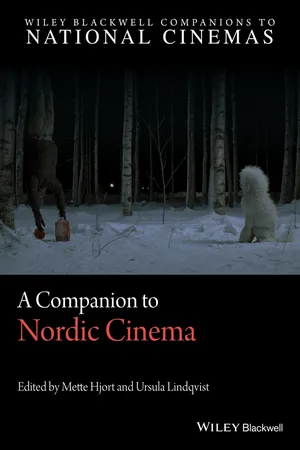
A Companion to Nordic Cinema
About this book
A Companion to Nordic Cinema presents a collection of original essays that explore one of the world's oldest regional cinemas from its origins to the present day.
Information
Part I
States of Cinema
Nordic Film Policy
Introduction
Mette Hjort and Ursula Lindqvist
In the Nordic region, film is, and has long been, a matter of keen interest to the state. How exactly this interest finds expression varies across national contexts, just as important differences emerge when we opt for a broader view, spanning many decades, with regard to regulatory decisions, policy work, and institution building in the area of Nordic film. Beneath the differences, however, and fueling, among other things, the articulation of film acts and creation of state-funded bodies devoted to film are a number of convictions that are deeply and widely held. These convictions are intimately related to the status of the countries in question as small nation-states, each with a national tongue without much reach or resonance beyond national borders, and with a population size limited enough to render the sustainability of a film industry on a purely commercial basis difficult if not impossible from the second half of the last century onwards.
Of these convictions, two are especially important, and this because they are persistently present in the region and capture some of the specificity of the Nordic region’s engagement with film. One pervasively held belief is that it is crucial to ensure that filmmaking is a locally embedded activity with sufficient density and scope to allow for authentic cultural expression, for what Rod Stoneman, referring to his work commissioning films by African filmmakers for Channel 4, calls “direct speech” (2013, 69). The implicit contrast with indirect speech points to the difference between an authentic voice, expressed in idioms—natural languages or aesthetic styles—that are recognized as having a degree of local provenance and thus cultural specificity, as compared with modes of expression that are somehow mostly on loan from an external source. At stake here is not the possibility of an isolated filmmaker making a highly personal film from time to time, but the much bigger idea that film can and should be part of the public conversation through which a community defines and understands itself. The commitment is, in large measure, to film as authentic cultural expression that can serve as a vehicle for the manifestation, shaping, and sustaining of collective identities.
A second belief driving trans-generational thinking about film in the Nordic region is that film spectators are also citizens and that film is a means of engaging citizens with norms and values that are integral to the project of building what, at a given moment in time, counts as a good society. In this case the commitment is to film as politically and socially efficacious, as profoundly “useful,” to use the term proposed by Haidee Wasson and Charles Acland (2011). Thus, for example, a thread running through the policy histories of Nordic cinemas is various versions of the idea that film has a role to play in supporting the emerging conditions for, or actual pillars of, what we now know as the welfare state, a phenomenon that has long been constitutive of collective identities in the Nordic region. As the region embraces the inevitabilities of various kinds of globalization, and with neo-liberal models, an ageing population, and other factors exerting pressure on the welfare state model, policy-style discussions regarding the “usefulness” of film have less to do with the sorts of issues that Claire Thomson (this section) brings into focus through her account of Dansk Kulturfilm—film’s contribution, for example, to educating citizens about their rights and obligations or to the mediation of normative understandings of how best to live—and a lot more to do with the gains that are to be had from successful branding. With globalization an acknowledged and inevitable reality, what is sought, through policy provisions, is a virtuous circle whereby film and television productions with global appeal contribute to the branding of entire nations, regions, and cities. The branding of these entities as “creative” is seen as a policy goal that is well worth pursuing inasmuch as success in this regard helps to foster the conditions under which the creative industries—and a host of related phenomena, ranging from film festivals to tourism—can thrive (Bondebjerg, this section).
During the earliest decades of Nordic film history, filmmaking was, it is true, largely a commercial undertaking, unfolding under economic conditions that involved little of the public/private hybridity that characterizes what Olof Hedling (this section) calls the “mixed economy” of later decades. If we look to figures such as the Dane Ole Olsen, who founded Nordisk Film in 1906, or to production companies such as AB Svensk Filmindustri, which emerged from the fusion of Svenska Biografteatern and Filmindustribolaget in 1919, we find ourselves focusing on a private sector where film was a commercial product and filmmaking a matter of contributing to a business undertaking that was very much subject to market forces. Yet, if we broaden our scope, so as to include the full span of Nordic film history, and especially the latter half of the last century and the first decades of the current one, what we find is a constantly evolving, yet continuously dense institutional landscape. Indeed, policy density, combined with high levels of institutional persistence or stability, is one of the salient features of the region when it comes to film, as compared, for example, with South Asian contexts such as the Philippines (Trice, forthcoming) or Bhutan (Grøn, this section), where the development of policies and sustainable institutions relevant to various forms of cinematic expression remains, to varying degrees, a project for the future.
The challenge in the Nordic case is to reflect some of the synchronic differences, for the countries in question are by no means interchangeable, and policy density is more obviously present in some cases than others. At the same time, it is also a matter, through the four chapters, of jointly offering a diachronic perspective that points to the ways in which key policies at the national level have changed over time. Especially important is the task of showing how various pan-Nordic as well as European Union initiatives have come to define many of the constraints and opportunities that film practitioners, not least film producers, take into account as structuring institutional frameworks as they go about their art, business, and craft.
Included in this section are four chapters that together shed light on the history of policy development in the Nordic region as well as on some of the more defining moments within it. Highlighting the transnational strategy that has defined policy making in the Danish context from the late 1990s onwards and the implications of the creation of the Nordic Film and TV Fund, Eurimages, and the EU MEDIA programs (in 1990, 1989, and 1991 respectively), Ib Bondebjerg’s chapter looks closely at how Zentropa, one of the region’s most successful production companies, has managed to leverage the relevant opportunities. Among other things, Olof Hedling’s account of film policy in the Swedish context describes how Sweden’s accession to the European Union in 1995 changed the institutional parameters for filmmaking in ways that have been decisive, and not only for Swedish filmmakers. An important focus for discussion is the regionalization of the Swedish film landscape as a result of the emergence of high-impact production centers in Trollhättan, Luleå, and Ystad, all supported through the European Union’s European Regional Development Fund (ERDF). In Claire Thomson’s chapter, devoted to Dansk Kulturfilm, what is made clear is the extent to which policy making and institution building in the North is anything but an enclosed, internal process, German, Italian, and British contexts having provided important reference points in this particular case. That the Nordic region is porous in ways that are well worth exploring is a central claim in Nis Grøn’s chapter. Exploring policy making through Nordic knowledge transfer, Grøn looks at partnerships between Denmark and Bhutan that build on a synergy of values and are designed to yield capacity building, and a film policy that is fit for purpose, in the context of the Himalayan kingdom. A matter of respecting the principles derived from the concept of Gross National Happiness, as articulated in 1972 by Bhutan’s Fourth Dragon King, Jigme Singye Wangchuck, filmmaking in Bhutan makes reference to the Nordic, and specifically, Danish case, for reasons having to do with one of the two pervasively held beliefs identified above: that film and human thriving, be it through happiness or welfare, can and should be inextricably linked.
References
- Acland, Charles R., and Haidee Wasson, eds. 2011. Useful Cinema. Durham, NC: Duke University Press.
- Stoneman, Rod. 2013. “Global Interchange: The Same, but Different.” In The Education of the Filmmaker in Africa, the Middle East, and the Americas, edited by Mette Hjort, 59–78. New York: Palgrave Macmillan.
- Trice, Jasmine, forthcoming. City of Screens.
1
Regional and Global Dimensions of Danish Film Culture and Film Policy
Ib ...
Table of contents
- Cover
- Title Page
- Table of Contents
- Notes on Contributors
- Acknowledgments
- Introduction
- Part I: States of Cinema
- Part II: Making Filmmakers
- Part III: Reeling ’Em In
- Part IV: Reinventing the Reel
- Part V: Connecting Points
- Part VI: The Eye of Industry
- Appendix: Declaration of Development
- Index
- End User License Agreement
Trusted by 375,005 students
Access to over 1.5 million titles for a fair monthly price.
Study more efficiently using our study tools.
Frequently asked questions
Yes, you can cancel anytime from the Subscription tab in your account settings on the Perlego website. Your subscription will stay active until the end of your current billing period. Learn how to cancel your subscription
No, books cannot be downloaded as external files, such as PDFs, for use outside of Perlego. However, you can download books within the Perlego app for offline reading on mobile or tablet. Learn how to download books offline
Perlego offers two plans: Essential and Complete
- Essential is ideal for learners and professionals who enjoy exploring a wide range of subjects. Access the Essential Library with 800,000+ trusted titles and best-sellers across business, personal growth, and the humanities. Includes unlimited reading time and Standard Read Aloud voice.
- Complete: Perfect for advanced learners and researchers needing full, unrestricted access. Unlock 1.5M+ books across hundreds of subjects, including academic and specialized titles. The Complete Plan also includes advanced features like Premium Read Aloud and Research Assistant.
We are an online textbook subscription service, where you can get access to an entire online library for less than the price of a single book per month. With over 1.5 million books across 990+ topics, we’ve got you covered! Learn about our mission
Look out for the read-aloud symbol on your next book to see if you can listen to it. The read-aloud tool reads text aloud for you, highlighting the text as it is being read. You can pause it, speed it up and slow it down. Learn more about Read Aloud
Yes! You can use the Perlego app on both iOS and Android devices to read anytime, anywhere — even offline. Perfect for commutes or when you’re on the go.
Please note we cannot support devices running on iOS 13 and Android 7 or earlier. Learn more about using the app
Please note we cannot support devices running on iOS 13 and Android 7 or earlier. Learn more about using the app
Yes, you can access A Companion to Nordic Cinema by Mette Hjort,Ursula Lindqvist in PDF and/or ePUB format, as well as other popular books in Media & Performing Arts & Film History & Criticism. We have over 1.5 million books available in our catalogue for you to explore.