Since 1960, with the advent of musical electronics, composers and musicians have been using ever more sophisticated machines to create sonic material that presents innovation, color and new styles: electro-acoustic, electro, house, techno, etc. music. The music of Pierre Henry, Kraftwerk, Pink Floyd, Daft Punk and many others has introduced new sounds, improbable rhythms and a unique approach to composition and notation.
Electronic machines have become essential: they have built and influenced the music of the most recent decades and set the trend for future productions.
This book explores the theory and practice related to the different machines which constitute the universe of musical electronics, omitting synthesizers which are treated in other works. Sequencers, drum machines, samplers, groove machines and vocoders from 1960 to today are studied in their historical, physical and theoretical context. More detailed approaches to the Elektron Octatrack sequencer-sampler and the Korg Electribe 2 groove machine are also included.
This chapter provides a definition of electronic music and presents some of the musical techniques that contributed to its ever-accelerating transformation over the past few decades.
1.1. Musique concrète
It would be tempting to claim that musique concrète (which translates literally to “concrete music”) was the foundation of today’s electronic music. Unfortunately, things are never quite that simple. The arrival of new technologies introduced various other new concepts, some even richer and more complex, which punctuated the evolution of music from the post-war era until the present day.
Who invented musique concrète? Even this question is not entirely straightforward to answer. Some might suggest that Pierre Schaeffer1 invented this style of music in 1948 from the studios of the RTF (Radiodiffusion télévision française, the French national broadcasting organization from 1949 to 1964). But digging a little deeper quickly reveals that musicians such as Hector Berlioz, Claude Debussy, John Cage, Herbert Eimert, Jorg Mager, and many others were also experimenting with similar concepts, styles, and approaches.
Figure 1.1.One of the logos of the RTF (used between 1959 and 1964)
Musique concrète was gradually conceived among a constellation of factors that contributed to shaping its ideas: technological advancements (tape recorders, sound generators, records, etc.), new art forms (cinema, television, radio, etc.), a period of musical renewal driven by new types of instrument (mechanical instruments, electromechanical instruments, electronic instruments, etc.), evolving environmental conditions for musicians (concert halls, studios, acoustic playback and reproduction equipment, etc.), and much more. This list is far from exhaustive.
Pierre Schaeffer can arguably be credited with popularizing musique concrète – if “popularize” is indeed the right word for such a niche style of music.
Before we go any further, let us take a moment to define and characterize exactly what the concept of musique concrète means. This is also the perfect opportunity to present some of the many musical styles that it has inspired.
Musique concrète has already been defined many times. However, it is often presented by invoking freshly minted terminology, the raison d’être of which seems to be to confuse or disorient amateurs and occasionally trip up even the most careful of experts.
Who better to define musique concrète than the man who originally introduced the term himself in 1948, Pierre Schaeffer?
The expression musique concrète was first immortalized on a paper in the article “Polyphonies”, published in December 1949. In this chapter, Schaeffer offers a clear and precise explanation of the term: “We have called our music by the name of ‘concrete’ because it is made from preexisting elements, borrowed from various sound materials, including both noises and musical sounds, then arranged experimentally by a direct construction that realizes the composer’s artistic intentions without the help of ordinary musical notation, even if such help were not impossible”.
1.2. The beginnings of electronic music
Armed with this definition of musique concrète, we are now ready to talk about electronic music, a much more nebulous concept – especially given how ubiquitous it has become today. We shall return to the modern view of electronic music later in this chapter. In its original context in the 1950s, Herbert Eimert2, one of the inventors of the style, gave the following definition: “Unlike musique concrète, which uses microphone recordings, electronic music only uses electro-acoustically generated sounds. These sounds are produced by a sound generator and engraved on tape. They can then be processed by performing complicated and dynamic frequency band manipulations”.
1.3. Electroacoustic music
The marriage of musique concrète and electronic music was preordained and inevitable, even if, on some level, they are opposing concepts. Electroacoustic music emerged as the fruit of their union in the late 1950s. Karlheinz Stockhausen3 was one of the pioneers of this type of music.
Electroacoustic music mixes concrete sounds recorded by one or several microphones with purely electronic sounds. One of the most important early pieces in this style was “Song of the Youths” (Gesang der Jünglinge), composed by Karlheinz Stockhausen in 1956. Some even earlier pieces, such as Orphée 51 by Pierre Schaeffer and Pierre Henry, Déserts by Edgard Varèse4, and Musica su due dimensioni by Bruno Maderna5, experimented with similar ideas.
In the 1960s, the term electroacoustic quickly became murkier, which was widely abused as a one-size-fits-all description for anything with elements of instrumental, concrete, and electronic music.
It is worth noting that any purely electroacoustic works from this period were almost entirely limited to recordings. Direct playback was extremely difficult to implement with the equipment that was available at the time, although this did not stop some artists from experimenting with it.
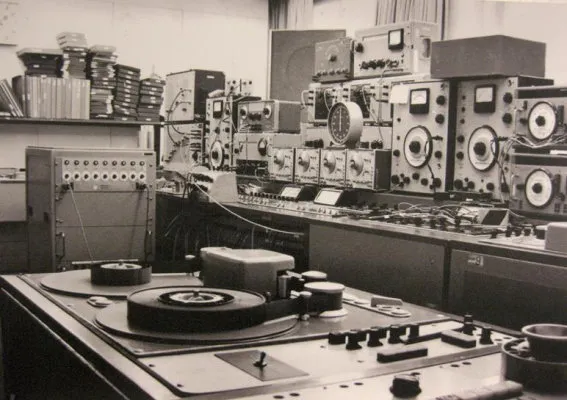
Figure 1.2.The Cologne-based radio station WDR, one of the workplaces of Karl Stockhausen. This studio was one of the first-ever electronic music studios
1.4. Acousmatic music
During the same period, in parallel with musique concrète and electronic music, the musical community embraced another new concept, acousmatic music. The objective of acousmatic music is to experiment with the listeners’ sense of hearing and their mental perception of musical messages to leave room for the imagination. The word “acousmatic” refers to an auditory situation where the sound source...
Table of contents
Cover
Table of Contents
Foreword
Preface
Introduction
1 Electronic Music
2 When Revolution Holds Us in Its Grasp
3 The MIDI Standard
4 Sequencers
5 Drum Machines
6 Samplers
7 Groove Machines
8 Vocoders
9 Octatrack: Maintenance, Repairs, and Tips
10 Octatrack: MIDI Sequences and Arpeggios
11 Korg Electribe: Maintenance and Hardware Tips
12 Korg Electribe: Software Tips
Conclusion
Appendices
Bibliography
Index
End User License Agreement
Trusted by 375,005 students
Access to over 1.5 million titles for a fair monthly price.
Study more efficiently using our study tools.
Frequently asked questions
Yes, you can cancel anytime from the Subscription tab in your account settings on the Perlego website. Your subscription will stay active until the end of your current billing period. Learn how to cancel your subscription
No, books cannot be downloaded as external files, such as PDFs, for use outside of Perlego. However, you can download books within the Perlego app for offline reading on mobile or tablet. Learn how to download books offline
Perlego offers two plans: Essential and Complete
Essential is ideal for learners and professionals who enjoy exploring a wide range of subjects. Access the Essential Library with 800,000+ trusted titles and best-sellers across business, personal growth, and the humanities. Includes unlimited reading time and Standard Read Aloud voice.
Complete: Perfect for advanced learners and researchers needing full, unrestricted access. Unlock 1.5M+ books across hundreds of subjects, including academic and specialized titles. The Complete Plan also includes advanced features like Premium Read Aloud and Research Assistant.
Both plans are available with monthly, semester, or annual billing cycles.
We are an online textbook subscription service, where you can get access to an entire online library for less than the price of a single book per month. With over 1.5 million books across 990+ topics, we’ve got you covered! Learn about our mission
Look out for the read-aloud symbol on your next book to see if you can listen to it. The read-aloud tool reads text aloud for you, highlighting the text as it is being read. You can pause it, speed it up and slow it down. Learn more about Read Aloud
Yes! You can use the Perlego app on both iOS and Android devices to read anytime, anywhere — even offline. Perfect for commutes or when you’re on the go. Please note we cannot support devices running on iOS 13 and Android 7 or earlier. Learn more about using the app
Yes, you can access Electronic Music Machines by Jean-Michel Reveillac,Jean-Michel Réveillac in PDF and/or ePUB format, as well as other popular books in Physical Sciences & Physics. We have over 1.5 million books available in our catalogue for you to explore.