5G for the Connected World
  1. English
  2. ePUB (mobile friendly)
  3. Available on iOS & Android
eBook - ePub

About this book

Comprehensive Handbook Demystifies 5G for Technical and Business Professionals in Mobile Telecommunication Fields

Much is being said regarding the possibilities and capabilities of the emerging 5G technology, as the evolution towards 5G promises to transform entire industries and many aspects of our society. 5G for the Connected World offers a comprehensive technical overview that telecommunication professionals need to understand and take advantage of these developments.

The book offers a wide-ranging coverage of the technical aspects of 5G (with special consideration of the 3GPP Release 15 content), how it enables new services and how it differs from LTE. This includes information on potential use cases, aspects of radio and core networks, spectrum considerations and the services primarily driving 5G development and deployment.

The text also looks at 5G in relation to the Internet of Things, machine to machine communication and technical enablers such as LTE-M, NB-IoT and EC-GSM. Additional chapters discuss new business models for telecommunication service providers and vertical industries as a result of introducing 5G and strategies for staying ahead of the curve. Other topics include:

  • Key features of the new 5G radio such as descriptions of new waveforms, massive MIMO and beamforming technologies as well as spectrum considerations for 5G radio regarding all possible bands
  • Drivers, motivations and overview of the new 5G system – especially RAN architecture and technology enablers (e.g. service-based architecture, compute-storage split and network exposure) for native cloud deployments
  • Mobile edge computing, Non-3GPP access, Fixed-Mobile Convergence
  • Detailed overview of mobility management, session management and Quality of Service frameworks
  • 5G security vision and architecture
  • Ultra-low latency and high reliability use cases and enablers, challenges and requirements (e.g. remote control, industrial automation, public safety and V2X communication)
  • An outline of the requirements and challenges imposed by massive numbers of devices connected to cellular networks

While some familiarity with the basics of 3GPP networks is helpful, 5G for the Connected World is intended for a variety of readers. It will prove a useful guide for telecommunication professionals, standardization experts, network operators, application developers and business analysts (or students working in these fields) as well as infrastructure and device vendors looking to develop and integrate 5G into their products, and to deploy 5G radio and core networks.
Frequently asked questions

Yes, you can cancel anytime from the Subscription tab in your account settings on the Perlego website. Your subscription will stay active until the end of your current billing period. Learn how to cancel your subscription.
No, books cannot be downloaded as external files, such as PDFs, for use outside of Perlego. However, you can download books within the Perlego app for offline reading on mobile or tablet. Learn more here.
Perlego offers two plans: Essential and Complete
  • Essential is ideal for learners and professionals who enjoy exploring a wide range of subjects. Access the Essential Library with 800,000+ trusted titles and best-sellers across business, personal growth, and the humanities. Includes unlimited reading time and Standard Read Aloud voice.
  • Complete: Perfect for advanced learners and researchers needing full, unrestricted access. Unlock 1.4M+ books across hundreds of subjects, including academic and specialized titles. The Complete Plan also includes advanced features like Premium Read Aloud and Research Assistant.
Both plans are available with monthly, semester, or annual billing cycles.
We are an online textbook subscription service, where you can get access to an entire online library for less than the price of a single book per month. With over 1 million books across 1000+ topics, we’ve got you covered! Learn more here.
Look out for the read-aloud symbol on your next book to see if you can listen to it. The read-aloud tool reads text aloud for you, highlighting the text as it is being read. You can pause it, speed it up and slow it down. Learn more here.
Yes! You can use the Perlego app on both iOS or Android devices to read anytime, anywhere — even offline. Perfect for commutes or when you’re on the go.
Please note we cannot support devices running on iOS 13 and Android 7 or earlier. Learn more about using the app.
Yes, you can access 5G for the Connected World by Devaki Chandramouli, Rainer Liebhart, Juho Pirskanen, Devaki Chandramouli,Rainer Liebhart,Juho Pirskanen in PDF and/or ePUB format, as well as other popular books in Technology & Engineering & Cyber Security. We have over one million books available in our catalogue for you to explore.

Information

1
Drivers and Motivation for 5G

Betsy Covell1 and Rainer Liebhart2
1Nokia, Naperville, USA
2Nokia, Munich, Germany

1.1 Drivers for 5G

Main drivers for the evolution of mobile networks in the past were mobile voice (2G/3G/Voice over Long Term Evolution [VoLTE]), messaging (Short Messaging Service [SMS], WhatsApp) and Internet access (Wideband Code Division Multiple Access [WCDMA], High Speed Packet Access [HSPA], Long Term Evolution [LTE]) whenever and wherever needed. Focus was on end consumers equipped with traditional handsets or smartphones.
Consumer demand continues to be insatiable with an ever growing appetite for the bandwidth that is needed for 4K and 8K video streaming, augmented reality (AR) and virtual reality (VR), among other use cases. On the same token, operators want the network to be ā€œbetter, faster and cheaperā€ without compromising any of these three elements.
The biggest difference between 5G and previous ā€œGsā€ is the diversity of applications that 5G networks need to support. Objects ranging from cars and factory machines, appliances to watches and apparel, will learn to organize themselves to fulfill our needs by automatically adapting to our behavior, environment or business processes. New use cases will arise, many not yet conceived, creating novel business models. 5G connectivity will impact the following areas:
  • Real world mobility. The way we travel and experience our environment;
  • Virtual mobility. The way we can control remote environments;
  • High performance infrastructure. The way the infrastructure supports us;
  • 4th Industrial Revolution. The way we produce and provide goods.
We already have indicators about these long‐term trends and disruptions and they are not only driven by the Internet and the telecommunication industry but by a multitude of different industries. 5G will be the platform enabling growth in many of these industries; the IT, car, entertainment, agriculture, tourism and manufacturing industries. 5G will connect the factory of the future and help to create a fully automated and flexible production system. It will also be the enabler of a superefficient infrastructure that saves resources.
Smartphones are becoming more and more a commodity which means that consumers will differentiate themselves increasingly with new gadgets such as VR devices, connected cars and devices for connected health.
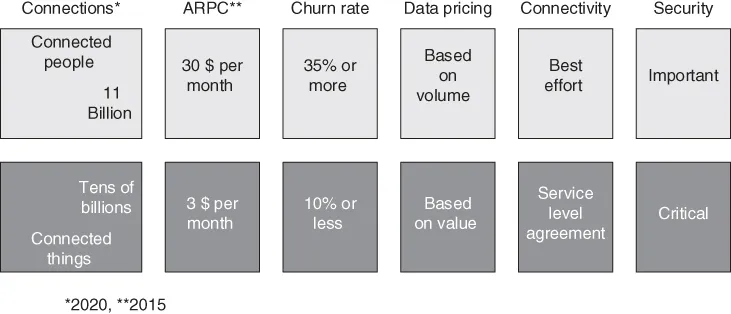
With the decline or at least flattened Average Revenue Per User/Average Revenue Per Device (ARPU/ARPD) in many markets worldwide (typical ARPU is around $30 per month, while ARPD is not more than $3 per month) the telecom industry is more and more considering new revenue streams besides traditional business models. This is where we see new business drivers and requirements, from vertical industries, the Internet of Things (IoT) and the digital society. In the past, the main driver for the mobile industry was connecting people, in the future it is about the ā€œconnected worldā€ meaning connecting everyone and everything at any time. This will create new and additional revenue streams for Mobile Network Operators (MNOs). Connecting ā€œthingsā€ like cars (e.g. 125 million vehicles to be connected by 2022), robots, meters, medical machines bring new challenges to the next generation of mobile networks. To name only a some of them:
  • Ubiquitous, pervasively ultra‐fast connectivity;
  • Resilient and secure networks;
  • Massive radio resources and ultra‐dense networks; and
  • Instantaneous connectivity.
Vertical industries and applications do have very diverse requirements with regards to throughput, latency, reliability, number of connections, security and revenue (see Figure 1.1).
Diagram of market characteristics, with boxes labeled connected people (11 billion) and things (tens of billions) under connections, 30 $ and 3 $ per month under ARPC, 35% and 10% or more under churn rate, etc.
Figure 1.1 Market characteristics (people and things).
This requires a highly flexible architecture of the new generation of mobile networks, on radio and core network side, as well as at the transport. Flexibility also includes a high ...

Table of contents

  1. Cover
  2. Table of Contents
  3. About the Editors
  4. List of Contributors
  5. Foreword by Tommi Uitto
  6. Foreword by Karri Kuoppamaki
  7. Preface
  8. Acknowledgements
  9. Introduction
  10. Terminology
  11. 1 Drivers and Motivation for 5G
  12. 2 Wireless Spectrum for 5G
  13. 3 Radio Access Technology
  14. 4 Next Generation Network Architecture
  15. 5 Access Control and Mobility Management
  16. 6 Sessions, User Plane, and QoS Management
  17. 7 Security
  18. 8 Critical Machine Type Communication
  19. 9 Massive Machine Type Communication and the Internet of Things
  20. 10 Summary and Outlook
  21. Appendix of 3GPP Reference Points
  22. Index
  23. End User License Agreement