Process Modeling and Simulation for Chemical Engineers
eBook - ePub

Process Modeling and Simulation for Chemical Engineers

Theory and Practice

  1. English
  2. ePUB (mobile friendly)
  3. Available on iOS & Android
eBook - ePub

Process Modeling and Simulation for Chemical Engineers

Theory and Practice

About this book

This book provides a rigorous treatment of the fundamental concepts and techniques involved in process modeling and simulation. The book allows the reader to:

(i)         Get a solid grasp of "under-the-hood" mathematical results

(ii)        Develop models of sophisticated processes

(iii)       Transform models to different geometries and domains as appropriate

(iv)       Utilize various model simplification techniques

(v)        Learn simple and effective computational methods for model simulation

(vi)       Intensify the effectiveness of their research

Modeling and Simulation for Chemical Engineers: Theory and Practice begins with an introduction to the terminology of process modeling and simulation. Chapters 2 and 3 cover fundamental and constitutive relations, while Chapter 4 on model formulation builds on these relations. Chapters 5 and 6 introduce the advanced techniques of model transformation and simplification. Chapter 7 deals with model simulation, and the final chapter reviews important mathematical concepts.

Presented in a methodical, systematic way, this book is suitable as a self-study guide or as a graduate reference, and includes examples, schematics and diagrams to enrich understanding. End of chapter problems with solutions and computer software available online at www.wiley.com/go/upreti/pms_for_chemical_engineers are designed to further stimulate readers to apply the newly learned concepts.
Frequently asked questions

Yes, you can cancel anytime from the Subscription tab in your account settings on the Perlego website. Your subscription will stay active until the end of your current billing period. Learn how to cancel your subscription.
No, books cannot be downloaded as external files, such as PDFs, for use outside of Perlego. However, you can download books within the Perlego app for offline reading on mobile or tablet. Learn more here.
Perlego offers two plans: Essential and Complete
  • Essential is ideal for learners and professionals who enjoy exploring a wide range of subjects. Access the Essential Library with 800,000+ trusted titles and best-sellers across business, personal growth, and the humanities. Includes unlimited reading time and Standard Read Aloud voice.
  • Complete: Perfect for advanced learners and researchers needing full, unrestricted access. Unlock 1.4M+ books across hundreds of subjects, including academic and specialized titles. The Complete Plan also includes advanced features like Premium Read Aloud and Research Assistant.
Both plans are available with monthly, semester, or annual billing cycles.
We are an online textbook subscription service, where you can get access to an entire online library for less than the price of a single book per month. With over 1 million books across 1000+ topics, we’ve got you covered! Learn more here.
Look out for the read-aloud symbol on your next book to see if you can listen to it. The read-aloud tool reads text aloud for you, highlighting the text as it is being read. You can pause it, speed it up and slow it down. Learn more here.
Yes! You can use the Perlego app on both iOS or Android devices to read anytime, anywhere — even offline. Perfect for commutes or when you’re on the go.
Please note we cannot support devices running on iOS 13 and Android 7 or earlier. Learn more about using the app.
Yes, you can access Process Modeling and Simulation for Chemical Engineers by Simant R. Upreti in PDF and/or ePUB format, as well as other popular books in Technology & Engineering & Chemical & Biochemical Engineering. We have over one million books available in our catalogue for you to explore.

Chapter 1
Introduction

Process modeling and simulation is our intellectual endeavor to explain real-world processes, foresee their effects, and improve them to our satisfaction. Using foundational rules and the language of mathematics, we describe a process, i.e., develop its model. Depending on what needs to be known, we pose the model as a problem. Its solution provides the needed information, thereby simulating the process as it would unfold in the real world.
This chapter lays the groundwork for process modeling and simulation. We explain the basic concepts, and introduce the involved terminology in a methodical manner. Our starting point is the definition of a system.

1.1 System

A system is defined as a set of one or more units relevant to the knowledge that is sought. Eventually, that knowledge is obtained as system characteristics, and their behavior in time and space.
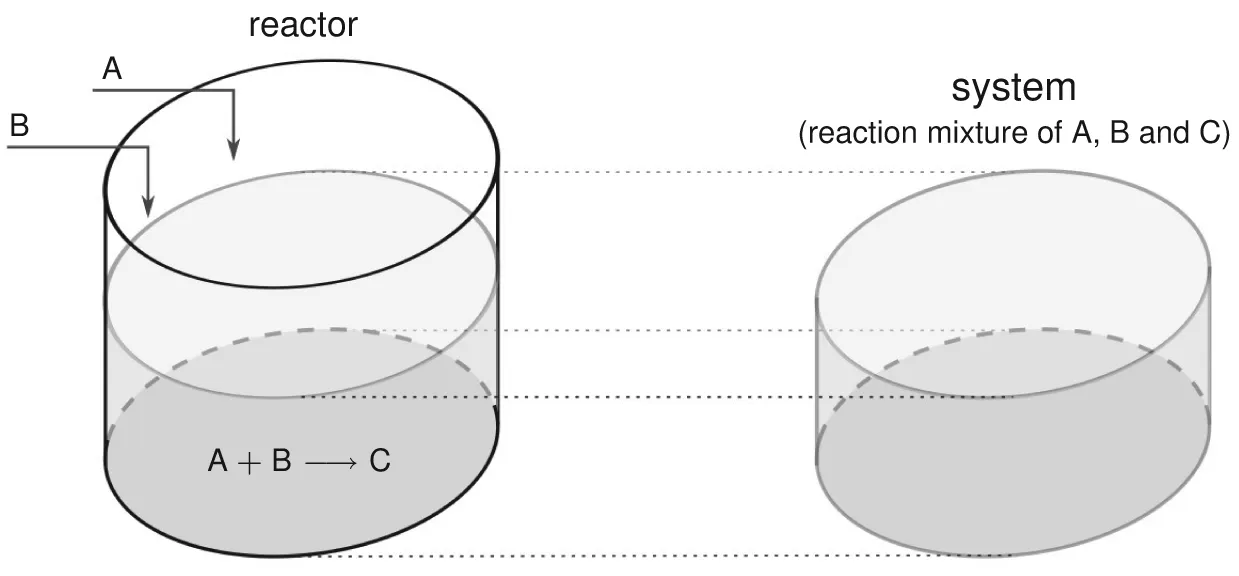
We specify a system based on what we want to know about it. Consider for example a well-mixed reactor shown in Figure 1.1 below. The reactor is fed certain amounts of non-volatile species A and B in a liquid phase. Inside the reactor, the species react to form a non-volatile liquid product C. Given that we wish to know the concentration of C in the liquid phase, the system is precisely the reaction mixture as shown in the figure. Anything not relevant – such as the reactor wall, and the vapor phase over the mixture – is not included in the system.
Scheme for A system of reaction mixture in a reactor.
Figure 1.1 A system of reaction mixture in a reactor
Everything external to a system constitute its surroundings. A region of zero thickness in the system separating it from the surroundings is called the boundary. Any interaction between a system and its surroundings requiring physical contact takes place across the boundary. For instance, this interaction could be transfer of mass.
For the above system of reaction mixture, the surroundings comprise the reactor wall, and the vapor phase over the reaction mixture. The system boundary is made of the surface of mixture in contact with (i) the reactor wall, and (ii) air. An example of interaction between this system and its surroundings is the evaporation of the species from the mixture through its top surface (i.e., across the boundary) to air.

1.1.1 Uniform System

A system is said to be uniform or homogenous if it stays the same, regardless of any recombination of its parts. As an illustration, consider a system in the shape of a cube. We split it into a set of arbitrary number of small cubes of identical size. Next, we recombine them in all possible ways to form the initial cube. The system would be uniform if each recombination (for each set of small cubes) resulted in the original system. If even one recombination produced a different system, the system would be non-uniform or heterogenous.

1.1.2 Properties of System

We associate a system with the properties it possesses. By property we mean any measurable characteristic that is related to matter, energy, space, or time. Some common examples of property are mass, concentration, temperature, enthalpy, pressure, volume, diffusivity, etc. With the help of the properties of a system, we can keep track of it, and compare it to other systems of interest.
System properties can be classified into intensive and extensive properties. Given a uniform system, an extensive property is proportional to the size or extent of the system. Examples of extensive properties are mass and volume. Thus, the mass of a fraction (say, 1/10th) of a system is the same fraction (1/10th) of the total mass of the system. On the other hand, an intensive property of a uniform system does not depend on its size or extent, and is the same, i.e., has the same value, for each part of the system. Examples of intensive property are concentration, temperature and pressure.
Thus, if a uniform system is at a certain pressure then any part of the system is at the same pressure. Equivalently, if all intensive properties of a system do not vary then the system is uniform. An example is the reaction mixture of Figure 1.1 on the previous page. The mixture has
  1. the same value of concentration of the species A throughout the system (or uniform concentration of A),
  2. uniform concentration of each of the remaining species B and C, and
  3. a similar uniformity of any other intensive property, e.g., temperature.
For a non-uniform system, one or more intensive properties vary within the system. More precisely, the properties vary with space inside the system. For example, if the reaction mixture of Figure 1.1 on p. 1 were not well-mixed then the species concentrations, and temperature would not be the same thro...

Table of contents

  1. Cover
  2. Title Page
  3. Copyright
  4. Dedication
  5. Table of Contents
  6. Preface
  7. Notation
  8. Chapter 1: Introduction
  9. Chapter 2: Fundamental Relations
  10. Chapter 3: Constitutive Relations
  11. Chapter 4: Model Formulation
  12. Chapter 5: Model Transformation
  13. Chapter 6: Model Simplification and Approximation
  14. Chapter 7: Process Simulation
  15. Chapter 8: Mathematical Review
  16. Index
  17. End User License Agreement