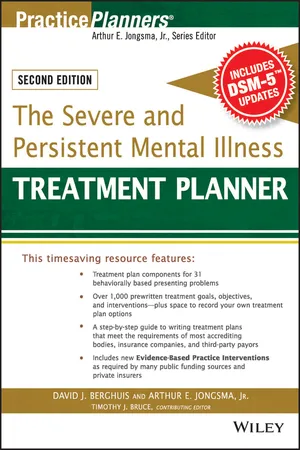
The Severe and Persistent Mental Illness Treatment Planner
- English
- ePUB (mobile friendly)
- Available on iOS & Android
The Severe and Persistent Mental Illness Treatment Planner
About this book
This timesaving resource features:
- Treatment plan components for 31 behaviorally based presenting problems
- Over 1, 000 prewritten treatment goals, objectives, and interventions—plus space to record your own treatment plan options
- A step-by-step guide to writing treatment plans that meet the requirements of most accrediting bodies, insurance companies, and third-party payors
- Includes new Evidence-Based Practice Interventions as required by many public funding sources and private insurers
Practice Planners ® THE BESTSELLING TREATMENT PLANNING SYSTEM FOR MENTAL HEALTH PROFESSIONALS
The Severe and Persistent Mental Illness Treatment Planner, Second Edition provides all the elements necessary to quickly and easily develop formal treatment plans that satisfy the demands of HMOs, managed care companies, third-party payors, and state and federal agencies.
- New edition features empirically supported, evidence-based treatment interventions
- Organized around 31 main presenting problems, including employment problems, family conflicts, financial needs, homelessness, intimate relationship conflicts, and social anxiety
- Over 1, 000 prewritten treatment goals, objectives, and interventions—plus space to record your own treatment plan options
- Easy-to-use reference format helps locate treatment plan components by behavioral problem
- Designed to correspond with The Severe and Persistent Mental Illness Progress Notes Planner, Second Edition
- Includes a sample treatment plan that conforms to the requirements of most third-party payors and accrediting agencies (including CARF, The Joint Commission, COA, and NCQA)
Additional resources in the Practice Planners ® series:
Progress Notes Planners contain complete, prewritten progress notes for each presenting problem in the companion Treatment Planners.
Documentation Sourcebooks provide the forms and records that mental health professionals need to efficiently run their practice.
For more information on our Practice Planners ®, including our full line of Treatment Planners, visit us on the Web at: www.wiley.com/practiceplanners
Frequently asked questions
- Essential is ideal for learners and professionals who enjoy exploring a wide range of subjects. Access the Essential Library with 800,000+ trusted titles and best-sellers across business, personal growth, and the humanities. Includes unlimited reading time and Standard Read Aloud voice.
- Complete: Perfect for advanced learners and researchers needing full, unrestricted access. Unlock 1.4M+ books across hundreds of subjects, including academic and specialized titles. The Complete Plan also includes advanced features like Premium Read Aloud and Research Assistant.
Please note we cannot support devices running on iOS 13 and Android 7 or earlier. Learn more about using the app.
Information
Chapter 1
ACTIVITIES OF DAILY LIVING (ADL)
BEHAVIORAL DEFINITIONS
- Demonstrates substandard hygiene and grooming, as evidenced by strong body odor, disheveled hair, or dirty clothing.
- Fails to use basic hygiene techniques, such as bathing, brushing teeth, or washing clothes.
- Evidences medical problems due to poor hygiene.
- Consumes a poor diet due to deficiencies in cooking, meal preparation, or food selection.
- Impaired reality testing results in bizarre behaviors that compromise ability to perform activities of daily living (ADLs).
- Demonstrates poor interaction skills as evidenced by limited eye contact, insufficient attending, and awkward social responses.
- Has a history of others excusing poor performance on ADLs due to factors that are not related to mental illness.
- Demonstrates inadequate knowledge or functioning in basic skills around the home (e.g., cleaning floors, washing dishes, disposing of garbage, keeping fresh food available).
- Has a history of loss of relationships, employment, or other social opportunities due to poor hygiene and inadequate attention to grooming.
LONG-TERM GOALS
- Increase functioning in ADLs in a consistent and responsible manner.
- Understand the need for good hygiene and implement healthy personal hygiene practices.
- Learn basic skills for maintaining a clean, sanitary living space.
- Regularly shower or bathe, shave, brush teeth, care for hair, and use deodorant.
- Experience increased social acceptance because of improved appearance or functioning in ADLs.
- Family, friends, and caregivers provide constructive feedback to the client regarding ADLs.
| SHORT-TERM OBJECTIVES | THERAPEUTIC INTERVENTIONS | ||
| 1. | Describe current functioning in ADLs. (1, 2, 3) | 1. | Assist the client in preparing an inventory of his/her positive and negative functioning regarding ADLs. |
| 2. | Ask the client to identify a trusted individual from whom he/she can obtain helpful feedback regarding daily hygiene and cleanliness. Coordinate feedback from this individual to the client. | ||
| 3. | Review the client's diet or refer him/her to a dietician for an assessment regarding basic nutritional knowledge and skills, usual diet, and nutritional deficiencies. | ||
| 2. | List the negative effects of not giving enough effort to responsible performance of ADLs. (4, 5, 6) | 4. | Ask the client to identify two painful experiences in which rejection was experienced (e.g., broken relationships, loss of employment) due to the lack of performance of basic ADLs. |
| 5. | Review with the client the medical risks (e.g., dental problems, risk of infection, lice) that are associated with poor hygiene or lack of attention to other ADLs. | ||
| 6. | Assist the client in expressing emotions related to impaired performance in ADLs (e.g., embarrassment, depression, low self-esteem). | ||
| 3. | Verbalize insight into the secondary gain that is associated with decreased ADL fu... | ||
Table of contents
- Cover
- Title Page
- Copyright
- Dedication
- PRACTICEPLANNERS® SERIES PREFACE
- ACKNOWLEDGMENTS
- INTRODUCTION
- SAMPLE TREATMENT PLAN
- Chapter 1: ACTIVITIES OF DAILY LIVING (ADL)
- Chapter 2: AGING
- Chapter 3: ANGER MANAGEMENT
- Chapter 4: ANXIETY
- Chapter 5: BORDERLINE PERSONALITY
- Chapter 6: CHEMICAL DEPENDENCE
- Chapter 7: DEPRESSION
- Chapter 8: EMPLOYMENT PROBLEMS
- Chapter 9: FAMILY CONFLICTS
- Chapter 10: FINANCIAL NEEDS
- Chapter 11: GRIEF AND LOSS
- Chapter 12: HEALTH ISSUES
- Chapter 13: HOMELESSNESS
- Chapter 14: INDEPENDENT ACTIVITIES OF DAILY LIVING (IADL)
- Chapter 15: INTIMATE RELATIONSHIP CONFLICTS
- Chapter 16: LEGAL CONCERNS
- Chapter 17: MANIA OR HYPOMANIA
- Chapter 18: MEDICATION MANAGEMENT
- Chapter 19: OBSESSIVE-COMPULSIVE DISORDER (OCD)
- Chapter 20: PANIC/AGORAPHOBIA
- Chapter 21: PARANOIA
- Chapter 22: PARENTING
- Chapter 23: POSTTRAUMATIC STRESS DISORDER (PTSD)
- Chapter 24: PSYCHOSIS
- Chapter 25: RECREATIONAL DEFICITS
- Chapter 26: SELF-DETERMINATION DEFICITS
- Chapter 27: SEXUALITY CONCERNS
- Chapter 28: SOCIAL ANXIETY
- Chapter 29: SOCIAL SKILLS DEFICITS
- Chapter 30: SPECIFIC FEARS AND AVOIDANCE
- Chapter 31: SUICIDAL IDEATION
- Appendix A: BIBLIOTHERAPY SUGGESTIONS
- Appendix B: REFERENCES FOR EVIDENCE-BASED CHAPTERS
- Appendix C: RECOVERY MODEL OBJECTIVES AND INTERVENTIONS
- End User License Agreement