Advances in Organometallic Chemistry and Catalysis
eBook - ePub

Advances in Organometallic Chemistry and Catalysis

The Silver / Gold Jubilee International Conference on Organometallic Chemistry Celebratory Book

  1. English
  2. ePUB (mobile friendly)
  3. Available on iOS & Android
eBook - ePub

Advances in Organometallic Chemistry and Catalysis

The Silver / Gold Jubilee International Conference on Organometallic Chemistry Celebratory Book

About this book

A contemporary compilation of recent achievements in organometallic chemistry

The prestigious International Conference on Organometallic Chemistry (ICOMC) was launched in 1963, providing a forum for researchers from around the world to share their findings and explore new paths to advance our knowledge and application of organometallic chemistry. The 25th ICOMC, held in Lisbon in 2012, gathered more than 1, 200 participants from 54 countries. This volume celebrates the 25th Silver Edition and the 50th Gold Year of the ICOMC.

Featuring contributions from invited 25th ICOMC speakers, Advances in Organometallic Chemistry and Catalysis highlights recent achievements and new and emerging areas of research in the field. Its seven sections cover:

  • Activation and Functionalization of Carbon Single Bonds and Small Molecules
  • Organometallic Synthesis and Catalysis
  • Organometallic Polymerization Catalysis
  • Organometallic Polymers and Materials
  • Organometallic Chemistry and Sustainable Energy
  • Bioorganometallic Chemistry
  • Organometallic Electrochemistry

Chapters discuss fundamental underlying concepts, offer illustrative examples and cases, and explore future avenues for continued research. Readers will discover basic principles and properties of organometallic compounds, reaction mechanisms, and detailed descriptions of current applications. Collectively, these chapters underscore the versatility, richness, and potential of modern organometallic chemistry, including its interrelationships with other scientific disciplines.

All the contributions are extensively referenced, providing a gateway to the most important original research papers and reviews in organometallic chemistry. Presenting a contemporary understanding of organometallic chemistry and its many applications, Advances in Organometallic Chemistry and Catalysis is recommended for all researchers in the field, from students to advanced investigators.

Frequently asked questions

Yes, you can cancel anytime from the Subscription tab in your account settings on the Perlego website. Your subscription will stay active until the end of your current billing period. Learn how to cancel your subscription.
No, books cannot be downloaded as external files, such as PDFs, for use outside of Perlego. However, you can download books within the Perlego app for offline reading on mobile or tablet. Learn more here.
Perlego offers two plans: Essential and Complete
  • Essential is ideal for learners and professionals who enjoy exploring a wide range of subjects. Access the Essential Library with 800,000+ trusted titles and best-sellers across business, personal growth, and the humanities. Includes unlimited reading time and Standard Read Aloud voice.
  • Complete: Perfect for advanced learners and researchers needing full, unrestricted access. Unlock 1.4M+ books across hundreds of subjects, including academic and specialized titles. The Complete Plan also includes advanced features like Premium Read Aloud and Research Assistant.
Both plans are available with monthly, semester, or annual billing cycles.
We are an online textbook subscription service, where you can get access to an entire online library for less than the price of a single book per month. With over 1 million books across 1000+ topics, we’ve got you covered! Learn more here.
Look out for the read-aloud symbol on your next book to see if you can listen to it. The read-aloud tool reads text aloud for you, highlighting the text as it is being read. You can pause it, speed it up and slow it down. Learn more here.
Yes! You can use the Perlego app on both iOS or Android devices to read anytime, anywhere — even offline. Perfect for commutes or when you’re on the go.
Please note we cannot support devices running on iOS 13 and Android 7 or earlier. Learn more about using the app.
Yes, you can access Advances in Organometallic Chemistry and Catalysis by Armando J. L. Pombeiro in PDF and/or ePUB format, as well as other popular books in Physical Sciences & Organic Chemistry. We have over one million books available in our catalogue for you to explore.

Information

Publisher
Wiley
Year
2013
Print ISBN
9781118510148
eBook ISBN
9781118742891
Part I
Activation and Functionalization of Carbon Single Bonds and of Small Molecules

Chapter 1

Organometallic Complexes as Catalysts in Oxidation of C–H Compounds

Georgiy B. Shul'pin
Department of Kinetics and Catalysis, Semenov Institute of Chemical Physics, Russian Academy of Sciences, Moscow, Russia

1.1 Introduction

Organometallic (i.e., containing Ļ€ or σ metal–carbon bonds) derivatives of transition metals are known as excellent catalysts in reactions that do not involve the insertion of oxygen atoms [1]. They are used in (selected examples of recent publications are given) hydrogen/deuterium (H/D) exchange [2a], dehydrogenation [2b–e], homogeneous syngas conversion [2f], hydrosilylation [2g], carbonylation [2h], and homogeneous water gas shift reaction [2i]. In other recent works, complex [
c1-math-0007
], where
c1-math-0008
and
c1-math-0009
,3-bis(2,6-bis(diphenylmethyl)-4-methylphenyl)imidazol-2-ylidene, was used as a catalyst in the racemization of chiral alcohols [2j], neutral
c1-math-0010
-arene ruthenium complexes with monodentate P-donor ligands found to catalyze the transfer hydrogenation reaction [2k].
Organometallic catalysts were employed in oxidation reactions of some organic compounds. Thus, complex
c1-math-0011
is a precatalyst for olefin epoxidation [3a], heterodinuclear ruthenium–iron complexes showed high activity for the catalytic oxidation of secondary alcohols with tert-butyl hydroperoxide to give ketones in aqueous media [3b]. In contrast, organometallic complexes were very rarely used as (pre)catalysts in oxygenation reactions of aromatic and saturated hydrocarbons [4a–e] (the latter can be called noble gases of organic chemistry because of their known inertness).
In various C–H oxygenation reactions, organometallic complexes can play the role of precatalyst. Compounds bearing carbon–metal bonds can also be some of intermediate compounds in the catalytic cycles. In this chapter, we discuss reactions in which an organometallic complex catalyzes the insertion of oxygen atoms into C–H bonds of hydrocarbons or other organic compounds. The focus will be made on the author's own works.

1.2 Oxygenation Reactions with Oxidants other than Peroxides

The first example of a metal-catalyzed oxygen atom insertion into the C–H bond was the reaction found by Shilov and Shteinman and their coworkers in 1972 (for reviews, see References 1h and 5). These authors demonstrated that
c1-math-0012
ion could catalyze H/D exchange in methane in a
c1-math-0013
COOD solution and, if
c1-math-0014
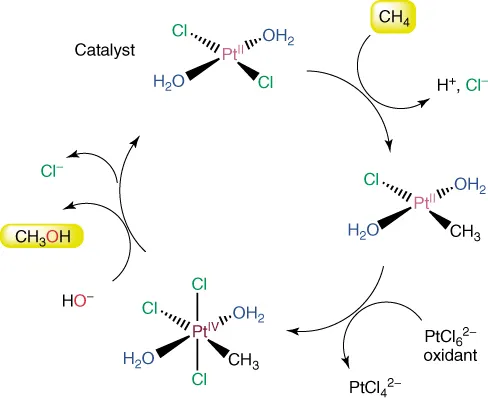
is added, the latter oxidizes methane to methanol (Shilov chemistry). The catalytic cycle in which
c1-math-0015
-methyl complexes of platinum(II) and platinum(IV) are involved is shown in Fig. 1.1.
Figure 1.1 The catalytic cycle proposed for the methane oxidation to methanol by
c1-math-0016
catalyzed by
c1-math-0017
.
c1f001
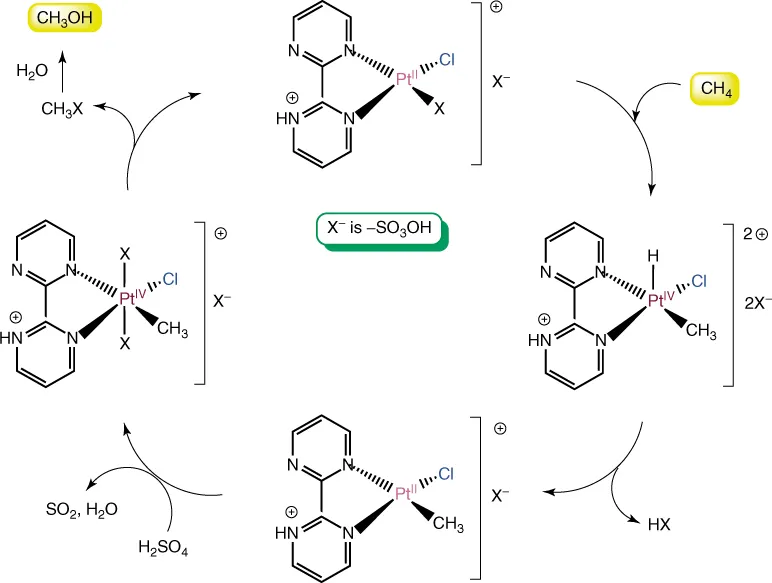
Later, Periana and coworkers proposed (2,2′-bipyrimidyl)platinum(II)dichloride as a catalyst (ā€œPeriana systemā€; see a recent review [4d]). Fuming sulfuric acid is the oxidant in this case. A simplified scheme of the catalytic cycle is shown in Fig. 1.2. It can be seen that some intermediates contain
c1-math-0018
-methyl-platinum bonds.
Figure 1.2 The simplified catalytic cycle for the methane oxidation by the Periana system.
Adapted from Reference 4d.
c1f002
Complexes containing the fragment
c1-math-0019
(
c1-math-0020
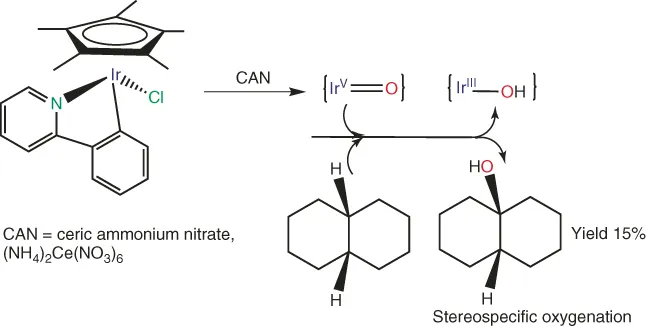
is pentamethylcyclopentadienyl) are active precatalysts in the Cāˆ’H oxidation of cis-decalin and cyclooctane. Ceric ammonium nitrate was a sacrificial oxidant and water was the oxygen source (Fig. 1.3). Calculations using the Density functional theory (DFT) method showed that the C–H oxidation of cis-decalin by
c1-math-0021
(ppy)(Cl) (
c1-math-0022
-phenylpyridine) follows a direct oxygen insertion mechanism on the singlet potential energy surface [6]. The authors proposed that some of intermediate species contain the
c1-math-0023
ring coordinated to the iridium ion. The authors also made a general conclusion: oxidation catalysis by organometallic species can be hard to interpret because of the possibility that the real catalyst is an oxidation product of the precursor.
Figure 1.3 Stereospecific oxygenation of cis-decalin catalyzed by the Ir organometallic derivative [6].
c1f003
Indeed, organometallic precatalysts can be transformed during an induction period into catalytically active species that do not contain metal–carbon bonds. For example, molybdenum [7a] and tungsten [7b] carbonyls catalyze aerobic photooxygenation of cyclohexane to cyclohexyl hydroperoxide (primary product) and cyclohexanol and cyclohexanone (Fig. 1.4). The proposed mechanism is shown in Fig. 1.5. It includes ...

Table of contents

  1. Cover
  2. Title Page
  3. Copyright
  4. Preface
  5. Contributors
  6. Part I: Activation and Functionalization of Carbon Single Bonds and of Small Molecules
  7. Part II: Organometallic Synthesis and Catalysis
  8. Part III: Organometallic Polymerization Catalysis
  9. Part IV: Organometallic Polymers and Materials
  10. Part V: Organometallic Chemistry and Sustainable Energy
  11. Part VI: Bioorganometallic Chemistry
  12. Part VII: Organometallic Electrochemistry
  13. Postscript: A Short History of the ICOMC Conferences
  14. Index