Co-written by a pioneer of the sustainability movement, this groundbreaking volume offers a new way of thinking about the economics of sustainable energy, a goal that has eluded scientists and economists for decades.
Every year, as soon as reports on global economic inequality remind us about the direction our civilization is heading, there is a hysterical reaction, but hysteria dies down within weeks and we go back to the lifestyle that brought us here today. Often the blame is laid on the Millennial generation for their "apathy," "lust for comfort," and "bratty" attitude. Yet, business insider surveys indicate it's the same Millennial generation that overwhelmingly cares for the state of the world and the direction in which our civilization is heading. Nearly 50% of them ranked climate change and destruction of nature as their primary concern. This is followed by concern for war and global conflict, and then global economic inequality. The vast majority of those surveyed are willing and eager to make lifestyle changes. This book breaks open the hypocrisy of our civilization and stops the blame game in its tracks and identifies the root causes of today's world economy, ecology, and global politics.
The book demonstrates that changes in lifestyle are necessary but not sufficient. No economic policy or technology development mode has a chance to survive, let alone thrive unless supported by the political establishment. In this process, the government plays a pivotal role. The challenge is to change the attitude of the government from a 'self-serving' controlling mode to a representative philanthropic mode. This new system of economic development and political governance is inspired by a long-forgotten understanding of political economics: medieval Islamic economics. In reviewing the history of economics from trade, currencies, and interest, the strengths and weaknesses of various economic developments over our centuries are evaluated. Based on the historical analysis, a step by step procedure is outlined for this fundamental change in our society today. As a whole, this book is the first in the modern era to offer such a comprehensive analysis, complete with solutions to the entire crisis of today's civilization.
Nobel laureate economist, Robert J. Shiller, famously pointed out: “Since the global financial crisis and recession of 2007–2009, criticism of the economics profession has intensified. The failure of all but a few professional economists to forecast the episode – the aftereffects of which still linger – has led many to question whether the economics profession contributes anything significant to society.” There is no denying that there is a sentiment in today’s world that the economists with all their economic theories have largely disappointed the general public. While energy is the driver of modern civilization, the role played by the economy in the formation of modern culture is pivotal. An energy manager has to be redeemed by the economic appeal of the project, despite more recent concern about society and the environment. In this regard, the biggest challenge of a new book on this is to present an answer to the question that Shiller’s comment poses. Of course, the answer is not trivial and it is no exaggeration to state that the answer has eluded all researchers and pundits of modern era. Recent studies reveal another depressing fact. Recent findings of Islam (2017) reveal that liberal economies grow faster (for instance, Poland) than the other (for instance, Bulgaria) but also create inequality and can lead to political failure in the long-run. This finding resonates depressingly when one tries to explain the current state of the economy of the United States in particular and the world in general. Recently, Oxfam reported that 388 billionaires had the same amount of money as the bottom 50% of the Earth’s population in 2010. The charity’s report also said that the richest one percent of the population would own more than half the world’s wealth by 2016. Indeed, the Oxfam report turned out to be ‘prophetic’ as the number whose wealth is equal to that of the poorest half of the world’s population has declined steadily since 2010. Of course, the discipline of economics has long been disconnected from social justice, but how can the irony of the original definition of economy (the Greek origins, meaning οίκος – “household” and νέμoμαι – «manage») be lost on us?
Only recently, Facebook lost $100 billion in 10 days, yet there has been no earthquake, flood, or war (Financial Post, 2018). Bitcoin has oscillated between values assessed between $1000 and $13000 within days, without any connection to real wealth (Shane, 2017). Nearly 100 million dollars worth of Bitcoin has been stolen without physically removing any real property (The Guardian, 2017). What we have seen is Information turned into a safe haven of fraud and economic disaster. In the mean time, the “leader of the free world admits” that there is a steep learning curve await the U.S. presidency. However, as usual, ‘the state of the union remains strong’ – the time of global deception has arrived.
Occasionally, facts are spewed out in terms of statistics, national debt, etc. However, at no time were scientific explanations provided as to what these data stand for. For instance, the U.S. debt is reported to be $21 trillion, almost all in Treasury Bonds and Bills. Excluding some $7 trillion held by states and American citizens, $14 billion is in the hands of holders outside the U.S. Just over half of that, $7 billion is held by the Chinese (Wattles and Mullen, 2018). While listing these economic data, all news outlets ignore to point out none of these ‘debts’, ‘investments’, ‘securities’ have any meaning in Information age, for which the exceptionalism is the rule. Tomorrow, the U.S.A. can decide that access to U.S. satellite would require a certain tariff or any other hysteria and all of a sudden all deals will be off. Instead, it is stated that if the Chinese were to begin bleeding off some of that into the financial markets (to recover the costs of the tariffs), the value could begin to go down, quickening with any acceleration on the selling pressure. If that paper began declining rapidly, it could take the value of the U.S. dollar down with it.
Overall, there is a great deal of frustration and people do not feel they are a part of the economic system. The general public has lost confidence in the government and people feel helpless as everyone agrees that there is a rush toward economic inequality and the current economic development scheme cannot be sustained. The public mood was captured by Americn writer, Gore Vidal (1925–2012), who wrote, “The genius of our ruling class is that it has kept a majority of the people from ever questioning the inequity of a system where most people drudge along paying heavy taxes for which they get nothing in return.” In the mean time, there is no shortage of alarmists that continue to put out notices that perpetrate further fear and the public mood spirals down to a level of collective depression. For instance, only recently, former Greek Finance minister and economics professor, Yanis Varoufakis warned that Karl Marx ‘will have his revenge’ as capitalism is coming to an end because it is making itself obsolete (Embury-Dennis, 2017). The former economics professor correctly described how companies such as Google and Facebook, for the first time ever, are having their capital bought and produced by consumers. Based on that observation, Varoufakis concluded something that has no connection to the science of economics. What we have here is a conclusion that appeals to everyone but it has no scientific basis nor does it give any solution.
The energy management sector is equally hopeless. There are numerous studies and even more voluminous conclusions but all point to the same main conclusion: we agree to disagree and life must go on. After spending billions of dollars in research, scientists could not even agree on if we actually have global warming, let alone the cause of it. Considering the fact that today’s science is only a degenerated form of millennia old dogma, it is no surprise that we cannot explain why sunlight is different from fluorescent light, or microwave is different from open flame, or paraffin was is different from beeswax, or carbon dioxide from trees is different from the one guzzled out of engine exhausts. If we cannot even explain these fundamental facts, how could today’s engineering that starts off with denaturing then calculates everything based on New science can begin to offer a solution to what Nobel Chemistry Laureate Robert Curl characterized a “technological disaster.” Every day, headlines appear that show, as a human race, we have never had to deal with more unsustainable technologies.
How can this spiralling down path be changed? Who could possibly come to rescue? The government? In reality, it has long been recognized that politicians are the most toxic of liars. A New York Times (May 11, 2015) headline reads: All Politicians Lie. Some Lie More Than Others. When policy makers lie, there appears to be no recourse of escape from a process that has been severely corrupted. British poet, William Shenstone (1714–1763) famously pointed out, “A liar begins with making falsehood appear like truth, and ends with making truth itself appear like falsehood.” What we have is ubiquitous presence of falsehood in every sector. Money being the driver and energy being the vehicle of this civilization, the falsehood that prevail in economic and energy sectors are the most extreme and it alone can cause the economic extremism that the world is experiencing today.
This book exposes the falsehood of the past with objective scientific analysis for both economics and technology development. It then shows how these falsehoods have been hidden behind hidden hands in order to incapacitate the world from discovering the scheme that has created the current culture of obscene economic inequality.
1.2 Research Questions Asked
In this book a number of key research questions are asked. Every chapter answers at least one of these questions. This format has been particularly useful since our groundbreaking book on the science of global warming and energy management (Islam et al., 2010). It is important to understand the nature of these questions before embarking into reading the main text of the book. It is equally important to avoid trivializing these questions, let alone forming an answer to these research questions. These are carefully selected questions that are addressed in various chapters with in-depth research and forming an opinion prior to reading the text would create a mental block and obfuscate natural cognition.
1.2.1 What is the Natural State of an Economy?
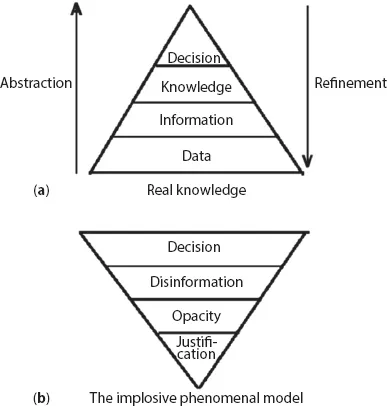
It is often said that New science is full with paradoxes. In fact, a culture that is obsessed with tangibles and myopic vision, more knowledge amounts to more uncertainties, thereby creating the paradox of ‘increasing knowledge’, thus redeeming the Orwellian ‘ignorance is bliss’ mantra. It is so deeply rooted that the ‘increasing knowledge paradox’ has become a topic of psychology (Schreiner, 2018). Those looking for an answer are then directed to productivity paradox, which apparently can be solved with productivity, arguably without creating the increasing knowledge paradox (Kijek and Kijek, 2018). This would be comical if not pathetically true that says volumes about modern-day cognition. We sought to solve the causes of all paradoxes, by seeking out the answer to this question: What is true? It turned to be a pivotal question that needed over 70 pages of to answer. That document, in the form of a white paper, became a part of every book that we have written since 2006, the time we sought the answer to this question. The usefulness of that paper was that it revealed the source of any paradox and if ‘what is true’ is properly defined with 100% logic, no paradox can arise from subsequent cognition. When it comes to economics, we pose this research question: What is the natural state of an economy? This is because if this natural state is scientifically defined, there would be no paradox. It is extremely important to come to grips with the reality that economists never defined what is natural before going off to define every natural state involving economy. It is no surprise that Economics is the one discipline that has the most number of paradoxes. One notable one is the Arrow information paradox, named after named after Nobel Laureate economists, Kenneth Arrow. Information being the prelude to knowledge, what we have effectively created is a double paradox and every information we have has become a recipe of the implosive top-down model, called the ‘aphenomenal’ model by Zatzman and Islam (Figure 1.1). It is established in this book that modern economics models are all aphenomenal and belong to Figure 1.1b, in which decisions are made based on self interest, profit margin, and myopic quarterly gains rather than going through the abstraction process (Figure 1.1a). In order to answer the research question posed, all current models are deconstructed and their spurious nature unraveled. It is after that the scientifically correct definition of natural state is shown and the truly natural state of economy is presented. The readership is thus prepared to see all energy policies and see past such paradoxes as Jevon’s paradox to have a clear picture of what economics of sustainable energy should entail. Answer to this research question is given in Chapter 2 and part of Chapter 3. In Chapter 2, a delinearized history of money/wealth is provided in order to comprehend fundamental traits of natural state. Chapter 3 then shows how modern economic theories are incapable of tracking any natural state of economy, thereby remaining irrelevant in studying overall sustainability of any economic development project.
Figure 1.1 Knowledge model vs. aphenomenal model.
1.2.2 What is the Current State of Economy?
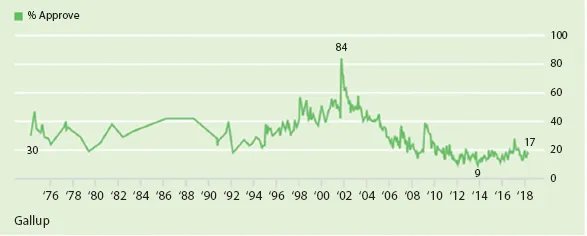
American journalist and author, Chris Hedges said, “We now live in a nation where doctors destroy health, lawyers destroy justice, universities destroy knowledge, governments destroy freedom, the press destroys information, religion destroys morals, and our banks destroy the economy.” We know for fact that there is very little confidence of general public in respective governments, who merely represent the same financial elites that control the media and the scientific community. Today, in thw U.S.A., Congress’ approval rate runs under 20% and often as long as 13%. It is also worth noting that the approval rate skyrocketed to over 80% only during the post 9/11 hype of war on terrorism, the same time the entire nation fell in unprecedented debt (Figure 1.2.). The question really becomes, what is really the true state of the economic status of the USA and the world that is led by USA.
Figure 1.2 Congressional approval rate for last 32 years (Gallup data).
The state of the economy of the mode...
Table of contents
Cover
Title page
Copyright page
Dedication
Preface
Chapter 1: Introduction
Chapter 2: Delinearized History of Economics and Energy
Chapter 3: The Incompatibility of Conventional Economic Analysis Tools with Sustainability Models
Chapter 4: State-of-the Art of Current Technology Development
Chapter 5: Comprehensive Analysis of Energy Sustainability
Chapter 6: The Islamic Track of Economical Analysis
Chapter 7: Framework of Economics of Sustainable Energy
Chapter 8: Economics of Sustainable Energy Operations
Chapter 9: Role of Government in Assuring Energy Sustainability
Chapter 10: Summary and Conclusions
Chapter 11: References and Bibliography
Index
End User License Agreement
Trusted by 375,005 students
Access to over 1.5 million titles for a fair monthly price.
Study more efficiently using our study tools.
Frequently asked questions
Yes, you can cancel anytime from the Subscription tab in your account settings on the Perlego website. Your subscription will stay active until the end of your current billing period. Learn how to cancel your subscription
No, books cannot be downloaded as external files, such as PDFs, for use outside of Perlego. However, you can download books within the Perlego app for offline reading on mobile or tablet. Learn how to download books offline
Perlego offers two plans: Essential and Complete
Essential is ideal for learners and professionals who enjoy exploring a wide range of subjects. Access the Essential Library with 800,000+ trusted titles and best-sellers across business, personal growth, and the humanities. Includes unlimited reading time and Standard Read Aloud voice.
Complete: Perfect for advanced learners and researchers needing full, unrestricted access. Unlock 1.5M+ books across hundreds of subjects, including academic and specialized titles. The Complete Plan also includes advanced features like Premium Read Aloud and Research Assistant.
Both plans are available with monthly, semester, or annual billing cycles.
We are an online textbook subscription service, where you can get access to an entire online library for less than the price of a single book per month. With over 1.5 million books across 990+ topics, we’ve got you covered! Learn about our mission
Look out for the read-aloud symbol on your next book to see if you can listen to it. The read-aloud tool reads text aloud for you, highlighting the text as it is being read. You can pause it, speed it up and slow it down. Learn more about Read Aloud
Yes! You can use the Perlego app on both iOS and Android devices to read anytime, anywhere — even offline. Perfect for commutes or when you’re on the go. Please note we cannot support devices running on iOS 13 and Android 7 or earlier. Learn more about using the app
Yes, you can access Economics of Sustainable Energy by Jaan S. Islam,M. R. Islam,Meltem Islam,M. A. H. Mughal in PDF and/or ePUB format, as well as other popular books in Scienze fisiche & Energia. We have over 1.5 million books available in our catalogue for you to explore.