The second edition of Small Animal Dental Equipment, Materials, and Techniques has been revised and updated to reflect the latest developments in veterinary dental practice.
Provides a comprehensive resource for integrating dental services into veterinary practice
Offers valuable advice on selecting dental equipment and materials
Presents clear descriptions for a range of dental terms and techniques
Includes a wealth of new images
Highlights dental information applicable to general practice
The dental operatory is the central point where patient, veterinarian, and staff come in contact with equipment, materials, instruments, and techniques necessary to diagnose, treat, and prevent dental disease (Figures 1.1 and 1.2). The challenge is to provide an efficient area for the use and storage of dental supplies, instruments, powered equipment, radiography unit(s), computer(s), suction, illumination, general anesthesia, monitoring devices, as well as a comfortable and safe place for the dental assistant(s) and practitioner(s) to treat patients. To avoid injury and aid efficiency, every effort should be made to decrease floor‐based equipment (dental delivery systems, anesthesia delivery units, dental X‐ray generators, and intravenous fluid stands).
Figure 1.1 Author's multiple station dental operatory in use.
If the practitioner has the luxury of planning the dental operatory versus retrofitting an already built area, an 8‐ft by 10‐ft area should be the minimum floor space allocated for one table. A 12‐ft by 15‐ft space is adequate space for at least two or more tables, storage, anesthesia, and a dental X‐ray unit.
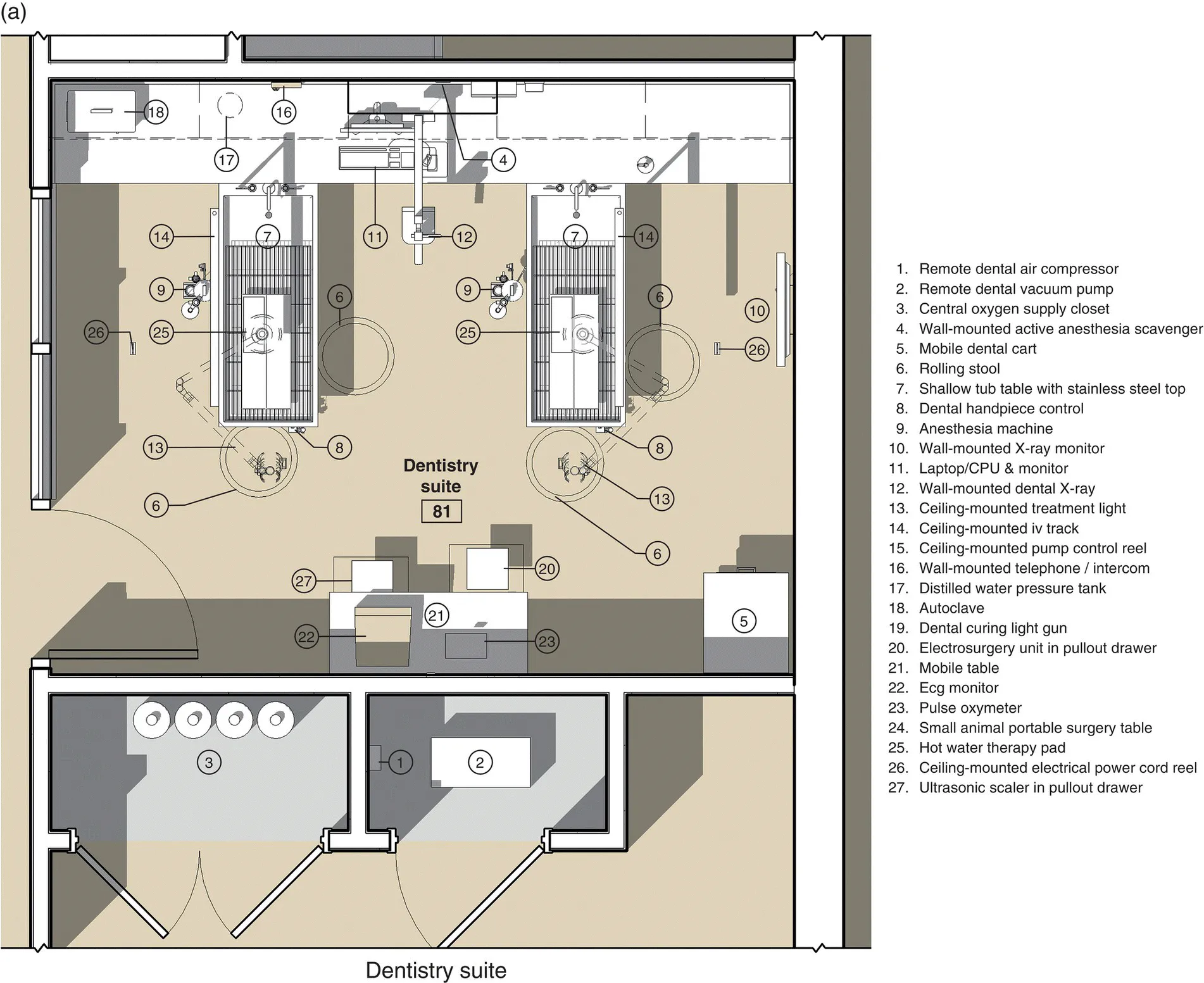
The number of operatory tables used for dentistry in a practice often is what limits the amount of dentistry that can be performed. “Dentistry” no longer is an hour or less procedure where primarily calculus (tartar) and plaque are removed from tooth crowns. The comprehensive oral prevention, assessment, and treatment (COPAT) visit includes dental scaling, polishing, irrigation, full‐mouth intraoral radiographs, and care to treat pathology uncovered during the assessment. The COPAT visit commonly takes two hours or more to complete. Ideally two or three tables should be planned – one used for patients going under anesthesia, teeth cleaning, and diagnostics, while the other one or two used for dental therapy (Figure 1.3).
Figure 1.3 (a) Two‐operatory table setup.
Source: Courtesy of Dr. Susan Crowder.
(b) Two‐operatory table setup.
Source: Courtesy of The Animal Medical Center in New York City, note all support equipment off the floor.
The dental operatory should not be located in the same room used for general surgery or surgical pack preparation to protect from contamination of the surfaces through ultrasonic aerosolization.
When a veterinarian works alone (two‐handed dentistry), considerable time is spent charting, acquiring instruments, materials, and equipment while the patient is anesthetized. Four‐handed dentistry (Figure 1.4a), which is commonly practiced in human dentistry, engages a dental assistant who helps in charting and envisages needs, handing over the instruments and materials in a timely manner. In veterinary dental practice, the patient also must be monitored while anesthetized. Six‐handed dentistry includes the practitioner, a dental assistant, and an anesthesia‐monitoring assistant, increasing the efficiency of dental procedures performed, often decreasing the anesthetic time (Figure 1.4b).
Figure 1.4 (a) Four‐handed dentistry.
Source: Courtesy of Dr. Susan Crowder.
(b) Six‐handed dentistry.
Source: Courtesy of Dr. Brook Niemeic.
Electricity, Water, and Drainage
Multiple electrical grounded 110‐V receptacles are recommended to power the delivery system, light curing unit, ultrasonic scaler, illumination source, computer and screens, monitoring equipment, and thermal control unit. Monitoring equipment may require a dedicated circuit to prevent interference from the ultrasonic scaler. Three four‐plug grounded outlets are usually sufficient for each operatory table.
Water is dispensed under pressure from the high‐speed delivery system to clear debris and prevent heat damage to surrounding tissue generated by drilling and to remove debris. A filter is recommended to decrease the sediment thereby increasing the efficiency and the life of dental handpieces. Distilled water can be used in stand‐alone units or obtained from a distiller and pumped directly into the delivery sy...
Table of contents
Cover
Table of Contents
About the Author
Foreword
Preface
Acknowledgements
1 The Dental Operatory
2 Equipment, Instruments, and Materials for Operative Dentistry
3 Oral Anatomy for the General Practitioner
4 Dental Radiography
5 Charting
6 The Comprehensive Oral Prevention, Assessment, and Treatment Visit
7 Oropharyngeal Inflammation
8 Tooth Resorption
9 Oral Trauma
10 Oral Masses
11 Occlusal Disorders, Extra Teeth, and Missing Teeth
Glossary
Index
End User License Agreement
Trusted by 375,005 students
Access to over 1.5 million titles for a fair monthly price.
Study more efficiently using our study tools.
Frequently asked questions
Yes, you can cancel anytime from the Subscription tab in your account settings on the Perlego website. Your subscription will stay active until the end of your current billing period. Learn how to cancel your subscription
No, books cannot be downloaded as external files, such as PDFs, for use outside of Perlego. However, you can download books within the Perlego app for offline reading on mobile or tablet. Learn how to download books offline
Perlego offers two plans: Essential and Complete
Essential is ideal for learners and professionals who enjoy exploring a wide range of subjects. Access the Essential Library with 800,000+ trusted titles and best-sellers across business, personal growth, and the humanities. Includes unlimited reading time and Standard Read Aloud voice.
Complete: Perfect for advanced learners and researchers needing full, unrestricted access. Unlock 1.5M+ books across hundreds of subjects, including academic and specialized titles. The Complete Plan also includes advanced features like Premium Read Aloud and Research Assistant.
Both plans are available with monthly, semester, or annual billing cycles.
We are an online textbook subscription service, where you can get access to an entire online library for less than the price of a single book per month. With over 1.5 million books across 990+ topics, we’ve got you covered! Learn about our mission
Look out for the read-aloud symbol on your next book to see if you can listen to it. The read-aloud tool reads text aloud for you, highlighting the text as it is being read. You can pause it, speed it up and slow it down. Learn more about Read Aloud
Yes! You can use the Perlego app on both iOS and Android devices to read anytime, anywhere — even offline. Perfect for commutes or when you’re on the go. Please note we cannot support devices running on iOS 13 and Android 7 or earlier. Learn more about using the app
Yes, you can access Small Animal Dental Equipment, Materials, and Techniques by Jan Bellows in PDF and/or ePUB format, as well as other popular books in Medicine & Veterinary Medicine. We have over 1.5 million books available in our catalogue for you to explore.