Kitchen and Bath Lighting
eBook - ePub

Kitchen and Bath Lighting

Concept, Design, Light

  1. English
  2. ePUB (mobile friendly)
  3. Available on iOS & Android
eBook - ePub

Kitchen and Bath Lighting

Concept, Design, Light

About this book

The industry standard illustrated guide from the National Kitchen and Bath Association

Co-published by the National Kitchen and Bath Association (NKBA), Kitchen and Bath Lighting is the go-to resource for designing, planning, and installing light in residential kitchen and bath projects. Full color illustrations throughout the book make Kitchen and Bath Lighting a visually absorbing experience. This beautiful volume begins with the basics of light, color, and vision, progressing from there through every stage of the residential lighting design process. With special attention to sustainability and lighting for older eyes, this book contains the information you need to know about the latest trends impacting the lighting industry.

Because the NKBA established the standard kitchen and bath guidelines for both new construction and remodels, Kitchen and Bath Lighting is aligned with the practices that are in high demand. This book is also an excellent choice for anyone hoping to obtain credentials as a Certified Kitchen Designer or Certified Bath Designer.

  • Comprehensive coverage of the kitchen and bath lighting process, from the fundamentals of color to design documentation to construction
  • Illustrated guidelines for using lighting tools like sources, luminaries, and controls in design development
  • Glossary and end-of-chapter exercises for quickly learning and referencing key terminology and lighting techniques
  • Companion website offering resources for instructors

This new addition to the NKBA's Professional Resource Library is an essential reference for kitchen and bath designers, lighting designers, and interior designers, as well as contractors, retrofitters, specifiers, and anyone else involved in lighting kitchens and bathrooms. Kitchen and Bath Lighting will give you the visual understanding of lighting that can lead directly to client satisfaction.
Frequently asked questions

Yes, you can cancel anytime from the Subscription tab in your account settings on the Perlego website. Your subscription will stay active until the end of your current billing period. Learn how to cancel your subscription.
No, books cannot be downloaded as external files, such as PDFs, for use outside of Perlego. However, you can download books within the Perlego app for offline reading on mobile or tablet. Learn more here.
Perlego offers two plans: Essential and Complete
  • Essential is ideal for learners and professionals who enjoy exploring a wide range of subjects. Access the Essential Library with 800,000+ trusted titles and best-sellers across business, personal growth, and the humanities. Includes unlimited reading time and Standard Read Aloud voice.
  • Complete: Perfect for advanced learners and researchers needing full, unrestricted access. Unlock 1.4M+ books across hundreds of subjects, including academic and specialized titles. The Complete Plan also includes advanced features like Premium Read Aloud and Research Assistant.
Both plans are available with monthly, semester, or annual billing cycles.
We are an online textbook subscription service, where you can get access to an entire online library for less than the price of a single book per month. With over 1 million books across 1000+ topics, we’ve got you covered! Learn more here.
Look out for the read-aloud symbol on your next book to see if you can listen to it. The read-aloud tool reads text aloud for you, highlighting the text as it is being read. You can pause it, speed it up and slow it down. Learn more here.
Yes! You can use the Perlego app on both iOS or Android devices to read anytime, anywhere — even offline. Perfect for commutes or when you’re on the go.
Please note we cannot support devices running on iOS 13 and Android 7 or earlier. Learn more about using the app.
Yes, you can access Kitchen and Bath Lighting by Dan Blitzer,Tammy Mackay in PDF and/or ePUB format, as well as other popular books in Architecture & Interior Design. We have over one million books available in our catalogue for you to explore.

Information

Publisher
Wiley
Year
2015
Print ISBN
9781118454541
eBook ISBN
9781119124566
Edition
1

1
How We See

Light, how it enables us to see, and lighting terminology together provide the necessary foundation for understanding lighting. In this chapter, we begin to consider these fundamental concepts. In subsequent chapters, we investigate lighting fundamentals in more detail.
  • Learning Objective 1: Describe the physics of light and the physiology of the eye.
  • Learning Objective 2: Explain in plain language how we see.
  • Learning Objective 3: Recognize and use key lighting terms and metrics.
  • Learning Objective 4: Distinguish between perceived and measured illumination.

PHYSICS OF LIGHT

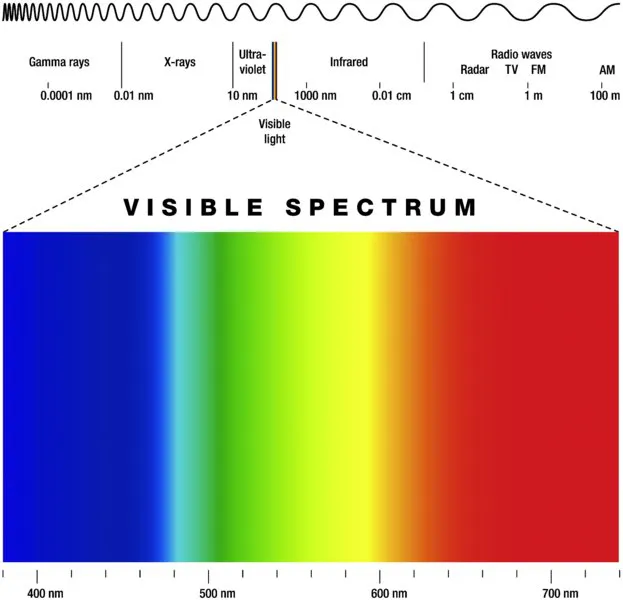
Light is the energy that enables us to see. Technically, light is part of the broad spectrum of electromagnetic energy and is defined as visually evaluated radiant energy (see Figure 1.1).
images
Figure 1.1 Light in the electromagnetic spectrum
Courtesy of Peter Hermes Furian
As you may recall from classes in physics, light exhibits the properties of both waves and particles. As a radiating wave, light can be described by its wavelength, which ranges from about 380 to 760 nanometers (billionths of a meter), the limits of human visual sensitivity. In the next chapter, we explain that describing light by its wavelength helps us to understand the interaction of light and materials. Later, when we look at light sources, we encounter the particle nature of light—especially in understanding LED technology.
A few observations:
  • Light itself is invisible. We see it only when it interacts with materials (e.g., the filament of an electric light source, fabrics, or faces). More on this important idea shortly.
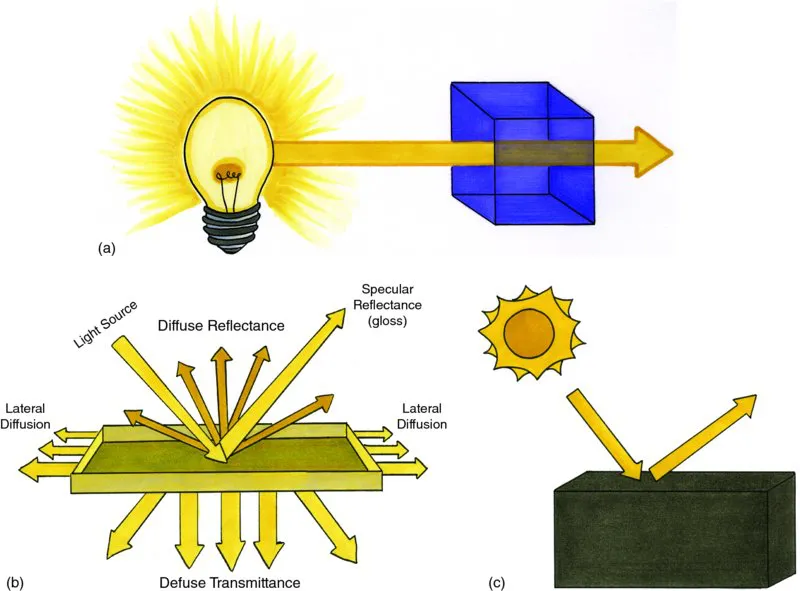
  • Light can travel through some materials.
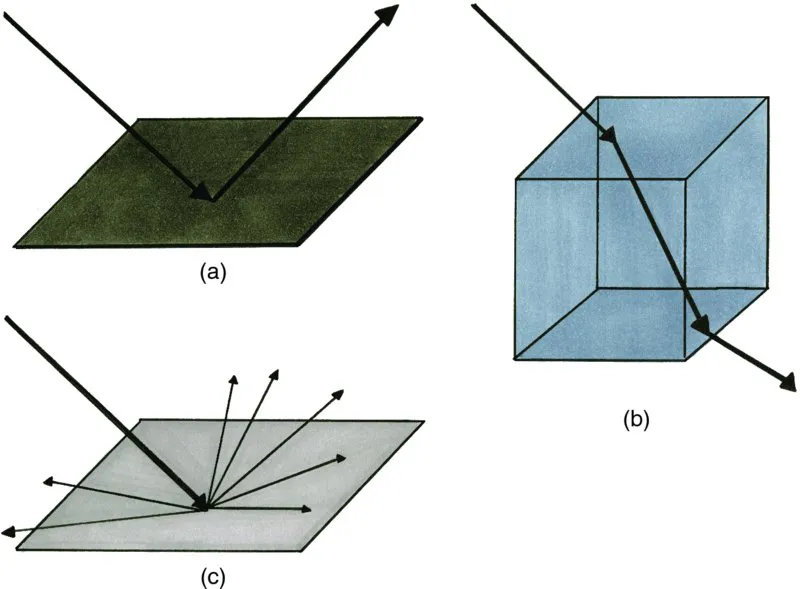
    • Transparent materials allow the passage of light without significant distortion so you can see the details of objects behind them (see Figure 1.2a).
    • Translucent materials allow light through but mix it up so that the details are obscured. (The entire object may be obscured, depending on the translucent material and the nature and location of the object.) (see Figure 1.2b).
    • Opaque materials block the passage of light altogether (see Figure 1.2c).
  • Light changes direction when it reflects off surfaces or when it passes through materials, refracting (bending) or scattering (see Figure 1.3).
  • Light that neither passes through nor reflects off materials is absorbed. Its energy becomes heat. Some light is absorbed in virtually every encounter with materials. Put your hand on the hood of a car that has been sitting in sunlight and see for yourself.
images
Figure 1.2 Transparent, translucent, opaque
images
Figure 1.3 Reflection, refraction, scattering

VISION

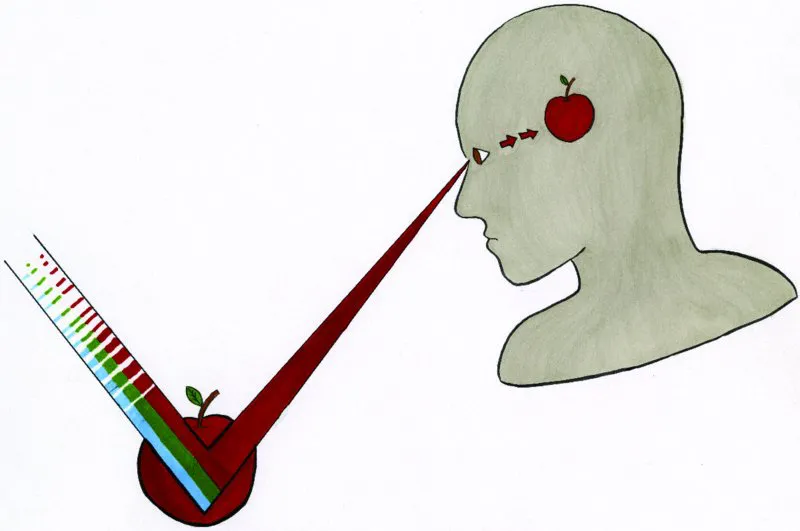
Although vision is not our oldest sense (we touch before we see), it dominates our perception. Basically, human vision is simple: Light interacts with objects; travels to, then enters, our eyes, where it is transformed into electrical signals; these signals travel neurological pathways to reach our brain, where they are interpreted into visual perception. Another way to express this basic process is by its four essential components (see Figure 1.4):
  1. Light source
  2. Object
  3. Eye
  4. Brain
images
Figure 1.4 Light source, object, eye, brain
We know a great deal about the physics of light and how it interacts with objects. We also know a great deal about the physiology of the human eye, how it receives light and creates neurological connections. We know considerably less about the complexities of how our neurological signals are combined with memory and interpretive algorithms into dynamic, three-dimensional perception.
Pause for a moment to consider the following. The signals received on the two-dimensional “screen” of our retina are fundamentally ambiguous: Is the retinal image a small object close by or a large one at a distance? Yet, apart from some notable optical illusions, we see the world unambiguously. This is only the most obvious example of our remarkable powers of visual perception. Good lighting can enhance these powers, while poorly designed lighting just makes seeing that much harder.

Contrast

Our visual system compares the incoming signals, searching for differences in light intensity and color. It does not measure or quantify them in technical photometric (light measurement) terms. Instead, the esse...

Table of contents

  1. COVER
  2. TITLE PAGE
  3. COPYRIGHT
  4. SPONSORS
  5. ABOUT THE NATIONAL KITCHEN & BATH ASSOCIATION
  6. PREFACE
  7. ACKNOWLEDGMENTS
  8. 1 HOW WE SEE
  9. 2 SEEING MATERIALS
  10. 3 SEEING THE SPACE AND EACH OTHER
  11. 4 SEEING THE WORK
  12. 5 SEEING AS WE AGE
  13. 6 SPEAKING ABOUT LIGHTING
  14. 7 SUSTAINABLE LIGHTING
  15. 8 THE IMPORTANCE OF DAYLIGHT
  16. 9 SCHEMATIC DESIGN
  17. 10 CHOOSING ELECTRIC LIGHT SOURCES
  18. 11 COMPARING ELECTRIC LIGHT SOURCES
  19. 12 LIGHT FIXTURES
  20. 13 LIGHTING CONTROLS
  21. 14 DESIGN DEVELOPMENT
  22. 15 DOCUMENTING THE LIGHTING DESIGN
  23. 16 GETTING LIGHTING BUILT
  24. GLOSSARY
  25. INDEX
  26. EULA