A comprehensive reference and teaching aid on tissue engineeringācovering everything from the basics of regenerative medicine to more advanced and forward thinking topics such as the artificial liver, bladder, and trachea
Regenerative medicine/tissue engineering is the process of replacing or regenerating human cells, tissues, or organs to restore or establish normal function. It is an incredibly progressive field of medicine that may, in the near future, help with the shortage of life-saving organs available through donation for transplantation.
Introduction to Tissue Engineering: Applications and Challenges makes tissue engineering more accessible to undergraduate and graduate students alike. It provides a systematic and logical eight-step process for tissue fabrication. Specific chapters have been dedicated to provide in-depth principles for many of the supporting and enabling technologies during the tissue fabrication process and include biomaterial development and synthesis, bioreactor design, and tissue vascularization. The tissue fabrication process is further illustrated with specific examples for liver, bladder, and trachea. Section-coverage includes an overall introduction of tissue engineering; enabling and supporting technologies; clinical applications; and case studies and future challenges.
Introduction to Tissue Engineering:
Presents medical applications of stem cells in tissue engineering
Deals with the effects of chemical stimulation (growth factors and hormones)
Covers current disease pathologies and treatment options (pacemakers, prosthesis)
Explains bioengineering, design and fabrication, and critical challenges during tissue fabrication
Offers PowerPoint slides for instructors
Features case studies and a section on future directions and challenges
As pioneering individuals look ahead to the possibility of generating entire organ systems, students may turn to this text for a comprehensive understanding and preparation for the future of regenerative medicine.
Frequently asked questions
Yes, you can cancel anytime from the Subscription tab in your account settings on the Perlego website. Your subscription will stay active until the end of your current billing period. Learn how to cancel your subscription.
At the moment all of our mobile-responsive ePub books are available to download via the app. Most of our PDFs are also available to download and we're working on making the final remaining ones downloadable now. Learn more here.
Perlego offers two plans: Essential and Complete
Essential is ideal for learners and professionals who enjoy exploring a wide range of subjects. Access the Essential Library with 800,000+ trusted titles and best-sellers across business, personal growth, and the humanities. Includes unlimited reading time and Standard Read Aloud voice.
Complete: Perfect for advanced learners and researchers needing full, unrestricted access. Unlock 1.4M+ books across hundreds of subjects, including academic and specialized titles. The Complete Plan also includes advanced features like Premium Read Aloud and Research Assistant.
Both plans are available with monthly, semester, or annual billing cycles.
We are an online textbook subscription service, where you can get access to an entire online library for less than the price of a single book per month. With over 1 million books across 1000+ topics, weāve got you covered! Learn more here.
Look out for the read-aloud symbol on your next book to see if you can listen to it. The read-aloud tool reads text aloud for you, highlighting the text as it is being read. You can pause it, speed it up and slow it down. Learn more here.
Yes! You can use the Perlego app on both iOS or Android devices to read anytime, anywhere ā even offline. Perfect for commutes or when youāre on the go. Please note we cannot support devices running on iOS 13 and Android 7 or earlier. Learn more about using the app.
Yes, you can access Introduction to Tissue Engineering by Ravi Birla in PDF and/or ePUB format, as well as other popular books in Biological Sciences & Biotechnology. We have over one million books available in our catalogue for you to explore.
After completing this chapter, students should be able to:
Provide examples of tissue and organ systems being developed using tissue engineering strategies.
Describe how tissue engineering can help solve the problem of chronic shortage of donor organs.
Discuss the tissue engineering paradigm as it applies to cardiovascular tissue engineering.
Define tissue engineering.
Describe the process of fabricating artificial tissue.
Discuss design principles related to tissue engineering.
Identify building blocks for the field of tissue engineering.
Describe scientific and technological challenges in the field of tissue engineering.
Describe strategies for the functional assessment of 3D artificial tissue.
Discuss seminal papers in the field of tissue engineering.
Describe potential applications for 3D artificial tissue.
Explain the relative advantages of 3D culture over 2D monolayer culture.
Describe the collaborative model for tissue engineering research.
Discuss the growth in the field of tissue engineering.
Discuss the participation rate from different disciplines in tissue engineering.
Explain the differences between tissue engineering and other related fields.
Chapter Overview
We begin this chapter by providing a broad overview of tissue engineering research and providing examples of tissue and organ systems that are currently under development using tissue engineering strategies. We next describe the chronic shortage of donor organs and provide a vision of how tissue engineering can help alleviate this problem. In the next section, we describe the tissue engineering paradigm and how it applies to the cardiovascular system. We then provide a formal definition of tissue engineering and describe the process to bioengineer 3-dimensional artificial tissue. In the next section, we describe the design principles related to tissue engineering and identify fundamental building blocks in the field. We then discuss some of the scientific and technological challenges in the field of tissue engineering. Next, we describe strategies for functional assessment of 3D artificial tissue and describe functional, biological and histological metrics. We next discuss seminal publications in the field of tissue engineering and the contribution of these toward the development of the field. We then move on to discuss potential applications of 3D bioengineered artificial tissue. Tissue engineering is a multidisciplinary field, and in the next section, we discuss the multidisciplinary nature of the field and how researchers from many different backgrounds work together. The next section is focused on the growth of tissue engineering as a scientific discipline and some of the drivers of this growth. We end this chapter by providing a description of scientific disciplines that are closely related to tissue engineering.
1.1 Introduction to Tissue Engineering
We begin our discussion of tissue engineering with a broad overview of the fieldāwhat exactly is tissue engineering and why is it important? While in the next section, we provide a formal definition of tissue engineering, we begin this discussion with a general overview of the field. Research in the field of tissue engineering is focused on the fabrication of artificial tissue and organs. The statement of purpose defined for tissue engineering (fabrication of artificial tissue and organs) is very challenging with numerous scientific and technological challenges, many of which we will discuss during the course of this book. However, the important concept to grasp is the simple notion that tissue engineering is equivalent to tissue and organ fabrication, a recurring theme throughout this book.
We have seen that tissue engineering refers to the fabrication of artificial tissue and organ systems; however, this statement requires further clarification. Artificial organ development using mechanical components is a mature field of research with mechanical hearts and left ventricular assist devices being used in patients. The field of tissue engineering should be differentiated from this area of research, as the objective of tissue engineering is to fabricate biological artificial organs that are similar in form and function to mammalian organs. Cells and biomaterials (which simulate mammalian extracellular matrix) are important components of artificial organs fabricated using tissue engineering strategies.
What is the long-term objective of tissue engineering research? The overarching theme in tissue engineering is artificial tissue and organ development. The potential application of artificial organs is obvious: transplantation in patients with damaged or diseased organs. There is a chronic shortage of donor organs, as the number of waitlisted patients is significantly greater than the number of donor organs available. Tissue engineering has the potential to alleviate this problem by fabricating artificial organs that can be used clinically.
Let us continue our discussion on tissue engineering by looking at some areas where active research is being conducted in the fabrication of artificial tissue and organs. Tissue engineering research has expanded significantly in the last decade with active research programs across the country and worldwide encompassing many different tissue and organ systems. There has been significant interest in cardiovascular tissue engineering, with research devoted to the fabrication of artificial heart muscle, blood vessels, valves, cell based cardiac pumps, ventricles, and entire bioartificial hearts. Another active area of research has been in the musculoskeletal system, encompassing fabrication of bone, cartilage, skeletal muscle, and tendons. A significant amount of research has been invested in tissue engineering of the urinary system, which consists of kidneys, urinary bladder, ureters, and urethras. Tissue engineering of the airway system has focused on fabrication of artificial tracheas and artificial lung tissue. The digestive system has been a very active area of tissue engineering research focused on the development of artificial liver tissue, pancreas, intestine tissue, and esophageal tissue. In addition, there is significant interest in the development of artificial skin and tissue engineering strategies for the central nervous system.
1.2 Chronic Shortage of Donor Organs
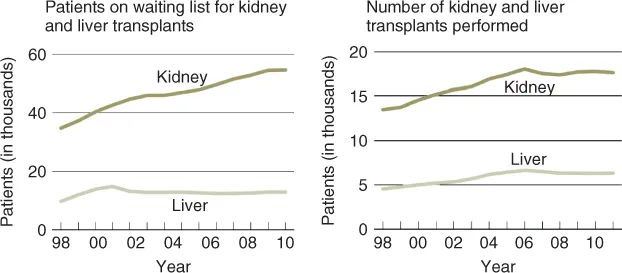
There is a chronic shortage of donor organs available for transplantation. This can be illustrated by the case of kidney and liver transplantation (Figure 1.1). As can be seen in the figure, the number of patients on the waiting list is significantly greater than the number of donor organs available (1). This chronic shortage of donor organs is evident in other organ systems as well, and highlights the urgency to develop novel strategies to address this problem. The ability to fabricate artificial organs in the laboratory using tissue engineering strategies can alleviate some of the problems associated with chronic shortage of donor organs. Rather than having a patient on a waiting list for a donor organ, the promise of tissue engineering is that artificial organs can be fabricated under controlled conditions in the laboratory and used for transplantation. This strategy can provide life-saving options for millions of patients around the globe. This is the grand vision of tissue engineeringāfabrication of artificial organs that can provide life-saving options for patients around the world.
Figure 1.1Donor Organ Shortage in the USāThere is a chronic shortage of donor organs. The number of patients waitlisted for kidney and liver transplants is significantly higher than the number of donor organs available. 1
1.3 The Tissue Engineering Paradigm
In this section, we introduce the tissue engineering paradigm using the cardiovascular system as an example. There are several conditions that can compromise the function of the heart, including acute myocardial failure, atherosclerosis, valve stenosis or hyperplastic left heart syndrome. Several strategies, including pharmacological agents, mechanical devices like pumps, and surgical interventions like heart transplantation, have been developed to help patients with cardiovascular disorders. Undoubtedly, these strategies have helped numerous people and saved many lives. However, heart transplantation is plagued by the chronic shortage of donor hearts, and many of the other treatment strategies also have limitations. The ability to bioengineer artificial hearts and components of the cardiovascular system can provide an alternative treatment modality for many patients; this can lead to an improvement in the quality of life and can also save the lives of many patients.
The field of cardiovascular tissue engineering is focused on the fabrication of artificial heart muscle, blood vessels, tri-leaflet heart valves, cell based cardiac pumps, tissue-engineered ventricles and bioartificial hearts (2). Artificial tissues and organs related to the cardiovascular system can be used in a variety of ways to help patients with cardiovascular disorders. For example, heart muscle can be used to provide functional support to the left ventricle of compromised hearts, thereby assisting in cardiac function. As another example, bioartificial hearts can be used as transplantable organs for patients with end-stage heart failure, thereby providing a life-saving option for many patients across the globe.
The purpose of the discussion presented in this section was to illustrate the tissue engineering paradigm using the cardiovascular system as an example. As we have seen, tissue engineering strategies can be applied toward the fabrication of artificial hearts and components of the cardiovascular system that can be used to repair, replace or augment the functional performance of comprised hearts. This is the fundamental premise of tissue engineeringāfabrication of artificial tissue and organs that can be used clinically to help patients by providing functional recovery of diseased or d...