eBook - ePub

About this book

Describes the basics of ROS metabolism in plants and examines the broad range of ROS signaling mechanisms

New discoveries about the effects of reactive oxygen species (ROS) on plants have turned ROS from being considered a bane into a boon, because their roles have been discovered in many plant developmental processes as signaling molecules. This comprehensive book teaches about the role of ROS metabolism in plants and how they affect various developmental processes. It also discusses in detail the advancements made in understanding the ROS signaling.

Reactive Oxygen Species in Plants: Boon Or Bane - Revisiting the Role of ROS begins by presenting the basic introduction to ROS and deciphers the detailed knowledge in ROS research. It then examines the broad range of ROS signaling mechanisms as well as how they may be beneficial for plants and human beings. This book also describes both the bane and boon aspects of ROS with their impact on plants, and how the recent revelations have compelled us to rethink ROS turning from stressors to plant regulators.

? Compiles, for the first time, the wholesome knowledge in ROS research and their cellular signaling

? Includes new discoveries and in-depth discussions about the advancements made in the field

? Discusses reactive oxygen species which are involved in a broad range of biological processes

Reactive Oxygen Species in Plants: Boon Or Bane - Revisiting the Role of ROS will help scientists to utilize the functions of ROS signaling for plants and also enable readers to gain a deeper knowledge of ROS research and signaling. It is highly recommended for researchers, scientists, and academicians in plant science as well for advanced undergraduate and postgraduate students.

Frequently asked questions

Yes, you can cancel anytime from the Subscription tab in your account settings on the Perlego website. Your subscription will stay active until the end of your current billing period. Learn how to cancel your subscription.
No, books cannot be downloaded as external files, such as PDFs, for use outside of Perlego. However, you can download books within the Perlego app for offline reading on mobile or tablet. Learn more here.
Perlego offers two plans: Essential and Complete
  • Essential is ideal for learners and professionals who enjoy exploring a wide range of subjects. Access the Essential Library with 800,000+ trusted titles and best-sellers across business, personal growth, and the humanities. Includes unlimited reading time and Standard Read Aloud voice.
  • Complete: Perfect for advanced learners and researchers needing full, unrestricted access. Unlock 1.4M+ books across hundreds of subjects, including academic and specialized titles. The Complete Plan also includes advanced features like Premium Read Aloud and Research Assistant.
Both plans are available with monthly, semester, or annual billing cycles.
We are an online textbook subscription service, where you can get access to an entire online library for less than the price of a single book per month. With over 1 million books across 1000+ topics, we’ve got you covered! Learn more here.
Look out for the read-aloud symbol on your next book to see if you can listen to it. The read-aloud tool reads text aloud for you, highlighting the text as it is being read. You can pause it, speed it up and slow it down. Learn more here.
Yes! You can use the Perlego app on both iOS or Android devices to read anytime, anywhere — even offline. Perfect for commutes or when you’re on the go.
Please note we cannot support devices running on iOS 13 and Android 7 or earlier. Learn more about using the app.
Yes, you can access Reactive Oxygen Species in Plants by Vijay Pratap Singh, Samiksha Singh, Durgesh K. Tripathi, Sheo Mohan Prasad, Devendra Kumar Chauhan, Dr. Vijay Pratap Singh,Dr. Samiksha Singh,Dr. Durgesh Kumar Tripathi,Dr. Sheo Mohan Prasad,Dr. Devendra K. Chauhan, Vijay Pratap Singh, Samiksha Singh, Durgesh Kumar Tripathi, Sheo Mohan Prasad, Devendra K. Chauhan in PDF and/or ePUB format, as well as other popular books in Biological Sciences & Biology. We have over one million books available in our catalogue for you to explore.

Information

Publisher
Wiley
Year
2017
Print ISBN
9781119287292
eBook ISBN
9781119324942

1
Generation Mechanisms of Reactive Oxygen Species in the Plant Cell: An Overview

Santwana Tiwari, Sanjesh Tiwari, Madhulika Singh, Anita Singh, and Sheo Mohan Prasad
Ranjan Plant Physiology and Biochemistry Lab., Department of Botany, University of Allahabad, Allahabad, India

Introduction

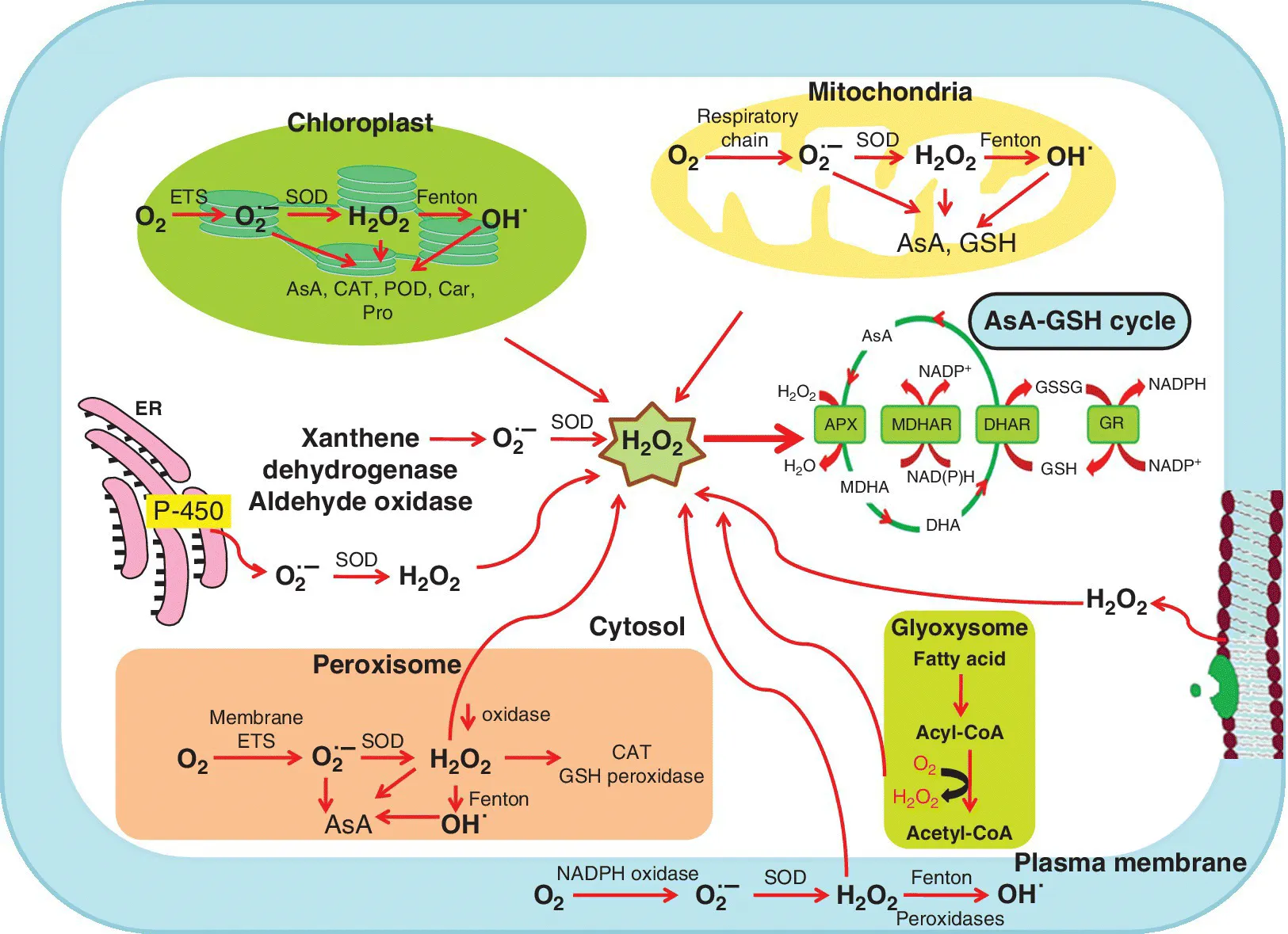
During the course of evolution, life on the Earth started in a reducing environment and about 3.2 billion years ago, the reducing environment changed to an oxidizing one due to the appearance and proliferation of the first oxygen‐evolving photosynthetic organisms, that is, cyanobacteria (Schopf et al., 2007). In other words, the cyanobacteria are considered to be the first organisms to release oxygen in the environment by means of an oxygen evolving complex (OEC) (Bekker et al., 2004). The outermost orbital of the dioxygen (O2) molecule has two unpaired electrons having same spin quantum number, and this enables O2 to accept electrons one at a time efficiently, and generate the reactive oxygen species (ROS). Out of the total O2 utilized by plants, 1% is diverted to produce ROS in various cell organelles (del Rio et al., 2002). Reactive oxygen species are essential by‐products of all aerobic organisms that are produced during normal metabolic processes as well as under stress conditions. The ROS‐producing subcellular organelles are mainly mitochondria, chloroplasts, peroxisomes, cytosol, and plasma membrane (Corpas et al., 2015; Hasan et al., 2016) (Figure 1.1). The roles of ROS are contradictory, they may have negative as well as positive roles depending upon their concentrations in the particular cell organelles. At higher concentrations, ROS cause damaging effects on proteins, DNA/RNA, and lipids by oxidative modification in plant cells (Gill and Tuteja, 2010; Hasan et al., 2016). On the other hand, previous evidence clearly showed that at lower concentrations ROS act as signaling molecules in plants for regulating developmental pathways and control of redox homeostasis and defense responses against pathogens and environmental stress (Wood et al., 2003; Apel and Hirt, 2004). There are well‐described mechanisms in prokaryotes where the concentration of ROS directly activates transcription factors that overexpress the genes to combat oxidative stress (Kiley and Storz, 2004). There are several ROS, such as superoxide radical (
images
), hydroxyl radical (·OH), hydroperoxyl radical (HO2·), hydrogen peroxide (H2O2), alkoxy radical (RO·), peroxy radical (ROO·), singlet oxygen (1O2), and excited carbonyl (RO*), all of which are cytotoxic to plants at elevated concentrations (Dismukes et al., 2001; Karuppanapandian et al., 2011). In the cell organelles accumulation of superoxide enhances oxidative stress rather than playing a role in redox signaling. However, in some cases it damages certain proteins that activate specific signaling pathways and consequently leads to death of the particular cell (Chen et al., 2009). Hydrogen peroxide (H2O2) acts as a signaling molecule that diffuses across membranes and triggers specific signal transduction pathways (Veal and Day, 2011). The balance between production and elimination of ROS is dependent upon various biotic and abiotic factors such as temperature, heavy metal concentration, drought, salinity, UV radiation, light, nutrient deficiency, and excessive use of pesticides and/or herbicides as well as pathogen attacks. This disturbance ultimately leads to increased concentration of ROS in particular cell organelles. The damaging effects of ROS are ameliorated by different antioxidative defense systems. The antioxidant system consists of enzymatic antioxidants, namely superoxide dismutase (SOD), peroxidase (POD), catalase (CAT), and glutathione S‐transferase (GST), ascorbate peroxidase (APX) and non‐enzymatic antioxidants, including non‐protein thiols (NP‐SH) ascorbate, tocopherol, caretenoid and cysteine. These act together as a machine to detoxify ROS (Kumar et al., 2015; Singh et al., 2016; Tripathi et al., 2012a,b, 2016a,b) (see Figure 1.1). Among these, SOD is considered as first line of defense; it dismutates the superoxide and subsequently H2O2 is generated. Further, H2O2 detoxification involves different enzyme systems in distinct cellular compartments. The peroxidase family includes ascorbate peroxidase (APX), glutathione peroxidase (GPX), and peroxidase (POD) for the elimination of H2O2. Another enzyme, CAT, is important in the removal of H2O2 generated in peroxisomes. GPX also reduces H2O2 as well as organic and lipid hydroperoxides by using glutathione (GSH) as substrate. Among the various H2O2‐detoxifying enzymes, APX plays the most essential role in scavenging ROS. APX is present in thylakoid, glyoxisome, chloroplast stroma, and cytosol, and is involved in the scavenging of H2O2 through water‐water and ascorbate‐glutathione (AsA‐GSH) cycles, utilizing AsA as the electron donor. One of the antioxidant enzymes, GST, participates in herbicide detoxification, hormone homeostasis, and regulation of apoptosis and also is involved in plant responses to biotic and abiotic stresses. Non‐enzymatic antioxidants include the major cellular redox buffers ascorbate and glutathione, as well as tocopherol, flavonoids, alkaloids, and carotenoids.
Image described by caption.
Figure 1.1 Schematic representation of major sites involved in reactive oxygen species (ROS) production and different scavenging mechanisms in plant cells. Abiotic and biotic stresses cause generation of toxic reactive oxygen species (ROS) such as the superoxide radical (
images
), singlet oxygen (1O2), hydrogen peroxide (H2O2), and hydroxyl radical (·OH). These interact with several essential macromolecules and metabolites causing cellular damage. Moreover, the process of formation of ROS due to the spilling of electrons (e) from chloroplasts (ETS or Mehler’s reaction), mitochondria (ETS involved in respiratory chain), peroxisomes (ETS involved in photorespiration) and plasma membranes (ETS); these electrons are taken up by molecular O2 and quickly converted into superoxide radical (SOR). SOR produced during stress conditions is detoxified by superoxide dismutase (SOD) activity, leading to formation of H2O2. Detoxification mechanisms involve enzymatic as well non‐enzymatic antioxidants to mitigate ROS‐induced damage in plants. The ascorbate–glutathione (AsA–GSH) cycle plays an important role in H2O2 breakdown. H2O2 is reduced to H2O with the help of ascorbate peroxidase (APX) using ascorbate (AsA) as the specific electron donor. APX is present in different organelles such as chloroplast (chlAPX), mitochondria (mitAPX), peroxisome (mAPX), and cytosol (cAPX). It protects plants from oxidative damage by delivering the electrons as well as minimizing ex...

Table of contents

  1. Cover
  2. Title Page
  3. Table of Contents
  4. List of Contributors
  5. 1 Generation Mechanisms of Reactive Oxygen Species in the Plant Cell: An Overview
  6. 2 Abiotic Stress, Generation of Reactive Oxygen Species, and Their Consequences: An Overview
  7. 3 Balancing Roles of Reactive Oxygen Species in Plants’ Response to Metalloid Exposure
  8. 4 Role of Reactive Oxygen Species in Magnetoprimed Induced Acceleration of Germination and Early Growth Characteristics of seeds
  9. 5 Reactive Oxygen Species: Generation, Damage, and Quenching in Plants During Stress
  10. 6 Effects of Reactive Oxygen Species on Crop Productivity: an Overview
  11. 7 Reactive Oxygen Species and Photosynthetic Functioning: past and present
  12. 8 Reactive Oxygen Species and Response of the Calvin–Benson Cycle: an Overview
  13. 9 Role of Reactive Oxygen Species in Photophosphorylation and Damage to D1 Protein: Past and Present
  14. 10 Reactive Oxygen Species and Antioxidants: A Continuous Scuffle within the Cell
  15. 11 Quenching of Reactive Oxygen Species Inside the Cell: Physiological, Biochemical, and Molecular Mechanisms
  16. 12 Adjustment of Plant Metabolism Against Reactive Oxygen Species: Past and Present
  17. 13 The Regulation of Plant Development: Cross‐talk of Reactive Oxygen Species and Plant Hormones
  18. 14 Cross‐talk of Reactive Oxygen Species and Nitric Oxide in Various Processes of Plant Development: Past and Present
  19. 15 Reactive Oxygen Species Signaling and Seed Germination: An Overview
  20. 16 Reactive Oxygen Species Signaling and Root Hair Development
  21. 17 Role of Reactive Oxygen Species Signaling in Cell Proliferation and Differentiation: An Overview
  22. Index
  23. End User License Agreement