Revamp your life to grow, evolve, and become who you want to be
Lifestorming is the indispensably practical handbook for becoming the person you want to be. Redesign your life, friends, behaviors, and beliefs to move closer to your goals every single day, guided by expert insight and deep introspection. Written by a veteran author team behind almost 100 books on human behavior, this guide helps you learn why you do things the way you do them, and how to do them better. The Lifestorming Test allows you to assess your current state in concrete terms, and assess your ability to change and adapt — from there, it's about identifying people, actions, habits, and beliefs that either support your personal and professional growth or hold you back. You'll learn the six building blocks of character, challenge your belief system, develop a leadership mindset, and overcome the fear and guilt of success. You'll map out an action plan, and learn how to continually move forward at work, at home, and in everyday life.
We often don't realize how much of our natural default is established by others. Whose goals are you working toward? Are you measuring your progress with the correct yardstick? This book shows you how to take a step back and compare your life today with the future you want — and build a plan for changing track toward constant evolution and growth.
Assess your current state and your capacity for change
Develop the right goals and the right metrics to create the future you want
Learn how character evolves, and why it's essential to growth
Change your habits and behaviors to consistently grow and evolve
We all carry around old baggage, obsolete "friendships", and counterproductive beliefs — and every day, they pull us a little further away from what we really want. Lifestorming is your real-world guide to shedding the stagnation, and allowing yourself to grow into the person you want to become.
Our natural human tendency is to think of ourselves as independent and authentic—authors of our own destinies. But that's a tall order and much tougher than it seems. Bombarded by external triggers and expectations, we can easily fall into roles and patterns established for us by other people.
Why can it be so hard to resist when someone assigns us a role and expects us to live out this role? I find it fascinating to watch this play out among professional role-players—actors. Some actors are true chameleons, morphing from one part to the next. Others seem to believe they are who they depict, developing attitudes and behaviors consistent with the characters they've played. Marlon Brando was famous for staying in role even when the cameras weren't on. William Shatner often seemed to be Captain James Kirk from Star Trek—even when not on the Starship Enterprise. Remember the famous ads, still parodied today—“I'm not a doctor, though I play one on television”—in which the actor proceeded—attired in white medical coat—to dispense health information? He was convincing because he began to believe in his own authority.
We often unconsciously become programmed to believe we are someone and then proceed to live our lives trying to fill that role. However, it's often the wrong role: not right for us, and sometimes even harmful.
For years people told me I should become a lawyer. In grammar school and high school I was told I argued well and debated effectively. At Rutgers, I majored in political science, a natural precursor to law school. I did well enough on the LSAT (Law School Admission Test) to earn a full scholarship to Rutgers Law.
There was only one problem. Over that summer, I realized I didn't want to be a lawyer. I never had dreams of working in criminal defense, or as a prosecutor, or settling estates, or refereeing divorces, or working for an organization's legal department. These are great aspirations—but they just weren't mine. I had different dreams, which initially didn't please those who wanted a legal career for me. My parents, who never had money, viewed law as a distinguished and high-earning profession. My teachers wanted it for me too. When I visited the dean of admissions to tell her to give the scholarship to someone else, she actually reached across the desk to try to grab my wrist! Thankfully, I didn't give into that pressure, and today I have a career I love.
A great many people follow their parents into a profession, even when they don't feel any passion for it themselves. A friend of mine followed his father into dentistry, believing it was a good way to make money in the medical field without becoming a physician. Although being a dentist is a great career for many professionals, it was not for him. Too late, he realized he essentially disliked pushing a high-speed drill an eighth of an inch from patients' tongues day in and day out. But by then his practice was paying for private school tuitions, his own educational debt, and all the trappings of an upper middle-class life. Trying another career at his age would have come at a tremendous cost. This conundrum isn't unique to dentistry, of course. Numerous professions represent a well-trodden path that is easier to follow than to leave.
This pattern can be also be influenced by siblings. Brothers and sisters are highly influenced by their sibs, and tend to play the same sports, or become cheerleaders, or join the band (and play the same instrument)—or do just the opposite to escape the comparisons. These are roles that have been established as successful, drawing praise from others, and creating a precedent to follow or from which to flee.
Thus, unseen by the naked eye, we, without thinking about it, may do our best to become the person we were programmed to be rather than the person who, in our hearts, we want to be!
Case Study
I was coaching the former vice chair of a large financial institution. He loved helping people and wanted to be a consultant after his mandatory retirement. His face lit up when he discussed the possibility of being an advisor to other executives.
Surprisingly, he seemed very curious when I asked him if he would be interested if another vice chair position became available. He asked me if I knew about such a position, how much it paid, and the size of the organization.
When I reminded him of his previous discussion about being a consultant, he immediately changed course, thanked me, and mentioned that he had become so used to focusing on money and status that he had temporarily forgotten that he was already rich and wanted to spend the rest of this life doing what he most valued.
Some very prestigious jobs are actually a poor fit when you consider the applicant's true aspirations. Retiring executives or admirals might be flattered by offers of a college presidency, for example, something others might ooh and ah at. They may have a vision of a job that allows them to serve as the public face of a venerable institution, leading great discourse and inspiring younger generations. The actual work of a college president, however, may involve sparring with tenured faculty, negotiating the demands of students, and meeting stringent fund-raising goals. Anyone who takes a job like that just because of the title and honorifics is likely to feel disappointed and betrayed. If a different person took the same job with a clear goal of improving higher education, though, she might find the role incredibly fulfilling.
An Evolutionary Journey
We're talking about taking an evolutionary journey through life. A journey without a “there.” Gertrude Stein coined the epithet “There is no there, there” when speaking of Oakland, California. But we mean exactly that. Your “there” is constantly migrating (we'll discuss metamorphosis and change in Chapter 3).
The evolving you is not a moving target, but pursues a moving target.
Milepost
Be careful that your “there” is not created by someone else or some external force, such as Facebook. Your “there” can, and often should, be constantly moving as your experiences, successes, and perspective change. Our bar may well become higher and higher as we journey through life.
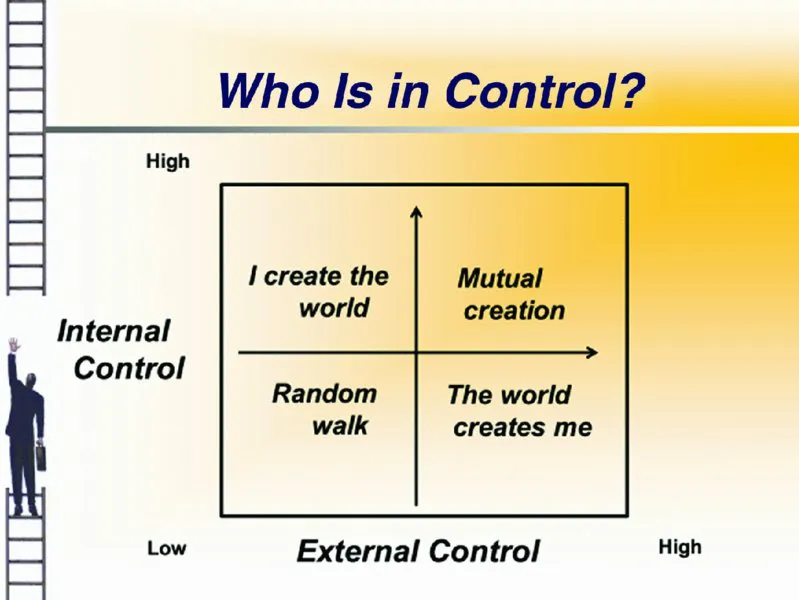
An initial question becomes: To what extent is your journey one of internal control, and to what extent one of external control? Do social and normative pressures have a legitimate role in who you are to become? Figure 1.1 illustrates these relationships.
Figure 1.1 Relationship of Internal and External Control
We're using the following definitions:
Control: The power to influence or direct.
Internal: The power that is believed by the performers to be theirs; within their purview.
External: The power that is believed by the performers to be wielded by others or by random events.
When we believe that both internal and external control are low (lower left), we're merely taking a random walk. (A more graphic manner to describe this quadrant is chaos: complete disorder and confusion.) I'm reminded of the classic story of the drunk accosted by the bartender and told to get out, who replies, “I didn't walk in here and I'm not leaving.”
Many people arise each day simply awaiting what occurs, without the intention of exerting themselves on the world. We see this in circumstances where external direction has been removed advertently or inadvertently (the leader of a group suddenly dies, or is delayed in arriving, or is having a bad day) and no one chooses to step forward into the vacuum. People mill about or drift away. Nothing productive occurs. This is much rarer among entrepreneurs, who realize (and are gratified) that they must make their own plans work, must achieve their own aspirations.
When internal control is seen as high and external control as low (upper left) there is the belief that “I create the world.” When carried to an extreme this can lead to narcissism and imperiousness, as well as to a false belief in one's abilities (and to being seen by others as the proverbial empty suit, or in Texas as “big hat, no cattle”).
Another version of this belief is illustrated by the classic motivational speech in which the speaker exhorts the audience to overcome fears simply by telling themselves they can or by emulating some deeply dramatic challenge that the speaker has overcome and wrestled to the ground.
One of the funniest examples of the weakness of belie...
Table of contents
Cover
Title Page
Copyright
Introduction
1: Setting Our Own Aspirations
2: The Importance of New Friends
3: Behavioral Metamorphosis
4: Believe It or Not
5: The Importance and Evolution of Character
6: Critical Abandonment (Knowing When to Hold and When to Fold)
7: The New You
8: Sustaining the Journey
9: Self-Mastery: The Lifestorming Field Guide to Your Successful Journey
Index
EULA
Trusted by 375,005 students
Access to over 1.5 million titles for a fair monthly price.
Study more efficiently using our study tools.
Frequently asked questions
Yes, you can cancel anytime from the Subscription tab in your account settings on the Perlego website. Your subscription will stay active until the end of your current billing period. Learn how to cancel your subscription
No, books cannot be downloaded as external files, such as PDFs, for use outside of Perlego. However, you can download books within the Perlego app for offline reading on mobile or tablet. Learn how to download books offline
Perlego offers two plans: Essential and Complete
Essential is ideal for learners and professionals who enjoy exploring a wide range of subjects. Access the Essential Library with 800,000+ trusted titles and best-sellers across business, personal growth, and the humanities. Includes unlimited reading time and Standard Read Aloud voice.
Complete: Perfect for advanced learners and researchers needing full, unrestricted access. Unlock 1.5M+ books across hundreds of subjects, including academic and specialized titles. The Complete Plan also includes advanced features like Premium Read Aloud and Research Assistant.
Both plans are available with monthly, semester, or annual billing cycles.
We are an online textbook subscription service, where you can get access to an entire online library for less than the price of a single book per month. With over 1.5 million books across 990+ topics, we’ve got you covered! Learn about our mission
Look out for the read-aloud symbol on your next book to see if you can listen to it. The read-aloud tool reads text aloud for you, highlighting the text as it is being read. You can pause it, speed it up and slow it down. Learn more about Read Aloud
Yes! You can use the Perlego app on both iOS and Android devices to read anytime, anywhere — even offline. Perfect for commutes or when you’re on the go. Please note we cannot support devices running on iOS 13 and Android 7 or earlier. Learn more about using the app
Yes, you can access Lifestorming by Alan Weiss,Marshall Goldsmith in PDF and/or ePUB format, as well as other popular books in Personal Development & Decision Making. We have over 1.5 million books available in our catalogue for you to explore.