A solid collection of interdisciplinary review articles on the latest developments in adhesion science and adhesives technology
With the ever-increasing amount of research being published, it is a Herculean task to be fully conversant with the latest research developments in any field, and the arena of adhesion and adhesives is no exception. Thus, topical review articles provide an alternate and very efficient way to stay abreast of the state-of-the-art in many subjects representing the field of adhesion science and adhesives.
Based on the success of the preceding volumes in this series "Progress in Adhesion and Adhesives"), the present volume comprises 12 review articles published in Volume 5 (2017) of Reviews of Adhesion and Adhesives.
The subject of these 12 reviews fall into the following general areas:
1. Nanoparticles in reinforced polymeric composites.
2. Wettability behavior and its modification, including superhydrophobic surfaces.
3. Ways to promote adhesion, including rubber adhesion.
4. Adhesives and adhesive joints
5. Dental adhesion.
The topics covered include: Nanoparticles as interphase modifiers in fiber reinforced polymeric composites; fabrication of micro/nano patterns on polymeric substrates to control wettability behavior; plasma processing of aluminum alloys to promote adhesion; UV-curing of adhesives; functionally graded adhesively bonded joints; adhesion between unvulgarized elastomers; electrowetting for digital microfluidics; control of biofilm at the tooth-restoration bonding interface; easy-to-clean superhydrophobic coatings; cyanoacrylates; promotion of resin-dentin bond longevity in adhesive dentistry; and effects of nanoparticles on nanocomposites Mode I and Mode II fractures.
Nanoparticles dispersed in fiber reinforced polymeric composites can improve many of their mechanical properties or impart to them additional electrical, thermal or magnetic properties. Such composites have found use in many applications as structural components, sensors, conductors, etc., and their study is an active area of research. Incorporating nanoparticles into the fiber-matrix interphase, i.e., the thin (≈ 0.1 – 1 μm) region between the fiber surface and the bulk matrix, can improve fiber-matrix adhesion by roughening the fiber surface, thus enhancing the mechanical interlock between the matrix and the fiber, or can result in a graded modulus from that of the stiff fiber to the bulk resin, often resulting in improved stress transfer and toughness. Many different methods to incorporate nanoparticles at or near fiber surfaces have been developed and implemented, each with its own advantages and disadvantages. In this review, three main methods for creating nanoparticle filled fiber-matrix interphases are discussed: growth of structured interphases from fiber surfaces, deposition of interphases onto fiber surfaces, and finally, formation of self-assembled interphases.
The inclusion of particulate fillers in polymeric media can result in composite materials with drastically different mechanical, thermal, electronic, magnetic, optical and chemical properties. In neat polymeric resins the dispersion state of the particulate fillers is of critical importance, and a poor dispersion can lead to reduced mechanical properties in the final product. To this end many strategies have been employed to precisely control the spatial arrangement and dispersion state of particulate fillers embedded in polymeric media [1–6]. Silane coupling agents are commonly used, for example, to improve particle dispersion by improving the chemical compatibility between the particles and the polymeric matrix [7–9]. Other surface treatments, such as adsorbing surfactants or grafting polymers to filler surfaces can be useful in keeping 2D materials, such as clays or graphene, intercalated and well dispersed [10, 11]. In other scenarios, such as with electrically conductive composites, percolated networks of conducting nanofillers, such as silver nanoparticles or carbon nanotubes (CNTs), are desired and particle-particle contacts are required to achieve the desired properties. Many techniques exist for controlling the spatial distribution of nanoparticles in bulk polymers or in thin films of polymeric material and many morphologies can be achieved [12–16].
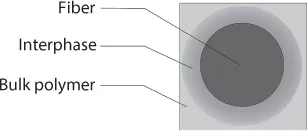
In fiber reinforced polymeric composites (FRPCs) the fiber-matrix interphase, i.e., a region extending approximately 0.1–1 μm into the bulk matrix from the fiber surface (see Figure 1.1), can determine many of the mechanical properties of the composite [17, 18]. The carbon-fiber epoxy interface, in particular is plagued by relatively weak adhesion often limiting the mechanical properties of their structural composites [19, 20]. Many methods have been employed to alter the interphase properties including chemical modification of the fiber surface [21–25], utilizing advanced fiber sizing packages [20, 26–30], and more recently by including nanoparticles into the interphase by various methods.
Figure 1.1 Schematic of the fiber-matrix interphase showing the bulk fiber in the center, surrounded by a region extending from the fiber surface to the bulk polymer referred to as the interphase. The polymer in the interphase region typically exhibits different mechanical properties compared to the bulk polymer, and this region is typically considered to be on the order of 0.1–1 μm.
Nanoparticles have been shown to improve the interfacial properties through a number of mechanisms. Firstly, nanoparticles can improve the mechanical interlock between the fibers and the matrix by adding additional surface roughness [31]. In addition, nanoparticle reinforced interphases can improve the stress transfer by grading the modulus from the stiff fiber reinforcement to the softer polymer matrix [32, 33]. Many types of nanoparticles have successfully been used as interphase modifiers including metal oxide particles [34–44], polymeric particles [45–47], CNTs [48–55], as well as graphitic structures and their oxides [33, 56–58].
Aside from improving mechanical properties such as the modulus, interfacial shear strength and toughness of the resulting FRPC, the incorporation of nanoparticles can impart additional functionality to the composite. Carbon fibers (CFs) decorated with an electrically percolated network of CNTs have been used as strain gauges for microcrack detection [52, 59], and electromagnetic shielding [60]. ZnO nanowire arrays grown from fiber surfaces have demonstrated piezoelectric properties resulting in composites with energy harvesting or dampening properties [40, 61, 62]. Depending on the type of reinforcing material and the morphology of the resulting interphase layer many other unique properties can be imparted to the final composite material.
In this review three main strategies for preparing FRPCs with reinforced interphases are discussed in detail. The first strategy is to grow structured interphases directly from the fiber surface using seeded growth techniques, graft polymerization, chemical vapor deposition (CVD), or electroless plating methods. The adhesion between the fiber surface and the grown interphase is often poor, and can lead to reduced mechanical properties unless the fiber surface is pretreated to improve the compatibility with the grown material. The properties of the resulting composites also depend on the morphology and density of the grown interphase, which is largely controllable by tuning the reaction conditions. Another strategy for modifying FRPC interphases is to deposit nanomaterials onto a fiber surface, which can be accomplished through electro-deposition, the use of advanced sizing packages, or covalent particle attachment. Lastly, the self-assembly of nanoparticle-rich interphases from an initially homogeneous thermosetting resin mixture using so-called “migrating agents” is discussed, and other possible methods to prepare self-assembled interphases such as phase-separation and polymer mediated depletion interaction are proposed.
1.2 Grown Interphases from Fiber Surfaces
1.2.1 Introduction
Seeded growth techniques and other aqueous solution processing techniques can be used to grow nanoscale features from fiber surfaces such as nanowhiskers (NWs) or other high aspect ratio materials. CVD is the most commonly used technique to grow single-walled carbon nanotubes (SWCNTs) on a variety of fiber surfaces including carbon [60, 63–66], glass [67], and ceramic [68] fibers. Multi-walled carbon nanotubes (MWCNTs) have also successfully been grown from fiber surfaces via a similar seeded growth technique [60], at much milder growth conditions than are required for SWCNTs. Aqueous solution processing is commonly employed to grow metal oxide NWs such as ZnO [36, 61, 62, 69–72], α-FeOOH [73], MnO2 [74] from a variety of fiber surfaces. Grown interphases are often used to improve the adhesion between the reinforcing fiber and the bulk matrix and the quality of the interphase is critically important in determining the ultimate mechanical properties of the resulting composite. Fibers with grown interphases have also been successfully used to prepare composites with applications in chemical sensing [73], EMI shielding [60], and energy harvesting [61, 62].
Growing interphases from fiber surfaces typically requires several processing steps, including removal of adsorbed processing aids or sizings from the fibers, deposition and annealing of nanoparticle seeds or precursors onto fibers, and finally the subsequent growth of the interphase. For example, SWCNTs are typically grown from catalytic Ni seeds via CVD at temperatures ranging from 700-1200 °C, while MWCNTs can be grown at more moderate temperatures around 550 °C [60]. CFs exposed to these relatively harsh reaction conditions can thermally degrade, leading to a reduction in the modulus and tensile strength (TS) of the bare fibers. Any grown interfacial layer must, therefore, overcome any decreases associated ...
Table of contents
Cover
Title page
Copyright page
Preface
Chapter 1: Nanoparticles as Interphase Modifiers in Fiber Reinforced Polymeric Composites: A Critical Review
Chapter 2: Fabrication of Micro/Nano Patterns on Polymeric Substrates Using Laser Ablation Methods to Control Wettability Behaviour: A Critical Review
Chapter 3: Plasma Processing of Aluminum Alloys to Promote Adhesion: A Critical Review
Chapter 4: UV-Curing of Adhesives: A Critical Review
Chapter 5: Stress and Failure Analyses of Functionally Graded Adhesively Bonded Joints of Laminated FRP Composite Plates and Tubes: A Critical Review
Chapter 6: Adhesion Between Unvulcanized Elastomers: A Critical Review
Chapter 7: Dielectrowetting for Digital Microfluidics: Principle and Application. A Critical Review
Chapter 8: Control of Biofilm at the Tooth-Restoration Bonding Interface: A Question for Antibacterial Monomers? A Critical Review
Chapter 9: Easy-to-Clean Superhydrophobic Coatings Based on Sol-Gel Technology: A Critical Review
Chapter 10: Cyanoacrylates: Towards High Temperature Resistant Instant Adhesives. A Critical Review
Chapter 11: Strategies to Inactivate the Endogenous Dentin Proteases to Promote Resin-Dentin Bond Longevity in Adhesive Dentistry: A Critical Review
Chapter 12: Effects of Nanoparticles on Nanocomposites Mode I and II Fracture: A Critical Review
End User License Agreement
Trusted by 375,005 students
Access to over 1.5 million titles for a fair monthly price.
Study more efficiently using our study tools.
Frequently asked questions
Yes, you can cancel anytime from the Subscription tab in your account settings on the Perlego website. Your subscription will stay active until the end of your current billing period. Learn how to cancel your subscription
No, books cannot be downloaded as external files, such as PDFs, for use outside of Perlego. However, you can download books within the Perlego app for offline reading on mobile or tablet. Learn how to download books offline
Perlego offers two plans: Essential and Complete
Essential is ideal for learners and professionals who enjoy exploring a wide range of subjects. Access the Essential Library with 800,000+ trusted titles and best-sellers across business, personal growth, and the humanities. Includes unlimited reading time and Standard Read Aloud voice.
Complete: Perfect for advanced learners and researchers needing full, unrestricted access. Unlock 1.5M+ books across hundreds of subjects, including academic and specialized titles. The Complete Plan also includes advanced features like Premium Read Aloud and Research Assistant.
Both plans are available with monthly, semester, or annual billing cycles.
We are an online textbook subscription service, where you can get access to an entire online library for less than the price of a single book per month. With over 1.5 million books across 990+ topics, we’ve got you covered! Learn about our mission
Look out for the read-aloud symbol on your next book to see if you can listen to it. The read-aloud tool reads text aloud for you, highlighting the text as it is being read. You can pause it, speed it up and slow it down. Learn more about Read Aloud
Yes! You can use the Perlego app on both iOS and Android devices to read anytime, anywhere — even offline. Perfect for commutes or when you’re on the go. Please note we cannot support devices running on iOS 13 and Android 7 or earlier. Learn more about using the app
Yes, you can access Progress in Adhesion and Adhesives, Volume 3 by K. L. Mittal in PDF and/or ePUB format, as well as other popular books in Technology & Engineering & Materials Science. We have over 1.5 million books available in our catalogue for you to explore.