Do your most important work when you are your most resourceful
Are you drowning in email? Overloaded with calendar invitations? Frustrated by wasteful meetings and an ever-growing workload? Then you know that being busy does not mean being productive. Most workers are being asked to take on more responsibilities with less support, advised to simply 'be innovative.' But you only have a finite amount of energy and thinking capacity available to you in a day. Most of us are wasting it on things that aren't contributing to our most important work: the activities that require problem solving, decision making and critical thinking.
Developed for business professionals, The First Two Hours teaches you how to design your day, rather than be at the mercy of it. Using research on neuroscience, energy flow and the body's natural rhythms, it divides the workday into manageable blocks and helps you determine when you are most resourceful, and therefore when you should complete your most demanding tasks.
Optimize your day in blocks of two hours
Take back control of your work life by creating a workflow designed for you
Do your most important work at the right time of day so it gets the resources it deserves
Decide when you need to be 'on' and when you can be 'available' so you can maximise productivity
In a time of near-constant information overload, this practical handbook helps you focus on getting done what you need to get done, when you are best able to do it. By learning to invest your energy strategically, you can be in the driver's seat every work day and achieve a level of productivity beyond what you thought possible. The First 2 Hours is the second book in Donna McGeorge's It's About Time series. With The 25-Minute Meeting, you'll learn to give your meetings purpose and stop them wasting your time; with The First 2 Hours, you'll find the best time of the day to do your most productive work; and with The 1-Day Refund, you'll discover how to give yourself the extra capacity to think, breathe, live and work.
Many of our productivity problems come about because we are operating on autopilot. We don’t think about what, when or even why we are doing things; we just do them in the order in which the tasks came to us, or how they’re written on our to-do list.
Just like the default settings of a computer program, our brain also has ingrained settings that it operates with: if I’m hungry, I eat; if I’m afraid, I run. These settings are designed to keep us alive.
Yet some of our less instinctive settings have been developed over years of learning, repetition and reward: in the morning, I check my email; in the afternoon, I hold our department meeting.
It can be very difficult to change settings that feel like they are hardwired. It takes understanding, discipline and practice. But you can do it.
More importantly, there is good reason to do it!
Even though you may be programmed to do things at a certain time because of habit, you are doing yourself a disservice.
When you learn how your body clock works, then you start to understand that there are optimal times for better brain performance at work. This means you can schedule the types of tasks you do to make the best use of your most productive time.
It starts with the first two hours of your day, and continues every two hours after that.
Read on to find out why there are good, better and best times of the day to do particular things, and how you can reprogram yourself to take advantage of that.
Chapter 1 Discover what affects your capacity (and your day)
So how do you currently spend the first two hours of your day?
Go on and think about it now.
I bet the first thing you do (like most of us) is open your email and see what pops up. Then, before you know it, it’s 1 pm and you’re still responding to emails or reacting to requests.
NEWSFLASH! You are letting email dictate your day.
Right now, you’re wasting your energy and your most productive time on email, instead of on the real work you have to do.
Whether you are conscious of it or not, those emails you have read, replied to or filed create distractions for the rest of the day and make you unproductive. You have given up control of your effectiveness.
Don’t worry — this book is not about being anti-email. After all, that’s the way most of us communicate at work. What I am saying is that there’s a time and a place for everything.
You need to start consciously thinking about the types of tasks you do throughout the day, when you do those tasks and whether you are making the best use of your most valuable time.
Why it’s about when
There are good scientific reasons as to why we need to pay attention to when we do specific things at work.
A lot of this can be explained by jet lag.
When we travel across different time zones, we mess with our body’s natural rhythms, known as circadian rhythms.
This is what creates feelings of fatigue and disorientation, and often results in insomnia at 3 am. Shiftworkers, who don’t work a typical nine-to-five day, may also experience this quite frequently.
It’s when we mess with our body’s natural rhythm that we begin to have problems.
That’s why we need to do our most important work when our body — and brain — is most awake, alert and ready for action.
For most of us, our most productive time will be first thing in the morning. Then by the afternoon our body and brain will be ready to switch to some routine tasks.
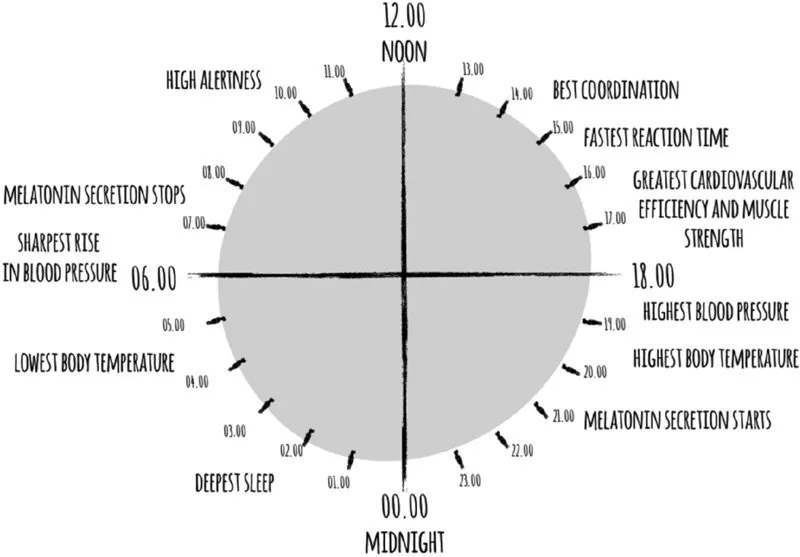
This is best explained by figure 1.1 (overleaf), which is based on the work (likely done in the morning) of Michael Smolensky and Lynne Lambert, published in their book The Body Clock Guide to Better Health. It shows a typical circadian rhythm.
Figure 1.1: typical body clock
Adapted from The Body Clock Guide to Better Health by Michael Smolensky and Lynne Lamberg
As you can see, for the majority of us our peak alertness is at 10 am and our best coordination is at around 2.30 pm.
Tasks that require attention and focus are best done in the morning, and repetitive tasks that require coordination are best done in the afternoon.
So again, let’s pause and consider the way you currently work in a typical day.
How does that match up?
If you are like most, you rush through your day from one crisis to another, answering as many emails as you can in the gaps between pointless meetings. It’s likely that when you get home from work, you will spend the evening inhaling coffee to stay awake, catching up on correspondence, preparing presentations for the next day, and getting work done at a time when your body wants to slow down and rest.
You’re stuck in a vicious cycle, and it’s doing you more harm than good.
Just like what happens with jet lag, if you continue to mess with your natural rhythms you will begin to interrupt your routine sleep habits. This is why it’s hard to switch off at night.
We need to pay more attention to the clock in our bodies than the clock on the wall.
I can’t decide!
Ever noticed that as the day wears on, your patience (and fuse) in meetings or discussions becomes shorter and more erratic?
If you look at the body clock in figure 1.1, then you’ll see why.
At 3 pm when you’ve been asked to decide between option A or option B — something that could cost the company millions if you’re wrong — you’ve probably sighed and said something like, ‘Let’s just go with option A and move on.’
When you le...
Table of contents
Cover
Titlepage
About the author
Acknowledgements
Introduction
How to use this book
Part I Why the first 2 hours?
Part II How to Make the Most of Your First 2 Hours
Your First 2 Hours clock
Work with me
Sources
Index
Eula
Trusted by 375,005 students
Access to over 1.5 million titles for a fair monthly price.
Study more efficiently using our study tools.
Frequently asked questions
Yes, you can cancel anytime from the Subscription tab in your account settings on the Perlego website. Your subscription will stay active until the end of your current billing period. Learn how to cancel your subscription
No, books cannot be downloaded as external files, such as PDFs, for use outside of Perlego. However, you can download books within the Perlego app for offline reading on mobile or tablet. Learn how to download books offline
Perlego offers two plans: Essential and Complete
Essential is ideal for learners and professionals who enjoy exploring a wide range of subjects. Access the Essential Library with 800,000+ trusted titles and best-sellers across business, personal growth, and the humanities. Includes unlimited reading time and Standard Read Aloud voice.
Complete: Perfect for advanced learners and researchers needing full, unrestricted access. Unlock 1.5M+ books across hundreds of subjects, including academic and specialized titles. The Complete Plan also includes advanced features like Premium Read Aloud and Research Assistant.
Both plans are available with monthly, semester, or annual billing cycles.
We are an online textbook subscription service, where you can get access to an entire online library for less than the price of a single book per month. With over 1.5 million books across 990+ topics, we’ve got you covered! Learn about our mission
Look out for the read-aloud symbol on your next book to see if you can listen to it. The read-aloud tool reads text aloud for you, highlighting the text as it is being read. You can pause it, speed it up and slow it down. Learn more about Read Aloud
Yes! You can use the Perlego app on both iOS and Android devices to read anytime, anywhere — even offline. Perfect for commutes or when you’re on the go. Please note we cannot support devices running on iOS 13 and Android 7 or earlier. Learn more about using the app
Yes, you can access The First 2 Hours by Donna McGeorge in PDF and/or ePUB format, as well as other popular books in Business & Business Skills. We have over 1.5 million books available in our catalogue for you to explore.