Provides an in-depth coverage of TV White Space Technology (TVWS) and the various challenges of its new innovations
This book covers the full spectrum of TVWS technology including regulations, technology, standardizations, and worldwide deployments. It begins with an introduction to cognitive radio and TVWS. The regulation activities in TVWS throughout North America, Europe, and Asia Pacific are covered in depth. After a discussion of regulations, the authors examine the standardizations developed to specify the enabling technologies of TVWS systems. The following chapter focuses on the key technologies that differentiate TVWS from a conventional wireless communication system.
Describes various worldwide use cases and deployments based on the needs of the consumers
Covers IEEE 802.19.1, IEEE 802.22, IEEE 802.11af, IEEE 802.15.4m, and IETF protocol for Accessing White Spaces
Studies the market and commercial potential of TVWS and other spectrum sharing technologies
Discusses technological trends in spectrum sharing and additional applications that could leverage on TVWS and other spectrum sharing technologies
TV White Space: The First Step Towards Better Utilization of Frequency Spectrum is written for telecommunications/networks operators, researchers, engineers, government regulators, technical managers, and network equipment manufacturers.
Chapter 1 Introduction to Cognitive Radio and Television White Space
Are wireless communication systems smart?
Wireless communication is a key enabler for smart systems such as smart cities, autonomous ports, and so on. However, are the current wireless communication systems themselves smart? This book looks at some initial aspects of smartness in wireless communication that could pave the way for future smarter wireless communication systems.
In the past decades, the demands for wireless communications grew exponentially. There is no sign of slowing down; instead, the growth seemed to be accelerating. Besides traditional television and audio broadcasting, today wireless communications are used everywhere from public cellular phone systems to enterprise wireless networks, as well as specialized systems in railway, maritime, and aviation transports, medical electronics, remote sensing, emergency services, security surveillance, military, radio astronomy, satellite, and so on.
Due to the emergence of Internet of Things (IoT), wireless applications are rapidly expanding into machine-to-machine (M2M) connections. All these applications make extensive use of the frequency spectrum. Many of such applications are bandwidth hungry. To cater for the growth of various new services, many countries all over the world have crafted their national broadband plans to address future communication needs with the aim to stimulate economic growth by providing better information infrastructure. Among the broadband alternatives, wireless is one of the most important items in these plans.
Unfortunately, spectrum is a scarce resource. While technologies are improving to squeeze more data into each frequency channel, policy makers still face stiff challenges in addressing the needs of everybody since the demand (in bandwidth) outpaced that of supply. For services that require dedicated channels, for example, cellular, it becomes harder and harder for regulators to clear up a chunk of frequency bands for these services. For example, the regulators worldwide find it hard to fully harmonize the spectrum for the fourth generation (4G) Long Term Evolution (LTE) networks since different countries have different fragments of spectrum left for such assignment. This issue is becoming more and more prominent as can be seen in the proposals toward the fifth generation (5G) networks where there is simply no common frequency spectrum available.
On the other hand, regulators also assigned some frequency spectrum as unlicensed bands such as the industrial, scientific, and medical radio bands (ISM). In these unlicensed bands, different wireless systems share the same spectrum resource and coexist by adopting politeness protocols. Wireless systems that use unlicensed bands, such as Wi-Fi, Bluetooth, ZigBee, and so on, are becoming more and more attractive since they have better spectrum utilization rate and there is no charge in spectrum usage.
One might ask why not the regulators assign all spectrums to be unlicensed? This book attempts to shed some light on the various considerations for spectrum usage.
In this chapter, we look at the various aspects of the spectrum, including their utilizations (Section 1.1), the future needs (Section 1.3), and why do we need more agile and dynamic spectrum access technologies (Sections 1.4 and 1.5).
Taxonomy
In this book, readers will see terms such as spectrum, frequency, band, channel, bandwidth, data rates, and so on appearing quite frequently. In some instances, they may be used interchangeably. In other cases, they refer to slightly different phenomena. In order to help the readers understand the differences, we use another natural resource, that is, land, as analogy.
Spectrum
Land
Frequency
Different types of lands, hilly, flat, forest, wetland, and so on
Band
Division of land for different usage, for example, parks, housing, roads, and so on
Channel
Marking of land so that rules could be followed more easily, for example, lane markings on roads
Bandwidth
Using the road as an example, this will be how wide the lane is being marked, for example, lanes for cars on highway are much wider than lanes for motorcycles
Data rates
If you view different vehicles as data packets, this is how fast the vehicles can flow through the road
1.1 Spectrum Survey
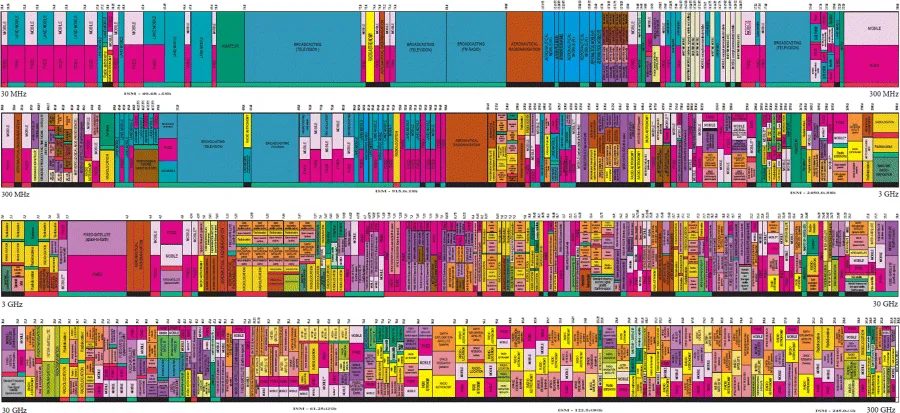
Let us take a look at the current spectrum utilization. Figure 1.1 shows the frequency allocations from 30 MHz to 300 GHz in the United States. It can be seen that the spectrum in this frequency range has been fully assigned.
Figure 1.1 A typical frequency allocation from 30 MHz to 300 GHz. (The chart was produced by the U.S. Department of Commerce, National Telecommunications and Information Administration, Office of Spectrum Management, January 2016.) (From Ref. [1]. Public domain.)
On the other hand, if we take a look at the spectrum utilization of the assigned frequencies in Table 1.1, which is the spectrum occupancy measurement at Green Band, West Virginia, we will be surprised that the utilization rate of the assigned frequencies is so low, and the average spectrum use is just 1% from 30 MHz to 2.7 GHz. There is a similar measurement report shown in Figure 1.2, where we can see that the spectrum efficiency is about 6.5% from 30 MHz to 7 GHz in Singapore. This implies that there are plenty of rooms for improvement. Spectrum is a natural and finite resource that all wireless communications rely on. Only if we continuously increase the spectrum utilization can the growth of wireless communications be sustainable.
Table 1.1 Summary of Spectrum Occupancy in Green Bank, West Virginia [2]
Start Frequency (MHz)
Bandwidth (MHz)
Spectrum Band Allocation
NRAO Spectrum Fraction Used
NRAO Occupied Spectrum (MHz)
Average % Occupied
30
24
PLM, Amateur, others
0.00045
0.01
0.0
54
34
TV 2–6, RC
0.11056
3.76
11.1
108
30
Air Traffic Control, Aero Nav
0.15485
4.65
15.5
138
36
Fixed Mobile, Amateur, others
0.02745
0.99
2.7
174
42
TV 7–13
0.00220
0.09
0.2
216
9
Maritime Mobile, Amateur, others
0.00556
0.05
0.6
225
181
Fixed Mobile, Aero, others
0.01842
3.33
1.8
406
64
Amateur, Radio Geolocation, Fixed, Mobile, Radiolocation
0.00379
0.24
0.4
470
42
TV 14–20
0.00379
0.16
0.4
512
96
TV 21–36
0.04283
4.11
4.3
608
90
TV 37–51
0.00156
0.14
0.2
698
108
TV 52–69
0.00113
0.12
0.1
806
96
Cell phone and SMR
0.00017
0.02
0.0
902
26
Unlicensed
0.00004
0.00
0.0
928
32
Paging, SMS, Fixed, BX Aux, and FMS
0.02459
0.79
2.5
960
280
IFF, TACAN, Global Positioning System (GPS), others
0.00000
0.00
0.0
1240
60
Amateur
0.00012
0.01
0.0
1300
100
Aero Radar, military
0.00000
0.00
0.0
1400
125
Space/Satellite, Fixed Mobile, Telemetry
0.00000
0.00
0.0
1525
185
Mobile Satellite, GPS L1, Mobile Satellite, Meteorological
0.00082
0.15
0.1
1710
140
Fixed, Fixed Mobile
0.00000
0.00
0.0
1850
140
PCS, Asyn, Iso
0.00001
0.00
0.0
1990
120
TV Aux
0.00009
0.01
0.0
2110
90
Common Carriers, Private Companies, MDS
0.00353
0.32
0.4
2200
100
Space Opera...
Table of contents
Cover
Series Page
Title Page
Copyright
Preface
Abbreviations
Chapter 1: Introduction to Cognitive Radio and Television White Space
Chapter 2: Regulations
Chapter 3: Standardizations
Chapter 4: TVWS Technology
Chapter 5: Worldwide Deployment
Chapter 6: Commercial and Market Potential
Chapter 7: Future Development
Appendix A: Dynamic Spectrum Alliance Model White Spaces Rules
Appendix B: Performance of SEA
Appendix C: Self-Positioning Based on DVB-T2 Signals
Appendix D: Algorithm for Dynamic Spectrum Assignment
Appendix E: Calculation for Area-Based WSDB
Appendix F: Embedded Broadcast WSDB
Appendix G: Revenue Maximization of WSDB-Q
Index
The Comsoc Guides to Communications Technologies
End User License Agreement
Trusted by 375,005 students
Access to over 1.5 million titles for a fair monthly price.
Study more efficiently using our study tools.
Frequently asked questions
Yes, you can cancel anytime from the Subscription tab in your account settings on the Perlego website. Your subscription will stay active until the end of your current billing period. Learn how to cancel your subscription
No, books cannot be downloaded as external files, such as PDFs, for use outside of Perlego. However, you can download books within the Perlego app for offline reading on mobile or tablet. Learn how to download books offline
Perlego offers two plans: Essential and Complete
Essential is ideal for learners and professionals who enjoy exploring a wide range of subjects. Access the Essential Library with 800,000+ trusted titles and best-sellers across business, personal growth, and the humanities. Includes unlimited reading time and Standard Read Aloud voice.
Complete: Perfect for advanced learners and researchers needing full, unrestricted access. Unlock 1.5M+ books across hundreds of subjects, including academic and specialized titles. The Complete Plan also includes advanced features like Premium Read Aloud and Research Assistant.
Both plans are available with monthly, semester, or annual billing cycles.
We are an online textbook subscription service, where you can get access to an entire online library for less than the price of a single book per month. With over 1.5 million books across 990+ topics, we’ve got you covered! Learn about our mission
Look out for the read-aloud symbol on your next book to see if you can listen to it. The read-aloud tool reads text aloud for you, highlighting the text as it is being read. You can pause it, speed it up and slow it down. Learn more about Read Aloud
Yes! You can use the Perlego app on both iOS and Android devices to read anytime, anywhere — even offline. Perfect for commutes or when you’re on the go. Please note we cannot support devices running on iOS 13 and Android 7 or earlier. Learn more about using the app
Yes, you can access TV White Space by Ser Wah Oh,Yugang Ma,Ming-Hung Tao,Edward Peh, Nim K. Cheung in PDF and/or ePUB format, as well as other popular books in Tecnologia e ingegneria & Comunicazioni mobili e wireless. We have over 1.5 million books available in our catalogue for you to explore.