Developmental Neuropathology
  1. English
  2. ePUB (mobile friendly)
  3. Available on iOS & Android
eBook - ePub

About this book

A definitive, clinically oriented guide to the pathology of genetics of developmental neuropathology

Developmental neuropathology relates to the wide range of disorders affecting the developing brain or pre- and post-natal life, with emphasis on the genetic and molecular mechanisms involved. This book provides a practical guide to diagnosing and understanding these disorders affecting this vulnerable population and potentially stimulates further advances in this exciting area. It also addresses the controversies in inflicted head injury in infants.

The fourth major title to be approved by the International Society of Neuropathology (ISN), Developmental Neuropathology offers in-depth chapter coverage of brain development; chromosomal changes; malformations; secondary malformations and destructive pathologies; developmental vascular disorders; acquired metabolic and exogenous toxins; metabolic disorders; Rett syndrome and autism; and infectious diseases. The text provides:

  • Clinical, disease-oriented approach to the pathology and genetics developmental neuropathology
  • Fuses classical and contemporary investigative approaches
  • Includes genetic and molecular biological pathogeneses
  • Fully illustrated
  • Approved and endorsed by International Society of Neuropathology

Developmental Neuropathology is the perfect book for practicing neuropathologists, pediatric pathologists, general pathologists, neurologists, and geneticists in deciphering the pathology and pathogenesis of these complex disorders affecting the nervous system of the embryo, fetus, and child.
Frequently asked questions

Yes, you can cancel anytime from the Subscription tab in your account settings on the Perlego website. Your subscription will stay active until the end of your current billing period. Learn how to cancel your subscription.
No, books cannot be downloaded as external files, such as PDFs, for use outside of Perlego. However, you can download books within the Perlego app for offline reading on mobile or tablet. Learn more here.
Perlego offers two plans: Essential and Complete
  • Essential is ideal for learners and professionals who enjoy exploring a wide range of subjects. Access the Essential Library with 800,000+ trusted titles and best-sellers across business, personal growth, and the humanities. Includes unlimited reading time and Standard Read Aloud voice.
  • Complete: Perfect for advanced learners and researchers needing full, unrestricted access. Unlock 1.4M+ books across hundreds of subjects, including academic and specialized titles. The Complete Plan also includes advanced features like Premium Read Aloud and Research Assistant.
Both plans are available with monthly, semester, or annual billing cycles.
We are an online textbook subscription service, where you can get access to an entire online library for less than the price of a single book per month. With over 1 million books across 1000+ topics, we’ve got you covered! Learn more here.
Look out for the read-aloud symbol on your next book to see if you can listen to it. The read-aloud tool reads text aloud for you, highlighting the text as it is being read. You can pause it, speed it up and slow it down. Learn more here.
Yes! You can use the Perlego app on both iOS or Android devices to read anytime, anywhere — even offline. Perfect for commutes or when you’re on the go.
Please note we cannot support devices running on iOS 13 and Android 7 or earlier. Learn more about using the app.
Yes, you can access Developmental Neuropathology by Homa Adle-Biassette, Brian N. Harding, Jeffrey A. Golden, Homa Adle-Biassette,Brian N. Harding,Jeffrey A. Golden, Francoise Gray,Katy Keohane in PDF and/or ePUB format, as well as other popular books in Medicine & Neurology. We have over one million books available in our catalogue for you to explore.

Information

Year
2018
Print ISBN
9781119013082
eBook ISBN
9781119013105
Edition
2
Subtopic
Neurology

1
Central Nervous System Manifestations of Chromosomal Change

Joseph R. Siebert
Department of Laboratories, Seattle Children's Hospital and Departments of Pathology and Pediatrics, University of Washington, Seattle, WA, USA

Introduction

A wide variety of morphologic and functional abnormalities have been identified in the central nervous systems (CNS) of patients with chromosomal defects. These are reviewed for the more commonly encountered karyotypes, with emphasis given to those aberrations in chromosome number (e.g., trisomy, monosomy) or chromosome morphology (i.e., large deletions and duplications) that affect the CNS. Disorders associated with mosaicism, lesser chromosomal changes (including translocations), or single gene mutations are not included.
Chromosomal changes are encountered in early pregnancy loss, but their true incidence is hard to determine. A commonly used estimate is 50%. Alterations like trisomy 16 (estimated to occur in 1% of all conceptuses) are unlikely to come to the attention of neuropathologists because of early fetal demise. The prevalence of chromosomal defects is summarized for common CNS anomalies in Table 1.1. Because of genetic mechanisms (e.g., incomplete penetrance and variable expressivity) and other factors, phenotypes do not always correlate precisely with specific karyotypes. For this reason, the tables in this chapter are limited to general summaries.
Table 1.1 Prevalence of chromosomal abnormalities in common central nervous system (CNS) anomalies.
CNS anomaly Estimated Prevalence of Abnormal Karyotype (%) Predominant Karyotypic Abnormality Reference
Anencephaly 9 Variable, including trisomy 13, 18, and triploidy 26
Holoprosencephaly 50 Trisomy 13, 18 27
Dandy-Walker malformation 45–55 Trisomy 9, 13, 18, 21; triploidy; del(6p) 28
Complete vermian agenesis 32 28
Inferior vermian agenesis 53 28
Chiari malformation Occasional Trisomy 13, 18 26
Microcephaly/micrencephaly Frequent Trisomy 9, 13, 18, 21; sex chromosome trisomy or monosomy 26
Isolated ventriculomegaly 12 Trisomy 21; 47XXY 29
Agenesis of corpus callosum 18 Trisomy 8, 13, 18; del(11q) 26,30
Spina bifida/myelomeningocele 17 Trisomy 13, 18; triploidy 31
Coloboma Often unspecified; 10% in 1993 study Trisomy 13, 18; triploidy; 5p-; 4p- 32
Micro-/anophthalmia 25+ Trisomy 13 33

The craniofacial complex

While this chapter is oriented toward the description of changes in the CNS, the cranium can scarcely be ignored. The embryogenesis of brain and cranium proceeds in tandem and anomalies of one structure are almost always reflected by changes in the other.
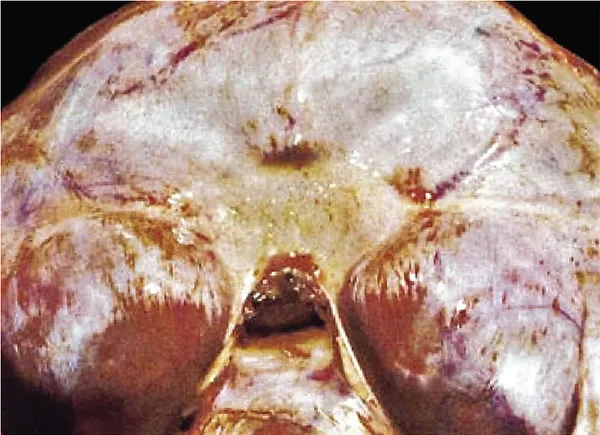
The pathologist whose study of the CNS is hampered by severe autolysis, commonplace in stillbirth, or delivery by dilatation and evacuation, does well to examine the cranium to get clues to CNS pathology [1]. Two examples are anencephaly and holoprosencephaly. In the former, the cranial base is markedly flattened, much of the calvaria is absent, and sphenoidal anomalies are common. In specimens altered by holoprosencephaly, the anterior cranial fossa is flattened, cribriform plates are small, obscured, or absent, the crista galli is reduced in size or absent, and the anterior falx cerebri is absent or hypoplastic (Figure 1.1). Axial anomalies are especially common in trisomy 13 and 18. Identifying any of these changes is of great help in achieving a diagnosis, or at least in attempting to corroborate prenatal imaging studies.
image described by caption.
Figure 1.1 Close view of cranial base, showing anterior and middle cranial fossae of patient with holoprosencephaly and trisomy 13. Note absence of ethmoid derivatives (crista galli, cribriform plates) and falx cerebri. In cases of ocular hypotelorism, the basisphenoid and sella turcica may be narrowed.

Genetic counseling and the neuropathologist

Affected individuals and/or their families desire to understand both present and future issues surrounding their condition. Families are concerned about implications for present and future care, as well as prevention, recurrence risk, and family planning. Neuropathologists should be integral members of the team that provides information to patients and their families. Specialists will serve their patients well by providing information that is of direct use to the genetic counselor. In addition to written reports, the pathologist should provide photographs, especially of external phenotypic features (face, head, hands, and so forth), that have diagnostic value. Ethical ramifications are considerable, but beyond the scope of this review.

Autosomal trisomy

A trisomic cell is defined by the presence of three homologous chromosomes. The condition is serious and often associated with prenatal demise, or live birth with multiple anomalies, some of which are life-threatening. Females with trisomy 13 or 18 have severe ovarian dysgenesis, resulting germ cell failure, and cannot reproduce, should they survive to reproductive age [2]. Women with trisomy 21 who become pregnant give birth to infants with trisomy 21 in about one-third of cases; affected males are sterile. Trisomic conditions with associated changes of the craniofacial complex and CNS are described below and summarized in Table 1.2.
Table 1.2 Craniocerebral findings in selected autosomal aneuploid conditions.
Karyotype Craniofacial Findings Morphologic and Functional Abnormalities of CNS
Trisomy 8 Scaphocephaly; prominent forehead; ocular hypertelorism; deeply set eyes; bulbous nose; thickened, everted lower lip; high or cleft palate; low set, dysplastic ears; micrognathia Variable psychomotor restriction; personality disorder/psychosis; agenesis of the corpus callosum; spina bifida occulta; less frequent CNS...

Table of contents

  1. Cover
  2. Title page
  3. Copyright
  4. List of Contributors
  5. Introduction
  6. Chapter 1: Central Nervous System Manifestations of Chromosomal Change
  7. Chapter 2: Neural Tube Defects
  8. Chapter 3: Midline Patterning Defects
  9. Chapter 4: Microcephaly
  10. Chapter 5: Hemimegalencephaly and Dysplastic Megalencephaly
  11. Chapter 6: Lissencephaly, Type I
  12. Chapter 7: Lissencephaly, Type II (Cobblestone Lissencephaly)
  13. Chapter 8: Polymicrogyria
  14. Chapter 9: Cerebral Heterotopia
  15. Chapter 10: Hippocampal Sclerosis, Granule Cell Dispersion, and Cortical Dysplasia
  16. Chapter 11: Tuberous Sclerosis Complex
  17. Chapter 12: Chiari Malformations
  18. Chapter 13: Dandy–Walker Malformation, Mega Cisterna Magna, and Blake's Pouch Cyst
  19. Chapter 14: Joubert Syndrome
  20. Chapter 15: Cerebellar Heterotopia and Dysplasia
  21. Chapter 16: Brainstem Malformations
  22. Chapter 17: Spinal Cord Lesions
  23. Chapter 18: Hydrocephalus
  24. Chapter 19: Antenatal Disruptive Lesions
  25. Chapter 20: Hemorrhagic Lesions
  26. Chapter 21: White Matter Lesions in the Perinatal Period
  27. Chapter 22: Gray Matter Lesions
  28. Chapter 23: Pediatric Head Injury
  29. Chapter 24: Pediatric Vascular Malformations
  30. Chapter 25: Sudden Infant Death Syndrome
  31. Chapter 26: Kernicterus
  32. Chapter 27: Lesions Induced by Toxins
  33. Chapter 28: Disorders of Carbohydrate Metabolism
  34. Chapter 29: Sphingolipidoses and Related Disorders
  35. Chapter 30: The Neuronal Ceroid Lipofuscinoses
  36. Chapter 31: Peroxisomal Disorders
  37. Chapter 32: Mitochondrial Disorders
  38. Chapter 33: Disorders of Amino Acid Metabolism and Canavan Disease
  39. Chapter 34: Pelizaeus–Merzbacher Disease
  40. Chapter 35: Cockayne Syndrome
  41. Chapter 36: Vanishing White Matter Disease
  42. Chapter 37: Alexander Disease
  43. Chapter 38: Neuroaxonal Dystrophy/Neurodegeneration with Brain Iron Accumulation
  44. Chapter 39: Spinal Muscular Atrophy
  45. Chapter 40: Autism Spectrum Disorders
  46. Chapter 41: Intrauterine Infections
  47. Chapter 42: Perinatal and Postnatal Infections
  48. Chapter 43: Rasmussen Encephalitis
  49. Index
  50. EULA