Managing Millennials For Dummies
eBook - ePub

Managing Millennials For Dummies

  1. English
  2. ePUB (mobile friendly)
  3. Available on iOS & Android
eBook - ePub

Managing Millennials For Dummies

About this book

Everything you need to harness Millennial potential

Managing Millennials For Dummies is the field guide to people-management in the modern workplace. Packed with insight, advice, personal anecdotes, and practical guidance, this book shows you how to manage your Millennial workers and teach them how to manage themselves. You'll learn just what makes them tick—they're definitely not the workers of yesteryear—and how to uncover the deeply inspirational talent they have hiding not far below the surface. Best practices and proven strategies from Google, Netflix, LinkedIn, and other top employers provide real-world models for effective management, and new research on first-wave versus second-wave Millennials helps you parse the difference between your new hires and more experienced workers. You'll learn why flex time, social media, dress code, and organizational structure are shifting, and answer the all-important question: why won't they use the phone?

Millennials are the product of a different time, with different values, different motivations, and different wants—and in the U.S., they now make up the majority of the workforce. This book shows you how to bring out their best and discover just how much they're really capable of.

  • Learn how Millennials are changing the way work gets done
  • Understand new motivations, attitudes, values, and drive
  • Recruit, motivate, engage, and retain incredible emerging talent
  • Discover the keys to optimal Millennial management

The pop culture narrative would have us believe that Millennials are entitled, lazy, spoiled brats—but the that couldn't be further from the truth. They are the generation of change: highly adaptive, bright, and quick to take on a challenge. Like any generation of workers, performance lies in management—if you're not getting what you need from your Millennials, it's time to learn how to lead them the way they need to be led. Managing Millennials For Dummies is your handbook for allowing them to exceed your expectations.

Frequently asked questions

Yes, you can cancel anytime from the Subscription tab in your account settings on the Perlego website. Your subscription will stay active until the end of your current billing period. Learn how to cancel your subscription.
No, books cannot be downloaded as external files, such as PDFs, for use outside of Perlego. However, you can download books within the Perlego app for offline reading on mobile or tablet. Learn more here.
Perlego offers two plans: Essential and Complete
  • Essential is ideal for learners and professionals who enjoy exploring a wide range of subjects. Access the Essential Library with 800,000+ trusted titles and best-sellers across business, personal growth, and the humanities. Includes unlimited reading time and Standard Read Aloud voice.
  • Complete: Perfect for advanced learners and researchers needing full, unrestricted access. Unlock 1.4M+ books across hundreds of subjects, including academic and specialized titles. The Complete Plan also includes advanced features like Premium Read Aloud and Research Assistant.
Both plans are available with monthly, semester, or annual billing cycles.
We are an online textbook subscription service, where you can get access to an entire online library for less than the price of a single book per month. With over 1 million books across 1000+ topics, we’ve got you covered! Learn more here.
Look out for the read-aloud symbol on your next book to see if you can listen to it. The read-aloud tool reads text aloud for you, highlighting the text as it is being read. You can pause it, speed it up and slow it down. Learn more here.
Yes! You can use the Perlego app on both iOS or Android devices to read anytime, anywhere — even offline. Perfect for commutes or when you’re on the go.
Please note we cannot support devices running on iOS 13 and Android 7 or earlier. Learn more about using the app.
Yes, you can access Managing Millennials For Dummies by Hannah L. Ubl,Lisa X. Walden,Debra Arbit in PDF and/or ePUB format, as well as other popular books in Negocios y empresa & Gestión. We have over one million books available in our catalogue for you to explore.

Information

Publisher
For Dummies
Year
2017
Print ISBN
9781119310228
eBook ISBN
9781119310242
Edition
1
Subtopic
Gestión
Part 1

Getting Started with Managing Millennials

IN THIS PART …
Uncover why managing Millennials can be so tough.
Orient yourself with generational birth years and key events and conditions that shape the people you live and work with.
Gain an understanding of where generational theory comes from and how to use it (and how not to!).
Take a deep dive into the Millennial psyche.
Decode who Millennials really are, how they got that way, and how they show up at work.
Distinguish fact from fiction when it comes to Millennial stereotypes.
Compare and contrast Millennials to Baby Boomers and Generation Xers.
Understand and eliminate your own generational biases when managing Millennials.
Chapter 1

Confronting the Millennial Management Challenge

IN THIS CHAPTER
check
Introducing the generational timeline
check
Examining shifts in today’s multigenerational workplace
check
Meeting the Millennials: traits, insights, and subtleties among them
check
Recognizing clash points
check
Finding a lot to love about Millennials
If you felt the need to pick up this book, page through chapters, or scan a series of helpful lists, you must have a reason. You may love every Millennial you work with and want to learn more about them. You may scratch your head anytime a Millennial asks when he can move up the ladder. You may struggle to motivate a generation that wears headphones at work and longs to bond with you at happy hour over a local IPA. You may be a Millennial yourself who doesn’t understand your own generation. Whomever you are, we’re glad you’re here, because this whole “Millennial thing” isn’t made up, and we understand your interest to learn more.
It’s no secret that Millennials are winning the generational media popularity contest. In 2015 alone, approximately 44,000 articles featuring Millennials graced the digital newsstands, partly because they’re a massive generation, set to comprise 75 percent of the global workforce by 2025. This coverage, bordering on excessive, has given Millennials a pretty notorious PR problem, often slandered as lazy, narcissistic, entitled brats.
Once upon a recent decade marked by neon fashion and big hair, another young generation entered the work arena. They appeared apathetic, wore flannel, rocked out to Nirvana and Run DMC, and entered work determined to succeed and enforce balance. Bosses and colleagues welcomed them with (somewhat) open arms and chuckled with a profound sense of knowing: “Someday we’ll figure out these kids, but until then they’ll have to figure it out themselves.” Now these flannel-wearing kids are Gen X managers and leaders running organizations. The companies who welcomed them reaped the rewards. Others who hoped their few hires would magically turn into Baby Boomers are reeling. They missed out. Companies may face a similar fate if they look to the Millennial generation and wonder, “Do I have to pay attention to you? Do I have to change things just to meet your needs? Maybe we’ll wait for the next generation and skip these needy Millennials.” While we understand your thought process, fair reader, we know your plight if you gloss over the youngest generation making waves in the workplace.
This chapter will prove that the Millennial struggle is real — first, we’ll forecast the current and future generational demographic shifts and then introduce who the Millennial generation is and is not. You’ll discover the importance of not just knowing who Millennials are but why they are the way that they are. Next, we’ll pepper your palette with what happens when the next generation clashes with other generations at work before finishing the chapter with giving you a solid glimpse into the future.

Pinpointing Millennials on the Generational Timeline

Understanding the generations begins with acknowledging that the time you’re born into influences who you become. Table 1-1 gives a breakdown by generation.
TABLE 1-1 Generational Breakdown
Generation
Birth Years
Benchmark Fact
Traditionalists
Pre-1946
Got their news on the radio
Baby Boomers
1946–1964
Television started entering the home
Generation Xers
1965–1979
Grew up during the birth of cable TV
Millennials
1980–1995
Saw the Internet become social for the first time
Generation Edgers (aka: Gen Z)
1996–2010
Grew up on Wi-Fi and smartphones
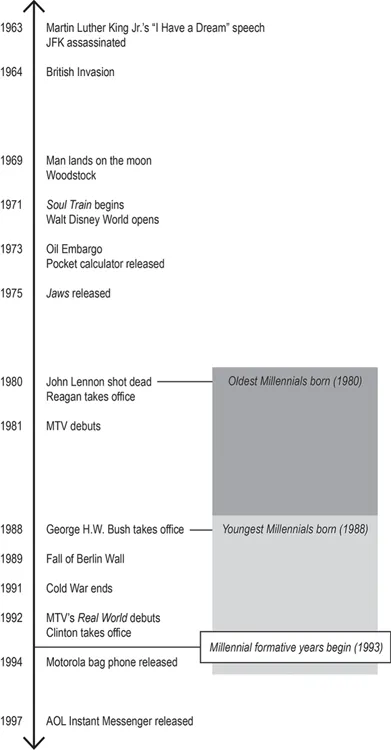
While it’s easy to look at this breakdown and think, “You’re just putting people into boxes!” the truth is more complex. For decades, generational theorists have found that the end of one generation and the beginning of another stems from the experiences they have in their formative years. To get a glimpse into some of those major moments, take a nostalgic walk through the timeline of generations past in Figure 1-1.
image
BridgeWorks. Minneapolis, MN. (October, 2016)
FIGURE 1-1: Generational timeline.
These years are not static; they’re fluid. Here’s a brief FAQ:
  • These numbers are different than others I’ve seen — why is that?
    Generational-year breakdowns are not fixed. They’re fluid because generational theory is a sociological science and therefore doesn’t follow hard rules. These years are determined by the researched truth that the events and conditions that you experience growing up shape who you are. For more about the distinction between sociology and psychology, see Chapter 2.
    tip
    Before jumping to any conclusions about who generations are, an education in generational theory can set you straight. If you feel like becoming a generational expert who knows all things generational, take a dive into Chapter 3.
  • What happened to Gen Y?
    If you are excited to read the passage on Gen Y and how different they are from Millennials, or if you’re a Millennial who is proud to be Gen Y and not a Millennial, we are sorry to disappoint you. “Gen Y” and “Millennial” are synonymous. When researchers were first puzzling out the youngest generation at work, they named them simply as the successor to Gen X and made fun with the play on words “generation why.” Super clever. However, as more research was done, “Millennial” stuck. You can use either moniker you want. Just know that they’re the same, and in this book, we mostly use the term “Millennial.” (Gen Y is more popular outside of the United States.)
  • What are their population sizes?
    At their peaks:
    • Traditionalists — 75 million
    • Baby Boomers — 80 million
    • Generation Xers — 60 million
    • Millennials — 82 million
    Note: Peak population indicates the highest population point of a generation. Information is taken from U.S. Census Data.
  • So how technologically savvy are Millennials really?
    Here’s the truth — all Millennials are not technological geniuses. The oldest Millennials didn’t use cellphones until they got out of college, and the youngest of the generation used a cellphone for the first time in middle school. That being said, they’ve always known a world where they’re expected to have a technological know-how beyond the generations that came before them. With each young generation comes another wave of the most technologically adept.
  • How much of the workforce do they comprise?
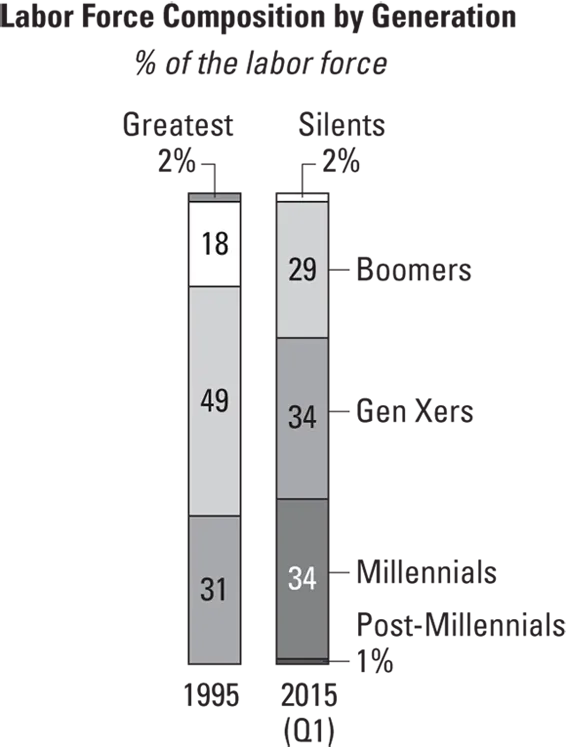
    It’s too hard to really pin this statistic down because it’s ever-changing, but just as generations before, the younger generation will continue to comprise more of the workforce than older generations. Many have estimated that Millennials will comprise 50 percent of the American workforce by 2020. In 2015, Pew Research Center updated the numbers as shown in Figure 1-2.
    Note: Pew Research Center’s birth years are ever-so-slightly different from ours, but not so significantly that it impacts the data trends.
image
"Millennials Surpass Gen Xers as the Largest Generation in U.S. Labor Force" Pew Research Center, Washington, DC (May, 2015) http://www.pewresearch.org/fact;tank/2015/05/11/millennials-surpass-gen-xers-as-the-largest-generation-in-u-s-labor-force/ft_15-05-04_genlaborforcecompositionstacked-2/
FIGURE 1-2: Labor force generational composition.

Spotting the Coming Sea of Change in the Workforce

The workplace is in the midst of a large transformation: Gregory is undergoing metamorphosis; Dr. Jekyll is becoming Mr. Hyde; the bud is blooming into a flower; the rain shower is becoming the thunderstorm. Needless to say, the generations are shifting quickly and making ripples at work as you read this sentence. It’s not enough to look at Millennials in a vacuum, because while you are working to figure out how to best manage them, the other generations are moving around at the same time. Maybe you’ve felt the shifting sea tides of the oncoming silver tsunami as Boomers leave the workplace en mas...

Table of contents

  1. Cover
  2. Title Page
  3. Table of Contents
  4. Introduction
  5. Part 1: Getting Started with Managing Millennials
  6. Part 2: Navigating Potential Clash Points
  7. Part 3: Accommodating Individual Differences Among the Millennial Masses
  8. Part 4: Gearing Up for the Coming Changes
  9. Part 5: The Part of Tens
  10. About the Authors
  11. Advertisement Page
  12. Connect with Dummies
  13. End User License Agreement