In order to enable a better understanding of the key concepts of automation, this book develops the fundamental aspects of the field while also proposing numerous concrete exercises and their solutions. The theoretical approach that it presents fundamentally uses the state space and makes it possible to process general and complex systems in a simple way, involving several switches and sensors of different types. This approach requires the use of developed theoretical tools such as linear algebra, analysis and physics, generally taught in preparatory classes for specialist engineering courses.
We will call modeling the step that consists of finding a more or less accurate state representation of the system we are looking at. In general, constant parameters appear in the state equations (such as the mass or the inertial moment of a body, the coefficient of viscous friction, the capacitance of a capacitor, etc.). In these cases, an identification step may prove to be necessary. In this book, we will assume that all the parameters are known, otherwise we invite the reader to consult Eric Walter’s book [WAL 14] for a broad range of identification methods. Of course, no systematic methodology exists that can be used to model a system. The goal of this chapter and of the following exercises is to present, using several varied examples, how to obtain a state representation.
1.1. Linear systems
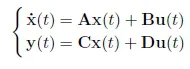
In the continuous-time case, linear systems can be described by the following state equations:
Linear systems are rather rare in nature. However, they are relatively easy to manipulate using linear algebra techniques and often approximate in an acceptable manner the nonlinear systems around their operating point.
1.2. Mechanical systems
The fundamental principle of dynamics allows us to easily find the state equations of mechanical systems (such as robots). The resulting calculations are relatively complicated for complex systems and the use of computer algebra systems may prove to be useful. In order to obtain the state equations of a mechanical system composed of several subsystems S1, S2, . . . , Sm, assumed to be rigid, we follow three steps:
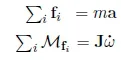
1) Obtaining the differential equations. For each subsystem Sk, with mass m and inertial matrix J, the following relations must be applied:
where the fi are the forces acting on the subsystem Sk, Mfi represents the torque created by the force fi on Sk, with respect to its center. The vector a represents the tangential acceleration of Sk and the vector
represents the angular acceleration of Sk. After decomposing these 2m vectorial equations according to their components, we obtain 6m scalar differential equations such that some of them might be degenerate.
2) Removing the components of the internal forces. In differential equations there are the so-called bonding forces, which are internal to the whole mechanical system, even though they are external to each subsystem composing it. They represent the action of a subsystem Sk on another subsystem Sℓ. Following the action–reaction principle, the existence of such a force, denoted by fk,ℓ , implies the existence of another force fℓ,k, representing the action of Sℓ on Sk, such ...
Table of contents
Cover
Contents
Title Page
Copyright
Introduction
1: Modeling
2: Simulation
3: Linear Systems
4: Linear Control
5: Linearized Control
Bibliography
Index
Trusted by 375,005 students
Access to over 1.5 million titles for a fair monthly price.
Study more efficiently using our study tools.
Frequently asked questions
Yes, you can cancel anytime from the Subscription tab in your account settings on the Perlego website. Your subscription will stay active until the end of your current billing period. Learn how to cancel your subscription
No, books cannot be downloaded as external files, such as PDFs, for use outside of Perlego. However, you can download books within the Perlego app for offline reading on mobile or tablet. Learn how to download books offline
Perlego offers two plans: Essential and Complete
Essential is ideal for learners and professionals who enjoy exploring a wide range of subjects. Access the Essential Library with 800,000+ trusted titles and best-sellers across business, personal growth, and the humanities. Includes unlimited reading time and Standard Read Aloud voice.
Complete: Perfect for advanced learners and researchers needing full, unrestricted access. Unlock 1.5M+ books across hundreds of subjects, including academic and specialized titles. The Complete Plan also includes advanced features like Premium Read Aloud and Research Assistant.
Both plans are available with monthly, semester, or annual billing cycles.
We are an online textbook subscription service, where you can get access to an entire online library for less than the price of a single book per month. With over 1.5 million books across 990+ topics, we’ve got you covered! Learn about our mission
Look out for the read-aloud symbol on your next book to see if you can listen to it. The read-aloud tool reads text aloud for you, highlighting the text as it is being read. You can pause it, speed it up and slow it down. Learn more about Read Aloud
Yes! You can use the Perlego app on both iOS and Android devices to read anytime, anywhere — even offline. Perfect for commutes or when you’re on the go. Please note we cannot support devices running on iOS 13 and Android 7 or earlier. Learn more about using the app
Yes, you can access Automation for Robotics by Luc Jaulin in PDF and/or ePUB format, as well as other popular books in Technology & Engineering & Robotics. We have over 1.5 million books available in our catalogue for you to explore.