With a turnover of some 5-15 billion € / year, the additive manufacturing has industrial niches bearers thanks to processes and materials more and more optimized. While some niches still exist on the application of additive techniques in traditional fields (from jewelery to food for example), several trends emerge, using new concepts: collective production, realization of objects at once (without addition Of material), micro-fluidic, 4D printing exploiting programmable materials and materials, bio-printing, etc. There are both opportunities for new markets, promises not envisaged less than 10 years ago, but difficulties in reaching them.
eBook - ePub
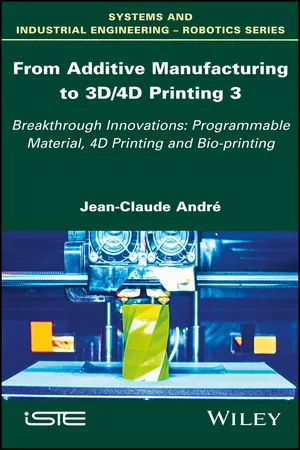
From Additive Manufacturing to 3D/4D Printing 3
Breakthrough Innovations: Programmable Material, 4D Printing and Bio-printing
- English
- ePUB (mobile friendly)
- Available on iOS & Android
eBook - ePub
From Additive Manufacturing to 3D/4D Printing 3
Breakthrough Innovations: Programmable Material, 4D Printing and Bio-printing
About this book
Information
PART 1
Programmable Smart/Intelligent Matter and 4D Printing
Introduction to Part 1
“Although we are positioned to see things from the perspective of intelligent objects, we should first observe that the significant is still distinctive whilst the intelligible is always universal”. (Aristotle, cited by Nadeau [NAD 16])“The development of 3D printing technology falls within the post-industrial framework looking towards the functionality economy. The digital economy amplifies this trend”. [GHI 16]“Two ways to reach the ‘truth’ are:
- 1) Non-explicability consisting in saying that the object in question is too complex and based on what we know today, it will never be possible for us to master;
- 2) Intelligibility by creating a given ‘relay’ concept. This pushes the question further back (e.g. the existence of God). This is the occurrence of vitalism introduced by Woodger in 1929”. [BUN 03]
“Paradigm shifts make scientists, within their particular sphere of research, see everything differently. To the extent that they only have access to the world through which they see, we may be led to say that after a revolution, scientists are reacting to a different world”. [KUH 62]
“Far from equilibrium, the irreversible processes are a source for consistency. The appearance of this coherent activity around matter – the ‘dissipative structures’ – impose upon us a fresh look, and a new way of positioning ourselves in relation to the system which we define and manipulate. Whilst equilibrium and quasi-equilibrium exist, the behavior of the system is, for a sufficiently long time, entirely determined by boundary conditions; we will henceforth acknowledge a certain level of autonomy. This enables us to speak of structures which are far from equilibrium such as ‘self-organization’ phenomena”. [PRI 09]“The ‘principle of scale relativity’ postulates that the fundamental laws of nature should be valid, whatever the ‘scale status’ for the system of reference. It is relationships of scale alone which have a given direction, never an absolute scale. Such a concept is also imposed as a fundamental principle which enables ‘compelling the description of a non-differentiable space–time relationship’”. [CHA 12]“The pessimist sees the difficulty in each opportunity; the optimist sees the opportunity in every difficulty”. [LEM 17]“There is nothing more dangerous than an idea when it is simply an idea”. [ALA 69]“Those who tell you that the only alternative is to slow down are impostors. To slow down, it is indeed necessary to use a given level of energy which counteracts the given acceleration of time”. [SMA 11]“Without talent, ingeniousness or curiosity, neither chance nor necessity suffices to produce innovation”. [FOR 02]“Behavior is motivation when passed through the filter of opportunity”. [SHI 11]“Transgressing the boundaries between disciplines [is] a subversive undertaking as it has every chance of ignoring the so-called havens of commonly accepted ways of thinking”. (Greenberg cited by Staune [STA 15])“Imagine that an excess of scientific and technological innovation is the solution: this amounts to a desire to run ever faster so as not to fall over”. [CÉR 17]
“The present metamorphosis marks the beginning of a new era, and it is not just law that it almost reformulates. Beyond a production technique, 3D printing is a paradigm shift which impacts upon product design, product creation and product consumption and the business models which flow from them” [CHA 16] … It is envisaged that we will expand upon this dynamic here by widening the dimension of the field covered: going from 3D to reach the fourth dimension! The discussion is in fact important because it evokes a possible transformation of how we produce objects without needing to assemble components that are manufactured separately. “Each product might ultimately be capable of self-assembly and implementation within extreme environments may be facilitated by the use of “Programmable Matter”. Programmable materials which build themselves thus make the use of assembly plants and heavy installation procedures superfluous. Robotization, at the crux of twentieth century productivity gains, would thus be integrated into the products themselves”. [GUI 14]
Kupiec and Sonigo [KUP 00] pose the issue of producing simple forms from clay. They introduce a Lamarckian principle in which the material is placed in ad hoc molds. Any foundry worker might produce these (whether from metal or polymers). They evoke Darwinian thinking with a paste that would change shape continuously, spontaneously, and by a process of natural selection or production by the bench scientist. The point is that we would have to wait for the appearance of the desired form (we do not know when this would happen). “Here the result does not pre-exist [unlike the mold]. These transformations are decided on by a given cause… which does not relate to the particular result and may stabilize another given form”. In this section, we are in an in-between phase. This involves the creation of a given object and spatial, temporal and operational evolutions, to varying degrees.
The idea of self-organization was introduced succinctly in the first volume concerning additive manufacturing research pushed to its limits. By the process of making matter intelligent (see the concept introduced 20–30 years ago by Alain Le Méhauté), it is possible to create 3D artifacts which may be considered to be interfaces between an “internal” environment, the smart substance and the organization of the artifact itself, and an external environment. In principle, the aim of this is controlled by the engineer. “Although the internal environment is adapted to the external environment or vice versa, the artifact will follow the assigned goals” ...
Table of contents
- Cover
- Table of Contents
- Title
- Copyright
- Acknowledgments
- Foreword
- Preface
- Introduction
- PART 1: Programmable Smart/Intelligent Matter and 4D Printing
- PART 2: Live “Smart” Matter and (Bio-printing)
- Conclusion
- Postface
- Index
- End User License Agreement
Trusted by 375,005 students
Access to over 1.5 million titles for a fair monthly price.
Study more efficiently using our study tools.
Frequently asked questions
Yes, you can cancel anytime from the Subscription tab in your account settings on the Perlego website. Your subscription will stay active until the end of your current billing period. Learn how to cancel your subscription
No, books cannot be downloaded as external files, such as PDFs, for use outside of Perlego. However, you can download books within the Perlego app for offline reading on mobile or tablet. Learn how to download books offline
Perlego offers two plans: Essential and Complete
- Essential is ideal for learners and professionals who enjoy exploring a wide range of subjects. Access the Essential Library with 800,000+ trusted titles and best-sellers across business, personal growth, and the humanities. Includes unlimited reading time and Standard Read Aloud voice.
- Complete: Perfect for advanced learners and researchers needing full, unrestricted access. Unlock 1.5M+ books across hundreds of subjects, including academic and specialized titles. The Complete Plan also includes advanced features like Premium Read Aloud and Research Assistant.
We are an online textbook subscription service, where you can get access to an entire online library for less than the price of a single book per month. With over 1.5 million books across 990+ topics, we’ve got you covered! Learn about our mission
Look out for the read-aloud symbol on your next book to see if you can listen to it. The read-aloud tool reads text aloud for you, highlighting the text as it is being read. You can pause it, speed it up and slow it down. Learn more about Read Aloud
Yes! You can use the Perlego app on both iOS and Android devices to read anytime, anywhere — even offline. Perfect for commutes or when you’re on the go.
Please note we cannot support devices running on iOS 13 and Android 7 or earlier. Learn more about using the app
Please note we cannot support devices running on iOS 13 and Android 7 or earlier. Learn more about using the app
Yes, you can access From Additive Manufacturing to 3D/4D Printing 3 by Jean-Claude André in PDF and/or ePUB format, as well as other popular books in Business & Accounting. We have over 1.5 million books available in our catalogue for you to explore.