In early research work on international communication, the countries of North Africa and the Middle East were seen as part of the "Third World", and the media had to be at the service of development. However, this situation is changing due to the transnationalization and liberalization of the media. Indeed, since the 1990s, the entry of the South – and Arab countries in this case – into the "information society" has become the dominant creed, although the vision is still globalizing and marked by stereotypes.
Representations of these societies are closely associated with international relations and geopolitics, characterized by tensions and conflicts. However, a force has come to disrupt the traditional rules of the game: Arab audiences. Digital media, the dissemination of which has been enabled by the implementation of the "information society", empowers them to participate fully in a media confluence. This liberation from the discourse has two major consequences: the media and journalism sector has become more strategic than ever, and action toward development must be reinvented.
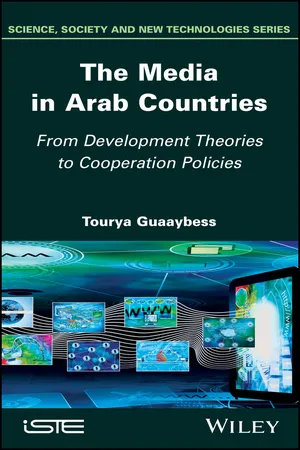
eBook - ePub
The Media in Arab Countries
From Development Theories to Cooperation Policies
- English
- ePUB (mobile friendly)
- Available on iOS & Android
eBook - ePub
The Media in Arab Countries
From Development Theories to Cooperation Policies
About this book
Trusted by 375,005 students
Access to over 1.5 million titles for a fair monthly price.
Study more efficiently using our study tools.
Information
1
International Communication and Arab Countries: Studies on Media Development and Media Geopolitics
“For Arab media research, the 2001 terrorist attacks were a turning point. Beginning with these events in New York and Washington, international interest in Arab media took off. ‘Al-Jazeera’ became the most sought-after term on the Internet; Western media became interested in Arab journalism and young scholars around the world discovered Arab media as a field of research and teaching (…)” (Hafez 2008).
Arab media is an exciting topic, or more precisely an exciting metatopic. We immediately think of the Al Jazeera television channel, talk shows and variety shows on satellite channels; televangelists or star journalists, bloggers and cyber-dissidents of the “Arab revolutions”; the use of digital media by different types of communities; the circulation of video and images on social networks and so on. Today, these topics and many others are indeed routinely addressed and it would be futile to list all recent and ongoing publications related to the Arab media. In the past, this work was not so abundant. We here follow the course of its development.
We will see that many of these works originally stem from the development field. Communication for development is a sub-discipline of international communication, itself defined by international relations. On a global scale, and from the point of view of Western observers, the Arab media were therefore also understood within the context of media geopolitics. Not all the works in question – regardless of the discipline in which they are part of – are listed here; the purpose of this chapter is above all to shed light on a fundamental trend. We will observe that, thanks to the work of the pioneers of the Anglo-American pragmatic school and the growing visibility of certain media (such as Al Jazeera), it has become an ordinary object, rather than a little-studied object or an almost exotic object. Finally, with regard to the link between media and development, it has not completely disappeared; traces of it can be found in the contemporary understanding of journalism.
1.1. Communication for development in France: an imported subdiscipline?
Development aid is not organized in a vacuum. The actions of diplomats and the projects of development agencies evolve according to international relations and geopolitics. The present study in international communication therefore deals with the question of development in the media field, as well as with media geopolitics. It should be noted that communication development is a discipline born in the United States and England; its shape is more tenuous in French universities where such studies are more often undertaken by individuals.
In France, we can find the epicenter of this subdiscipline of communication and information sciences (CIS) in Bordeaux, or the three pillars of French CIS, Robert Escarpit, André-Jean Tudesq (Vitalis 2010) and Anne-Marie Laulan, have paved the way for other researchers such as Annie Lenoble-Bart and Alain Kiyindou (founder of the journal Communication, technologies et développement). UNESCO Chairs, anchored in media and communication studies (or “communication and information sciences”), encourage scientific work and exchanges with developing countries. Their institutional nature – they must comply with a set of conditions – places them in a somewhat separate situation from the academic field. Bernard Miège inaugurated the UNESCO Chair in International Communication in 1997 in Grenoble at GRESEC (Groupe de Recherche sur les Enjeux de la Communication), while Michel Matthien established the UNESCO Chair in Pratiques journalistiques et médiatiques. Entre mondialisation et diversité Culturelle (“Journalistic and media practices: between globalization and cultural diversity”). A few years later, Alain Kiyindou launched the third UNESCO Chair in the Department of Information and Communication Sciences at the Michel de Montaigne University in Bordeaux: Pratiques émergentes des technologies et communication pour le développement (“Emerging technologies and communication practices for development”, Kiyindou 2014).
From a scientific viewpoint, international communication in France is slowly becoming institutionalized and owes its prestige to Armand Mattelart. He founded the Centre d'Études sur les Médias, les Technologies et l'Internationalisation (CEMTI; Center for Media, Technology and Internationalization Studies) in 2001 at the University of Paris 8. Tristan Mattelart, his son, taught international communication at the same university before returning to the Institut Français de Presse (French Press Institute) at the University of Paris 2, where he associated his name with other renowned researchers with an interest in the media around the world – Jacques Kayser1, author of Written Information in Developing Countries (Kayser 1960) and, later, Jacques Barrat, geographer and media geopolitics specialist at the University of Paris 2 (see Barrat 1992a). To their own work, it is worth adding the numerous research projects of PhD students from the South whose doctoral theses they have supervised. Fortunately, these doctoral students from Africa, the Maghreb countries, South America and Asia continue to contribute to our knowledge of the media and communication. Their work often focuses on their countries of origin as areas of investigation, areas that they are rediscovering with the tools and approaches of CIS in France.
1.2. Development and geopolitics: two distinct matters?
To come back to our point, communication for development and geopolitics seem to belong to two quite distinct universes from the viewpoint of the values they convey, and the field of solidarity does not a priori agree well with the realpolitik of international diplomacy. One of the objectives of this work is to reveal this variation of perspective in the representation of Arab countries through the examination of the media. Indeed, over time, focus has been less on development than on geopolitics in the media in Arab countries even though these two aspects have coexisted since the advent of the media. While it was assumed that it was appropriate to improve people’s living conditions, in particular using the media in Arab countries, this model was marginalized without being openly and definitively called into question. From the mid-1990s, Arab media have been considered with a much less North/South approach. Indeed, the research work reflected a less functionalist vision of the media in the Middle East and North African countries even though they sometimes keep a distant, culturalist perspective, in the treatment of this subject2. In contrast to these patterns, political scientist Yves Schémeil argues for a post-Western social science:
“A true post-Western social science will be universal […] so much so that one can speak of a set of non-Western contributions to a universal knowledge of all humanity. It already has several identifiable features: It does not separate facts and ideas, actions and intentions, calculations and values; it is global if not syncretic (Schemeil 2015)”.
This is perhaps already somewhat the case today: the Arab media are treated, by most researchers, as a subject, not necessarily exotic, an ordinary subject of social sciences. One of the privileged angles is that of the Arab transnational media since the 2000s. The advent of satellite channels and networks has contributed to this “dis-orientalization” of analytical tools, or, to quote James Curran and Park Myung-Jin, a “de-Westernization” of analytical tools in the study of media (Curran and Park 2000). They thrived in the crisis contexts of several countries in the region in the early 2000s. Since then, work on the Arab media has increased considerably, with news channels such as Al Jazeera acting as its impetus.
Finally, following the uprisings in Arab countries in 2010–2011, studies on national experiments is increasing. The “Arab Spring” has brought to the forefront – literally – other media and other components of society: those challenging the established order, perfectly embodied by social networks fed by connected youth and bloggers and by a new generation of journalists. Let us retrace this evolution.
1.3. In the beginning: (Arab) media and development
First, let us ask ourselves a basic question. Why this link between “media” and “development”? And why the Arab countries? In reality, the concern for development through the media is, so to speak, inscribed in the genes of international communication3 at a time when non-Western countries are understood in a global geography of media and communication. And we are no exception to this heritage, since our original research interest was in the media in developing countries. It was not the Arab countries that led us to work on this theme, but the opposite. The terrain could have been different.
This somewhat innocuous precision has all its importance because the course remains unchanged: cultural specificities are obvious facts that cannot be denied but they do not constitute the central analytical angle of this work. We started from the intuition and then from the observation, never denied, that the modes of emergence and functioning of modern media (written press, audiovisual media, digital media) respond to logics that are specific to them and that, fundamentally, are universal. At the very least, it seems useful to start from this principle – using the same analytical tools – in order to be possibly surprised by an anthropological specificity.
1.4. Academic publications on Arab media: from scarcity to profusion
Academic publications on Arab media are now very rich; they were rarer before the 2000s. We cannot ignore two classic, founding works on this once marginal theme. The first anthology is written by William Rugh, an American diplomat, several times ambassador to the Middle East and author of The Arab Press: News Media and Political Process in the Arab World, first published in 1979 (Rugh 2004). This book deals with the written press in different Arab countries, and the author classifies the press according to its degree of fr...
Table of contents
- Cover
- Table of Contents
- Foreword
- Introduction: The Extent, Decadence and Surge of Development Aid through the Media
- List of Acronyms
- 1 International Communication and Arab Countries: Studies on Media Development and Media Geopolitics
- 2 The Obsolescence of Classical Theories of International Communication
- 3 The Information Society or the Liberal Remodeling of Development Theories
- 4 In the Field: Liberalization Under the Control of Governments and Businessmen
- 5 The “Arab Street” in the Press: a Specific Frame of the South
- 6 Geopolitics of the Arabic-speaking Media and Politics of Influence
- 7 Cooperation and Training of Journalists in the Digital Media Era
- 8 Development Policy and Journalism: Between Standards Competition and Cooperation
- Conclusion
- References
- Index
- End User License Agreement
Frequently asked questions
Yes, you can cancel anytime from the Subscription tab in your account settings on the Perlego website. Your subscription will stay active until the end of your current billing period. Learn how to cancel your subscription
No, books cannot be downloaded as external files, such as PDFs, for use outside of Perlego. However, you can download books within the Perlego app for offline reading on mobile or tablet. Learn how to download books offline
Perlego offers two plans: Essential and Complete
- Essential is ideal for learners and professionals who enjoy exploring a wide range of subjects. Access the Essential Library with 800,000+ trusted titles and best-sellers across business, personal growth, and the humanities. Includes unlimited reading time and Standard Read Aloud voice.
- Complete: Perfect for advanced learners and researchers needing full, unrestricted access. Unlock 1.5M+ books across hundreds of subjects, including academic and specialized titles. The Complete Plan also includes advanced features like Premium Read Aloud and Research Assistant.
We are an online textbook subscription service, where you can get access to an entire online library for less than the price of a single book per month. With over 1.5 million books across 990+ topics, we’ve got you covered! Learn about our mission
Look out for the read-aloud symbol on your next book to see if you can listen to it. The read-aloud tool reads text aloud for you, highlighting the text as it is being read. You can pause it, speed it up and slow it down. Learn more about Read Aloud
Yes! You can use the Perlego app on both iOS and Android devices to read anytime, anywhere — even offline. Perfect for commutes or when you’re on the go.
Please note we cannot support devices running on iOS 13 and Android 7 or earlier. Learn more about using the app
Please note we cannot support devices running on iOS 13 and Android 7 or earlier. Learn more about using the app
Yes, you can access The Media in Arab Countries by Tourya Guaaybess,Tourya Guaaybess in PDF and/or ePUB format, as well as other popular books in Social Sciences & Media Studies. We have over 1.5 million books available in our catalogue for you to explore.