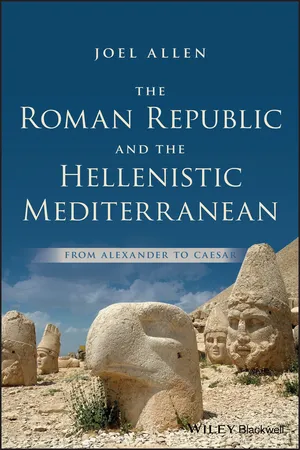
Presents a history of the Roman Republic within the wider Mediterranean world, focusing on 330 to 30 BCE
Broad in scope, this book uniquely considers the history of the Roman Republic in tandem with the rich histories of the Hellenistic kingdoms and city-states that endured after the death of Alexander the Great. It provides students with a full picture of life in the ancient Mediterranean world and its multitude of interconnections—not only between Rome and the Greek East, but also among other major players, such as Carthage, Judaea, and the Celts. Taking a mostly chronological approach, it incorporates cultural change alongside political developments so that readers get a well-balanced introduction to the era.
The Roman Republic and the Hellenistic Mediterranean: From Alexander to Caesar offers great insight into a momentous era with chapters on Alexanders in Asia and Italy; Mediterranean Cosmopolitanism; The Path of Pyrrhus; The Three Corners of Sicily; The Expanding Roman Horizon; Hercules and the Muses; The Corinth-Carthage Coincidence; The Movements of the Gracchi; The New Men of Rome and Africa; The Conspiracies of Cicero and Catiline; The World According to Pompey; Roman Alexanders; and more. It also looks at the phenomenon of excessive violence, particularly in the cases of Marius, Sulla, and Mithridates. The final chapter covers the demise of Cleopatra and examines how the seeds planted by Octavian, Octavia, and Antony sprouted into full Hellenistic trappings of power for the centuries that followed.
Situates the development of Rome, after the death of Alexander the Great, in the context of significant contemporaneous regimes in Asia Minor, the Levant, and Egypt
Provides students with insight into how various societies respond to contact and how that contact can shape and create larger communities
Highlights the interconnectedness of Mediterranean cultures
Strikes a balance between political, geopolitical, and cultural inquiries
Considers how modes of international diplomacy affect civilizations
Includes helpful pedagogical features, such as sources in translation, illustrations, and further readings
Roman Republic and the Hellenistic Mediterranean is an excellent book for undergraduate courses on the Roman Republic, the Hellenistic World, and the ancient Mediterranean.
Trusted by 375,005 students
Access to over 1.5 million titles for a fair monthly price.
814: Legendary date for the foundation of Carthage
776: First Olympic Games in Greece
Mid‐eighth century: Earliest Greek colony in Italy, on Pithecusae in the Bay of Naples. Writing down of Hellenic epics.
734: Legendary date for the foundation of Syracuse
664–609: Assyrian domination of Egypt
c. 600: Approximate date for the foundation of Massilia
c. 561–527: Tyranny of Peisistratus in Athens
550–530: Reign of Cyrus the Great of Persia; conquest of Lydia and Babylon; liberation of Judaea
525: Persian conquest of Egypt
510–508: Overthrow of Hippias and foundation of democracy in Athens
490, 480–479: Wars between Persia and the Greeks
480: Battle of Salamis: Athens defeats the Persian navy; Battle of Himera: Syracuse defeats the Carthaginians
478: Foundation of the Delian League/Athenian Empire
472: Aeschylus, The Persians
447–438: Construction of the Parthenon in Athens
431–404: The Peloponnesian war between Athens and Sparta and their allies
359–336: Reign of Philip II in Macedonia
338: Battle of Chaeronea: Philip II defeats Athens and Thebes; death of Artaxerxes III of Persia
Principal Themes
Cultures and civilizations along the Mediterranean littoral were interconnected in ways both productive and conflicting.
General prosperity in the Bronze Age (c. 3100–1100) was followed by a period of inactivity in the so‐called Dark Age (c. 1100–750) across the Mediterranean, from which complex societies reemerged in the Archaic Age (c. 750–500), a time when major cities like Carthage, Syracuse, and Rome took shape.
Political innovations of the Archaic period include democracy in Athens, an inclusive imperial system among Persian dominions, and republics in Carthage and Rome.
During the Classical Age in Greece (c. 500–336), the Peloponnesian War (432–404) pitted Athenian and Spartan networks of allies against each other and grew to encompass theaters overseas, including in Sicily, Egypt, and the Persian Empire. Carthage and Syracuse simultaneously engaged in a long war for Sicily.
Macedonia and Epirus, in the course of the fourth century, took advantage of privations resulting from the Peloponnesian War to expand their territory and influence, ultimately to prosecute a new war against Persia and the East.
1.1 Introduction
The Mediterranean Sea is locked by land on all sides, and is about as wide from west to east as the continental United States: the distance from Gibraltar to Alexandria is about the same as from San Francisco to New York, and Athens in the middle could be their Chicago in terms of relative positions against the compass. Unlike the United States, it should go without saying, water is everywhere, but it is a sea that is chopped up by a multitude of protruding and receding land masses, islands, coves, promontories, and bays. From most shorelines, it is not uncommon to see more land somewhere on the horizon, a day's boat ride away if wind and current should cooperate (see Map 1.1). The four peninsulas of this chapter title reach toward and twist away from each other. The combination of Italy and Sicily, as one goes southward, pushes at first from west to east, then curls back from east to west like a fisherman's hook. At its tip, it comes within a hundred miles of touching a second peninsula extending north and east from Africa: Cap Bon is modern Tunisia and in antiquity was the stronghold of Carthage. The Balkan Peninsula, culminating in Greece and the Peloponnese, like Italy, also sweeps west to east as one moves south. Its momentum disintegrates into a scattering of islands that skips nearly all the way to the broad west coast of Asia Minor, which is itself surrounded on three sides by the Black, Aegean, and eastern Mediterranean Seas, a fourth peninsula, albeit a massive one whose coasts are far from each other.
Map 1.1 Topographical map of the Mediterranean world.
These four landmasses came to dominate affairs in the Mediterranean as homes to powerful civilizations, but it is possible to overstate their significance to the exclusion of others. For example, the model overlooks the protruding bump of North Africa that was the heartland of Cyrene, a powerful city‐state throughout the Hellenistic period, and it sets aside certain large islands – the Balearics, Sardinia, Corsica, Malta, Crete, Rhodes, and Cyprus – which, with self‐sustaining economies of agriculture, fishing, and production in their own right, offered more than just stopping points for seafarers. In the far southeast, or “lower right,” corner, the Nile Delta, with its alluvial interpenetration of water and land, constitutes a kind of reverse peninsula, providing both entrance‐in as well as security‐out.
Depending on one's perspective or inclination, an option of metaphors is available for the student of Mediterranean topography, as it relates to history: are these realms engaged in boxing matches, or conspiring in team huddles? That is, one could emphasize the frequent conflict that flared among the various populations of the Mediterranean over millennia, or one could focus on the enormous abundance that came with communication and trade, which were relatively easy, especially by preindustrial standards. Today the term Mediterranean is used collectively: for travel brochures it might describe a salubrious climate of warm summers and mild winters; on menus, it marks a type of robust but healthy cuisine stocked with peppers, dates, olives, and grapes, and fortified with fish and with the products of sheep and goats, from meat to milk. A certain sameness characterizes the physical world of the coastal Mediterranean even as inland tracts vary widely from hot, dry deserts to well‐watered mountain ranges. The entire vast “basin,” if it may be called that, has been host to vastly different political regimes, societies, religions, and empires, and yet in antiquity, any peoples near the sea might be seen as related somehow, with all being members of an oikoumene, a Greek term for the part of the world that was “inhabited.” Herodotus saw the Etruscans in Italy as the descendants of wanderers from Asia Minor, and the Roman writer Sallust believed the Numidians of North Africa had as their ancestors displaced Persians who settled there and intermarried with indigenous tribes. In the 1940s, the French scholar Fernand Braudel pioneered a historical approach to the Mediterranean that encompassed all its regions as part of single world regardless of language, culture, and nation, a method that was advanced and updated by Peregrine Horden and Nicholas Purcell in 2000. This book is influenced by them, and also by Peter Green’s magisterial Alexander to Actium: The Historical Evolution of the Hellenistic Age (1990), in its investigation of the interactions of Mediterranean cultures that coexisted in ways both productive (trade, pilgrimage, discovery) and not (warfare, slavery, forced migration), concentrating on a 300 year span of momentous change and volatility.
Our period is framed by the careers of two phenomenal leaders, not owing to any kind of inherent excellence on their part but because of the far‐ranging changes that were wrought by their policies and campaigns. Alexander the Great moved Greek culture in a new direction when he led troops out of the Balkans and into Asia Minor, the Levant, Egypt, Mesopotamia, and the Hindu Kush in the 330–320s BCE; nearly three centuries later, Julius Caesar did much the same thing for Italy, only this time moving west into Gaul, Britain, and Spain, before his own sojourn in Egypt and the rest of the East. Almost all dates in this study fall “before the common era,” and so the abbreviation BCE is hereafter generally left out except where context requires it. Two introductory chapters, which form the backdrop for developments in the ensuing sections, review major events and trends up to the launch of the two Alexanders' invasions in 336 (Chapter 3). The current chapter focuses on the East, principally the foundational histories of the Greeks, Phoenicians (which at this point may include the Carthaginians), and other residents of the Persian Empire as found in Egypt, Asia Minor, and further inland. Chapter 2 introduces the contemporaneous rise of Rome in Italy, which, while not disconnected from the rest of the Mediterranean, is treated separately given the prominence achieved by the Republic in later chapters. Historical evidence becomes more nuanced and plentiful as the period progresses, and so the coverage of material becomes denser with each chapter: Chapter 5 examines a 30 years span, while Chapter 15 is devoted to just six. Chapter titles include benchmark dates covered by each, though these temporal borders are porous and nonexclusive, and details that fall within one chapter's formal timeline may appear earlier or later, in keeping with thematic organizations.
1.2 Bronze Age Connections and Dark Age Divisions
The civilizations of the Mediterranean were interconnected from the earliest prehistory. The city‐states of Sumer in Mesopotamia and the Nile regime of the Old Kingdom in Egypt both emerged around 3100, the start of the Bronze Age. These predate the Hellenistic world by nearly a full millennium more than the Hellenistic world predates this book's readership, and for our purposes it is sufficient to trace only broadly the relationships that existed among them and others, and the social, political, and geopolitical trends that came about as a result. International ties can be readily demonstrated through a number of evidential strands. A traffic in material goods is clear, as artifacts in Egyptian style and manufacture are found in Bronze Age graves in the islands, the Balkans, Asia Minor, and Mesopotamia, and vice versa. Written records, be they in Sumerian cuneiform, Egyptian hieroglyphics, or the primitive syllabic alphabet of early Greek from the mid‐second millennium, record the movements of diplomatic embassies, military regiments, and merchant ships. Vestiges of Bronze Age writings also reveal several other hallmarks of complex societies and economies, such as business contracts, real estate transactions, marriage negotiations, legal codes, personal correspondence, and reli...
Table of contents
Cover
Table of Contents
Preface and Acknowledgments
List of Credits
1 To 336: Four Peninsulas and a Delta
2 To 336: Roman Origins and Institutions
3 To 321: Alexanders in Asia and Italy
4 To 295: An Elusive Equilibrium
5 To 264: The Path of Pyrrhus
6 To 238: The Three Corners of Sicily
7 To 201: The Expanding Roman Horizon
8 To 186: Hercules and the Muses
9 To 164: Hostages of Diplomacy
10 To 133: The Price of Empire
11 To 101: The “New Men” of Rome and the Mediterranean
12 To 79: Boundless Violence
13 To 63: Extraordinary Commands
14 To 52: The World According to Pompey
15 To 44: Roman Alexanders
Epilogue: Not the End
Index
End User License Agreement
Frequently asked questions
Yes, you can cancel anytime from the Subscription tab in your account settings on the Perlego website. Your subscription will stay active until the end of your current billing period. Learn how to cancel your subscription
No, books cannot be downloaded as external files, such as PDFs, for use outside of Perlego. However, you can download books within the Perlego app for offline reading on mobile or tablet. Learn how to download books offline
Perlego offers two plans: Essential and Complete
Essential is ideal for learners and professionals who enjoy exploring a wide range of subjects. Access the Essential Library with 800,000+ trusted titles and best-sellers across business, personal growth, and the humanities. Includes unlimited reading time and Standard Read Aloud voice.
Complete: Perfect for advanced learners and researchers needing full, unrestricted access. Unlock 1.5M+ books across hundreds of subjects, including academic and specialized titles. The Complete Plan also includes advanced features like Premium Read Aloud and Research Assistant.
Both plans are available with monthly, semester, or annual billing cycles.
We are an online textbook subscription service, where you can get access to an entire online library for less than the price of a single book per month. With over 1.5 million books across 990+ topics, we’ve got you covered! Learn about our mission
Look out for the read-aloud symbol on your next book to see if you can listen to it. The read-aloud tool reads text aloud for you, highlighting the text as it is being read. You can pause it, speed it up and slow it down. Learn more about Read Aloud
Yes! You can use the Perlego app on both iOS and Android devices to read anytime, anywhere — even offline. Perfect for commutes or when you’re on the go. Please note we cannot support devices running on iOS 13 and Android 7 or earlier. Learn more about using the app
Yes, you can access The Roman Republic and the Hellenistic Mediterranean by Joel Allen in PDF and/or ePUB format, as well as other popular books in History & Ancient History. We have over 1.5 million books available in our catalogue for you to explore.