Fix Your Team
eBook - ePub

Fix Your Team

The Tools You Need to Rebuild Relationships, Address Conflict and Stop Destructive Behaviours

  1. English
  2. ePUB (mobile friendly)
  3. Available on iOS & Android
eBook - ePub

Fix Your Team

The Tools You Need to Rebuild Relationships, Address Conflict and Stop Destructive Behaviours

About this book

Transform team dynamics with practical, real-world tools for sustainable change

Fix Your Team is the manager's essential and practical guide to diagnosis and intervention. Packed with expert insight acquired over decades of experience in workplace relations and conflict resolution, this book systematically addresses problems with team dynamics and provides a blueprint for moving forward. Authors Rose Bryant-Smith and Grevis Beard bring a unique combination of legal nous, conflict management expertise, emotional intelligence and business experience to provide a wealth of valuable insights, with robust tools designed for easy implementation.

This book offers diagnostic guidance to help you analyse existing issues with confidence, and a clear framework for removing the dysfunction. It includes practical scenarios we can all relate to, and actionable guidance on building buy-in, executing the strategy and looking after yourself through tough transformations. By tackling problems early and providing employees with the opportunity to improve their working relationships, managers, human resources and other internal advisors demonstrate their commitment to productivity, genuine care for employees and dedication to a healthy and ethical working environment. People working in dysfunctional teams will understand better what is going on, and understand what options exist for improvement.

  • Diagnose team problems and learn what tools are available to help
  • Determine the best use of resources and choose an implementable fix
  • Develop a business case for intervention, and get support from the top
  • Build morale, productivity and collaboration within the team
  • Upskill employees to ensure sustainable improvements
  • Build accountability in everyone for a positive workplace culture

In today's competitive environment, managers need to bring out the best in everyone. Team dysfunction affects productivity at all levels, and it's contagious — managers must stop the problem before it spreads, to prevent larger and more pervasive issues down the road. Remediating team issues reduces legal and safety risks, but it goes deeper than that. Solving problems before they become public or impact other areas of the business improves the team's respect for managers and leadership, reducing unnecessary turnover and resignations of good staff. Fix Your Team is a groundbreaking handbook for management looking to improve team dynamics, with practical solutions for productivity-killing, unethical and distracting issues. It gives all managers and internal advisors the confidence, strategies and solutions they need to repair tricky, toxic and troubled teams to create a great workplace.

Frequently asked questions

Yes, you can cancel anytime from the Subscription tab in your account settings on the Perlego website. Your subscription will stay active until the end of your current billing period. Learn how to cancel your subscription.
No, books cannot be downloaded as external files, such as PDFs, for use outside of Perlego. However, you can download books within the Perlego app for offline reading on mobile or tablet. Learn more here.
Perlego offers two plans: Essential and Complete
  • Essential is ideal for learners and professionals who enjoy exploring a wide range of subjects. Access the Essential Library with 800,000+ trusted titles and best-sellers across business, personal growth, and the humanities. Includes unlimited reading time and Standard Read Aloud voice.
  • Complete: Perfect for advanced learners and researchers needing full, unrestricted access. Unlock 1.4M+ books across hundreds of subjects, including academic and specialized titles. The Complete Plan also includes advanced features like Premium Read Aloud and Research Assistant.
Both plans are available with monthly, semester, or annual billing cycles.
We are an online textbook subscription service, where you can get access to an entire online library for less than the price of a single book per month. With over 1 million books across 1000+ topics, we’ve got you covered! Learn more here.
Look out for the read-aloud symbol on your next book to see if you can listen to it. The read-aloud tool reads text aloud for you, highlighting the text as it is being read. You can pause it, speed it up and slow it down. Learn more here.
Yes! You can use the Perlego app on both iOS or Android devices to read anytime, anywhere — even offline. Perfect for commutes or when you’re on the go.
Please note we cannot support devices running on iOS 13 and Android 7 or earlier. Learn more about using the app.
Yes, you can access Fix Your Team by Rose Bryant-Smith,Grevis Beard in PDF and/or ePUB format, as well as other popular books in Business & Management. We have over one million books available in our catalogue for you to explore.

Information

Publisher
Wiley
Year
2018
Print ISBN
9780730354499
eBook ISBN
9780730354505
Edition
1
Subtopic
Management

Part I
What is going on?

Before you can apply the right tools to get your team back on track, you first need to identify what’s going wrong. You need to:
  • recognise the symptoms of the dysfunction/s that are occurring in your team
  • understand what conflict, conduct or cultural issues are causing problems, noting where there is more than one
  • think through the problems from the perspective of your colleagues in the team. What is their lived experience of the team right now? What is driving their behaviours? What are they trying to achieve? How do they want things to be different?
Don’t worry if you feel a little overwhelmed as you begin to diagnose the issues. The chapters in part I are designed to help you. We will set out the 12 most common dysfunctions that we have seen in workplaces across Australia and overseas over the past 20 years.
The Symptoms box at the start of each chapter in Part I lists the behaviours that commonly manifest when a team is in the grip of that particular dysfunction. Do any of those symptoms look familiar? You may very quickly recognise a dysfunction that you and your team are experiencing. Keep reading and you’ll learn how and why that problem arises, and how it affects team functioning.
Don’t stop when you identify one dysfunction your team is experiencing. There may be one or a variety of issues, which may be distinct or enmeshed together. In our experience, it’s rare that only one specific problem affects a team over a long period of time. Usually a team in crisis is facing two or three challenges, such as an unassertive manager, confusion over accountabilities and values, and a toxic personality who is taking advantage of the situation. Review all 12 dysfunctions to determine whether more than one is present in your team.
After identifying the problems your team is facing, Part II will guide you through some further thinking, as you progress towards choosing the right interventions for you.

Chapter 1
GOSSIP CULTURE: Cruel conversations

SYMPTOMS

  • Some colleagues are conducting spiteful conversations in which they mock and denigrate others.
  • What might have started as harmless banter in the lunch- room, or constructive speculation in challenging times, now has people delighting in others’ misfortunes, true or fabricated.
  • Cliques are excluding and isolating individuals — socially, professionally or both.
  • As the gossip spreads, untrue rumours have started to damage a colleague’s professional reputation.
  • Gossip spreads to social media platforms.

WHAT’S GOING ON

It’s human to want to understand situations, read the play of social activity and recognise the motivations of others. We like to guess at what’s going on, and, in our less honourable moments, we may feel smug satisfaction when people we envy or dislike are struggling. Gossip exists in many workplaces, and it can be destructive.

What is gossip?

The positive sharing of information can be healthy. Constructive speculation about what’s going on in the company, “building social connections with colleagues, discussion of who might get that sought-after promotion — these conversations are quite natural. As humans, we try to make sense of what’s happening around us, even when we have little information on which to base our understanding. Whether out of competition, curiosity or a genuine wish to see our colleagues succeed, we’re inherently interested in what other people are doing.
If the speculation is negative and seeks to drag someone else down, that’s a very different story. This is gossip: nasty, inflammatory and potentially embarrassing to the target.
Gossiping employees select isolated pieces of information (facts) and turn them into something bigger (speculation). We’ve all heard it: exaggeration, embellishment and rumours. Will our co-worker get fired? Who did what to whom at the end-of-year party? What’s really happening in this or that colleague’s life? Many of us have overheard sensational and salacious tales about who has a drinking problem, who is having an affair, drug addiction, financial trouble, and what questionable leverage Kaylene must have with the CEO to have won that promotion.
The problem is that such reality TV–style dramas are often embellished, unreliable and disruptive. Gossips who fabricate juicy tales when they should be working are often incredibly distracting to their co-workers. Sharing personal, private information, whether or not it is true, is inappropriate and potentially destructive.

Motivations of gossips

Gossips can be driven by social ambition, self-worth issues, jealousy, spite, mischief or plain old boredom. Some gossips spread rumours to fill the void of a quiet period at work, while others spread gossip deliberately and strategically to gain an advantage over others.
One consequence of gossiping (that the gossips themselves usually don’t seem to understand or care about) is that gossips are never trusted. Only other gossips and clueless hangers-on will share information with such people.

Gossip can breach legal standards

At its heart, gossip is a power play used to harm and disempower others. Far from ‘harmless’, it often amounts to bullying others. Under Australian workplace laws, bullying at work occurs when a person or a group of people repeatedly behaves unreasonably towards a worker or a group of workers, and the behaviour creates a risk to health and safety. Bullying can involve, for example: aggressive or intimidating conduct; belittling or humiliating comments; spreading malicious rumours; teasing, practical jokes or ‘initiation ceremonies’; exclusion from work-related events; unreasonable work expectations, including too much work, or work beyond a worker’s skill level; displaying offensive material; or pressure to behave in an inappropriate manner.
Negative, targeted and ongoing gossip is, at its heart, a pattern of unreasonable conduct towards a colleague. Gossips use information and misinformation to harm, disempower and exclude others.
Sometimes, gossip includes sexual content and innuendo, or maligning colleagues for engaging in sexual conduct (actual or invented). This can contribute to a sexualised culture and can even amount to sexual harassment: unwelcome conduct of a sexual nature.
Gossip can be a symptom or tool of resistance to change, or rejection of accountability. Malicious rumours can be used to undermine, deter or marginalise the manager who is trying to effect change. Gossip can also be about fear or suspicion of outsiders — for example, false statements being made about the beliefs, practices or lifestyle of a stakeholder from a different cultural background (see chapter 7).

Gossip thrives when information is lacking

Aristotle famously said that nature abhors a vacuum, postulating that any space or void would immediately fill with life. Gossip loves silence, filling it with vague information and speculation. Misinformation will thrive when no one in the workplace really knows what’s going on. Employees who don’t trust their manager or who lack information will make things up to fill in the blanks. A false answer, to them, is better than no answer at all.
This means that in times of change or upheaval, such as during restructures, gossip can run riot. In these circumstances, employees quite naturally feel fearful and insecure and seek answers, while the organisation’s leaders cannot answer every question, perhaps because not all the information is available yet. Gossips then step in to fill the information void.

IMPACT ON THE TEAM

Gossip can disrupt and damage:
  • interpersonal relationships
  • the motivation and morale of the team overall
  • the systems of work and how employees work together (avoidance and missed opportunities to collaborate)
  • productivity
  • employee engagement and retention (high-performing employees, feeling either distracted or undermined, seek work elsewhere).
If the gossip spreads to social media platforms, the negativity and criticisms are even more public. These forums are less controlled and far more visible to the outside world, which ramps up the potential risks to the individuals and the employer. Social media creates the perfect environment for gossip to flourish, as the following case study illustrates.

CASE STUDY
FACEBOOK GOSSIP AFTER THE PARTY

The Christmas party at signage company Hancock Signature is always a raucous event. After this year’s party, Zara posted some photos of the party on Facebook, including one of machine operator Spyros and Leila, a temp. Underneath the photo, Zara commented, ‘Love is in the air’. The photo attracted multiple likes and additional comments alluding to a relationship between Spyros and Leila and suggesting that Leila had been drinking excessively at the party.
The following week in the office, the gossip is rife. Spyros is furious. He is happily married and was talking to Leila to make her feel part of the party, as she was new to the office. Leila, who is a teetotaller for religious reasons, is upset as well. She had been brought in to assist Zara with her work and she wonders whether Zara is trying to intimidate her. She goes to HR to ask what she can do.
You can see from this example how easily gossip can s...
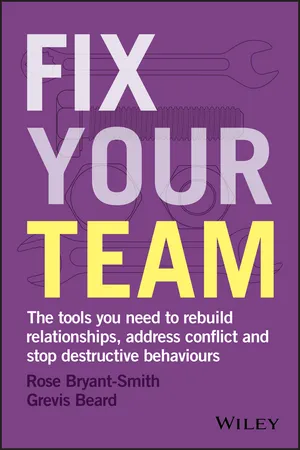
Table of contents

  1. Cover
  2. Epigraph
  3. Title page
  4. Copyright
  5. Dedication
  6. ABOUT THE AUTHORS
  7. ACKNOWLEDGEMENTS
  8. INTRODUCTION
  9. PART I WHAT IS GOING ON?
  10. PART II THE FIX YOUR TEAM TOOLKIT
  11. PART III MAKING IT WORK
  12. FIX YOUR TEAM TOOLKIT
  13. SELECT RESEARCH CITATIONS
  14. INDEX
  15. END USER LICENSE AGREEMENT