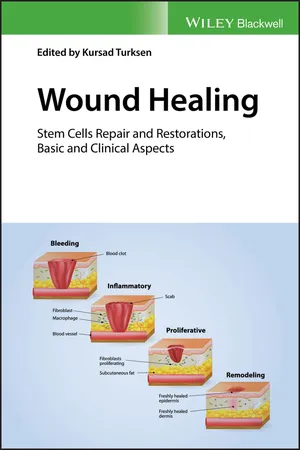
A comprehensive resource on the recent developments of stem cell use in wound healing
With contributions from experts in the field, Wound Healing offers a thorough review of the most recent findings on the use of stem cells to heal wounds. This important resource covers both the basic and translational aspects of the field. The contributors reveal the great progress that has been made in recent years and explore a wide range of topics from an overview of the stem cell process in wound repair to inflammation and cancer. They offer a better understanding of the identities of skin stem cells as well as the signals that govern their behavior that contributes to the development of improved therapies for scarring and poorly healing wounds.
Comprehensive in scope, this authoritative resource covers a wealth of topics such as: an overview of stem cell regeneration and repair, wound healing and cutaneous wound healing, the role of bone marrow derived stems cells, inflammation in wound repair, role and function of inflammation in wound repair, and much more. This vital resource:
Provides a comprehensive overview of stem cell use in wound healing, including both the basic and translational aspects of the field
Covers recent developments and emerging subtopics within the field
Offers an invaluable resource to clinical and basic researchers who are interested in wound healing, stem cells, and regenerative medicine
Contains contributions from leading experts in the field of wound healing and care
Wound Healing offers clinical researchers and academics a much-needed resource written by noted experts in the field that explores the role of stem cells in the repair and restoration of healing wounds.
Chapter 1 Stem Cell Regeneration and Repair – Overview
Clement D. Marshall, Alessandra A. Moore, Michael T. Longaker and H. Peter Lorenz
Department of Surgery and Reconstructive Surgery, The Stanford University Medical Center, Stanford, CA, USA
Introduction
While at first glance the skin appears to be no more than a static unchanging surface, it is in fact a complex, dynamic organ that continuously replenishes its cellular and molecular content. In addition to this homeostatic maintenance, skin has evolved the remarkable ability to rapidly repair itself after injury. For our most distant ancestors, there was presumably evolutionary pressure to rapidly restore the barrier function of skin before infection could set in. The result of this evolutionary necessity is scar tissue, which serves as a protective barrier, but falls short in several ways compared with uninjured skin. In humans, the end point of healing all but the smallest injuries is the formation of scar [1]. For most people, scars are a cosmetic concern, but many patients are affected by major scars that result in debilitating contractures as well as disfigurement in aesthetically sensitive areas such as the face. Children with major scars in visible areas such as the face often suffer from long-term psychological stress and impaired self-esteem [2]. If excessive scar formation represents one end of the human wound healing spectrum, the other end consists of chronic and non-healing wounds. Often arising in patients with diabetes, peripheral arterial disease, impaired mobility, and other comorbidities, chronic wounds typically require months of intensive treatment and consume substantial healthcare resources [3].
Stem cells are a key cellular player in the repair of skin after injury and during normal homeostasis. Tremendous progress has been made in recent years toward delineating the role of stem cells in these processes. An improved understanding of the identities of skin stem cells as well as the signals that govern their behavior will hopefully allow for the development of improved therapies for scarring and poorly healing wounds. This chapter will begin with an overview of the events of normal wound healing and stem cell biology and will then review our current understanding of the role of stem cells in skin regeneration and repair.
Overview of Skin Wound Healing
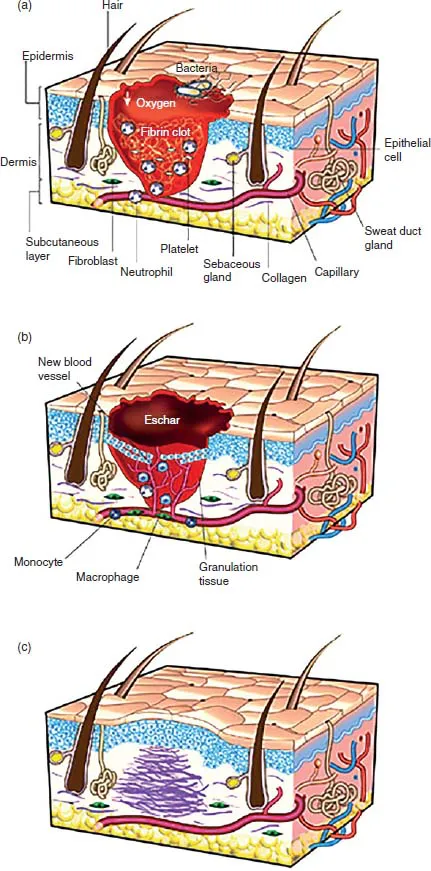
The major function of skin is to provide a barrier that excludes noxious and infectious agents of the outside world while protecting underlying structures from trauma and preventing the loss of valuable body fluid. Wound repair appears to have evolved in a way that rapidly restores these functions while simultaneously preventing infection of the wound (Figure 1.1).
Figure 1.1There are three classic stages of wound repair: (a) inflammation, (b) new tissue formation, and (c) remodeling. (a) Inflammation. This stage lasts until about 48 h after injury. Depicted is a skin wound at about 24–48 h after injury. The wound is characterized by a hypoxic (ischaemic) environment in which a fibrin clot has formed. Bacteria, neutrophils, and platelets are abundant in the wound. Normal skin appendages (such as hair follicles and sweat duct glands) are still present in the skin outside the wound. (b) New tissue formation. This stage occurs about 2–10 days after injury. Depicted is a skin wound at about 5–10 days after injury. An eschar (scab) has formed on the surface of the wound. Most cells from the previous stage of repair have migrated from the wound, and new blood vessels now populate the area. The migration of epithelial cells can be observed under the eschar. (c) Remodeling. This stage lasts for a year or longer. Depicted is a skin wound about 1–12 months after repair. Disorganized collagen has been laid down by fibroblasts that have migrated into the wound. The wound has contracted near its surface and the widest portion is now the deepest. The re-epithelialized wound is slightly higher than the surrounding surface and the healed region does not contain normal skin appendages. (Reproduced from Gurtner et al. [1], with permission from Nature Publishing Group.)
The first events after a skin injury has occurred relate to the restoration of hemostasis. A fibrin and platelet plug prevents ongoing bleeding from blood vessels. The fibrin matrix that composes the plug provides a scaffold for wound healing cells that will migrate in later. Activated platelets in the injury provide early chemical signals that activate other cells and potentiate further wound healing events [4].
The first phase of a true wound repair is known as the inflammatory phase. Immune cells such as macrophages, neutrophils, and lymphocytes enter the wound tissue and begin the process of removing bacteria, dead cells, and other debris [5]. Cytokines released during wounding and hemostasis are critical for the recruitment of these immune cells to the wound [4]. Immune cell influx is accompanied by a local inflammatory reaction characterized by increased blood flow and capillary leaking, causing the typical symptoms of redness, swelling, and increased warmth. In addition to cleaning the wound area and removing infectious agents, immune cells release a host of cytokines and other chemical mediators that encourage other cells to engage in healing behaviors [4].
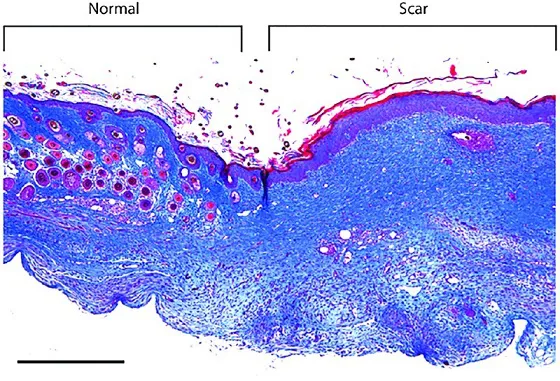
Inflammation is followed by the proliferative phase of wound healing. This refers to the migration of cells into the wound, particularly fibroblasts and keratinocytes, that are responsible for building new tissue to reconstruct the wound. These cells are highly responsive to chemical mediators released by immune cells during the inflammatory phase [6]. New epidermis and dermis are constructed to replace the empty space left by the wound during this phase. In almost all wounds, the new skin is built in the form of scar [1]. Compared with normal skin, scar lacks hair follicles and sweat glands, is stiffer, and is often raised and hyperpigmented. The basement membrane of the epidermis in scar is flat and does not contain the rete pegs that normally project down into the dermis [7] (Figure 1.2). Large scars, particularly those located over a joint, often contract as a result of myofibroblast action. This contraction occurs in the remodeling phase of wound healing, during which scar extracellular matrix, including collagen, is extensively remodeled [4]. Contractures can be painful and cause severe physical impairment, particularly in patients with large burn scars [8].
Figure 1.2Masson's trichrome staining of the interface between normal (left) and scarred (right) dorsal skin in the adult mouse. Normal skin contains hair follicles and other dermal appendages. Scarred skin does not contain these appendages and the epidermis is flattened. Note that that scarred dermis is thicker than the normal dermis. Scale bar, 500 μm.
While stem cells are normally active at a low level in uninjured skin to maintain homeostasis, they are recruited during the proliferative phase of wound healing to provide large numbers of new cells to populate the healing wound [9].
Stem Cell Definition: History
Most cells have short life spans and are not capable of indefinite self-renewal. In the 1970s, the concept of the stem cell was developed to describe a special population of cells that divide in order to replenish a population of differentiated cells but do not themselves differentiate. Over time the definition of the stem cell has evolved [10]. Today, stem cells are generally considered to be undifferentiated cells that self-renew and that produce differentiated cells as progeny [11]. Within this broad definition there are many types of stem cells that differ based on their capacity for long- or short-term self-renewal and the number of different cell types that they produce [11].
The presence of stem cells has been verified in most tissues of the body, although certain tissues such as the pancreas may not contain stem cells [10, 12]. The precise manner in which a stem cell behaves and produces differentiated progeny differs depending on the tissue involved. Cell surface markers and genes expressed by stem cells also differ markedly between tissues, making identification and isolation of stem cells sources challenging. Many stem cells express regulatory genes that are switched off in their progeny, making the identification of the progeny cells in vivo more difficult. Furthermore, a s...
Table of contents
Cover
Title page
Copyright
List of Contributors
Chapter 1 Stem Cell Regeneration and Repair – Overview
Chapter 2 Cadherins as Central Modulators of Wound Repair
Chapter 3 Tight Junctions and Cutaneous Wound Healing
Chapter 4 The Role of Microvesicles in Cutaneous Wound Healing
Chapter 5 Wound Healing and Microenvironment
Chapter 6 Wound Healing and the Non-cellular Microenvironment
Chapter 7 Contribution of Adipose-Derived Cells to Skin Wound Healing
Chapter 8 Role of Bone Marrow-Derived Stem Cells in Wound Healing
Chapter 9 Role of Vitamin D and Calcium in Epidermal Wound Repair
Chapter 10 Oral Mucosal Healing
Chapter 11 Role of Adipose-Derived Stem Cells in Wound Healing: An Update from Isolation to Transplantation
Chapter 12 The Hair Follicle as a Wound Healing Promoter and Its Application in Clinical Practice
Chapter 13 Impaired Wound Healing in Diabetic Ulcers: Accelerated Healing Through Depletion of Ganglioside
Chapter 14 Inflammation in Wound Repair: Role and Function of Inflammation in Wound Repair
Chapter 15 Inflammation, Wound Healing, and Fibrosis
Chapter 16 The Potential Role of Photobiomodulation and Polysaccharide-Based Biomaterials in Wound Healing Applications
Chapter 17 Is Understanding Fetal Wound Repair the Holy Grail to Preventing Scarring?
Chapter 18 Inflammation and Cancer
Index
EULA
Trusted by 375,005 students
Access to over 1.5 million titles for a fair monthly price.
Study more efficiently using our study tools.
Frequently asked questions
Yes, you can cancel anytime from the Subscription tab in your account settings on the Perlego website. Your subscription will stay active until the end of your current billing period. Learn how to cancel your subscription
No, books cannot be downloaded as external files, such as PDFs, for use outside of Perlego. However, you can download books within the Perlego app for offline reading on mobile or tablet. Learn how to download books offline
Perlego offers two plans: Essential and Complete
Essential is ideal for learners and professionals who enjoy exploring a wide range of subjects. Access the Essential Library with 800,000+ trusted titles and best-sellers across business, personal growth, and the humanities. Includes unlimited reading time and Standard Read Aloud voice.
Complete: Perfect for advanced learners and researchers needing full, unrestricted access. Unlock 1.5M+ books across hundreds of subjects, including academic and specialized titles. The Complete Plan also includes advanced features like Premium Read Aloud and Research Assistant.
Both plans are available with monthly, semester, or annual billing cycles.
We are an online textbook subscription service, where you can get access to an entire online library for less than the price of a single book per month. With over 1.5 million books across 990+ topics, we’ve got you covered! Learn about our mission
Look out for the read-aloud symbol on your next book to see if you can listen to it. The read-aloud tool reads text aloud for you, highlighting the text as it is being read. You can pause it, speed it up and slow it down. Learn more about Read Aloud
Yes! You can use the Perlego app on both iOS and Android devices to read anytime, anywhere — even offline. Perfect for commutes or when you’re on the go. Please note we cannot support devices running on iOS 13 and Android 7 or earlier. Learn more about using the app
Yes, you can access Wound Healing by Kursad Turksen in PDF and/or ePUB format, as well as other popular books in Biological Sciences & Biotechnology. We have over 1.5 million books available in our catalogue for you to explore.