eBook - ePub
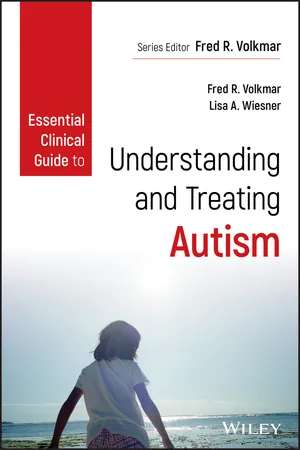
Essential Clinical Guide to Understanding and Treating Autism
- English
- ePUB (mobile friendly)
- Available on iOS & Android
eBook - ePub
Essential Clinical Guide to Understanding and Treating Autism
About this book
Coauthored by the premier expert on autism in the United States and an experienced academic and practicing pediatrician, this volume provides concise and practical information based on the most up-to-date research and clinical experience for primary care givers around the world. Showing clinicians how to most effectively use evidence-based techniques, this invaluable guide offers primary-care providers access to expert, current research and practice guidelines allowing them to confidently support children who present with symptoms of autism.
Information
CHAPTER 1
What Is Autism?
Diagnostic Concepts, Causes, and Current Research
Autism and related conditions (now widely known as autism spectrum disorders, or ASDs) are disorders that share significant social disability as a major defining feature. This social disability is quite severe, and its severity and early onset lead to more general and pervasive problems in learning and adaptation. Over the years there have been a number of changes in classification, and for purposes of completeness we'll give a brief summary of these conditions here. Then we'll go on to briefly review what we know about causes and review some of the current research on the condition. For primary care providers it is helpful to understand how our understanding of autism has changed over time and how it is manifested clinically. Subsequent chapters will review aspects of autism and related conditions in more depth. This chapter gives an overview of diagnostic concepts, causes of the condition, and current research.
The Discovery of Autism
The condition known as autistic disorder, childhood autism, or infantile autism (all three names mean the same thing) was first described by Dr. Leo Kanner in 1943 (although cases had likely been noted earlier). Kanner reported on 11 children with what he termed “an inborn disturbance of affective contact,” that is, these children came into the world without the usual interest in other people and in dealing with the social world. (For an interesting, and somewhat divergent, set of views on the development of autism as a concept see the books by Donvan and Zuker [2016] and Silberman [2015] in the reading list at the end of this chapter.) Dr. Kanner gave a careful and detailed description of the unusual behaviors these cases exhibited. Kanner mentioned that these children exhibited “resistance to change.” He also identified them as having an “insistence on sameness.” For example, these children might require that their parents take the same route to school or church and become very upset if there was any deviation from this routine. They might panic if anything in their living room was out of place. They might be very rigid about what kinds of clothes they would wear or foods they would eat. The term resistance to change also was used to refer to some of the unusual behaviors frequently seen in children with autism, for example, the apparently purposeless motor behaviors (stereotypies) such as body rocking, toe walking, and hand flapping; Kanner felt that these behaviors might be helping the child “maintain sameness.”
Kanner mentioned that when language developed at all it was unusual. For example, the child with autism might fail to give the proper tone to his or her speech (that is, might speak like a robot) or might echo language (echolalia) or confuse personal pronouns (pronoun reversal). Or, when asked if he or she wanted a cookie, the child might respond “Wanna cookie, wanna cookie, wanna cookie.” Sometimes the language that was echoed was from the distant past (delayed echolalia). Sometimes it happened immediately (immediate echolalia). Sometimes part of it was echoed but part had been changed (mitigated echolalia).
In his original report Kanner thought there were two things essential for a diagnosis of autism—first the autism that is social isolation and second the unusual behaviors and insistence on sameness. (See Box 1.1.)
BOX 1.1 KANNER'S DESCRIPTION OF AUTISM
The outstanding, “pathognomonic,” fundamental disorder is in the children's inability to relate themselves in the ordinary way to people and situations for the beginning of life. Their parents referred to them as having always been “self‐sufficient”; “like in a shell”; “happiest when left alone”; “acting as if people weren't there”; “perfectly oblivious to everything about him”; “giving the impression of silent wisdom”; “failing to develop the usual amount of social awareness”; “acting almost as if hypnotized.” This is not, as in schizophrenic children or adults, a departure from an initially present relationship; it is not a “withdrawal” from formerly existing participation. There is from the start an extreme autistic aloneness that, whenever possible, disregards, ignores, shuts out anything that comes into the child from outside. Direct physical contact or such motion or noise as threatens to disrupt the aloneness is either treated “as if it weren't there” or, if this is no longer sufficient, resented painfully as a distressing interference.
… This insistence on sameness led several children to become greatly disturbed upon the sight of anything broken or incomplete. A great part of the day was spent in demanding not only the sameness of the wording of a request but also the sameness of the sequence of events.
… The dread of change and incompleteness seems to be a major factor in the explanation of the monotonous repetitiousness and the resulting limitation in the variety of spontaneous activity. A situation, a performance, a sentence is not regarded as complete if it is not made up of exactly the same elements that were present at the time the child was first confronted with it. If the slightest ingredient is altered or removed the total situation is no longer the same and this is not accepted as such, or it is resented with impatience “or even with a reaction of profound frustration.”
Source: Kanner (1943, pp. 242, 245, 246).
By the late 1970s there was a consensus that autism was characterized by (1) impaired social development of a type quite different from that in normal children, (2) impaired language and communication skills—again of a distinctive type, (3) resistance to change or insistence on sameness as reflected in inflexible adherence to routines, motor mannerisms, and stereotypies, and other behavioral oddities; and (4) an onset in the first years of life. There have been some changes in how autism is diagnosed since that time and we'll discuss them shortly, but we should also note some important (and persistent) mistakes about autism.
Some Early Mistakes About Autism
Although Kanner's description remains a “classic,” it was not, of course, the last word on the subject. Some aspects of his original report misled early clinicians and investigators.
Autism and Intelligence
Kanner originally thought that children with autism probably had normal intelligence. He thought this because they did rather well on some parts of intelligence (IQ) tests. On other parts of these tests, however, they did quite poorly or refused to cooperate at all. Kanner assumed that, if they did as well on all parts of the IQ test as they did on the one or two parts that they seemed to do well on, the child would not be retarded. Unfortunately, it turns out that often cognitive or intellectual skills are difficult to assess, in large part because these are frequently very scattered. Put in another way, children with autism often do some things well such as solving puzzles but they may have tremendous difficulty with more language‐related tasks. The degree of discrepancy among different skill areas is very unusual in the typically developing population but very frequent in children with autism.
As time went on it became clear that overall many children with autism have an intellectual disability (IQ below 70). In the past this was true for the majority of cases, but fortunately with earlier diagnosis and more effective interventions, this number has gone down so that probably only a minority of cases now do so. However, the pattern of performance in autism is usually rather different from that seen in mental retardation without autism, often with highly discrepant scores in various parts of the IQ test, for example, strengths in nonverbal abilities but great weakness in verbal or more socially related tasks. Occasionally (maybe 10% of the time) children with autism have some unusual ability, such as drawing, playing music, memorizing things, or sometimes calculating days of the week for events in the past or future (calendar calculation). These abilities are usually isolated (the otherwise very wonderful version of autism in Rain Man is misleading in this respe...
Table of contents
- Cover
- Title Page
- Table of Contents
- Preface
- CHAPTER 1: What Is Autism?: Diagnostic Concepts, Causes, and Current Research
- CHAPTER 2: Screening and Diagnostic Assessment
- CHAPTER 3: Approaches to Providing Medical Care
- CHAPTER 4: Frequent Medical Conditions and Problems
- CHAPTER 5: Overview of Educational Programs and Interventions
- CHAPTER 6: Securing Services
- CHAPTER 7: Autism in Infants and Preschool Children
- CHAPTER 8: School-Age Children
- CHAPTER 9: Adolescents and Adults
- CHAPTER 10: Behavioral and Psychiatric Problems: Issues and Interventions
- CHAPTER 11: Considering Medications for Behavior and Mental Health Problems
- CHAPTER 12: Considering Complementary and Alternative Treatments
- CHAPTER 13: Supporting Families
- APPENDIX 1: Diagnostic Descriptions and Criteria for Autism and Related Pervasive Developmental Disorders
- APPENDIX 2: Understanding School and Specialist Assessment
- Glossary
- Index
- End User License Agreement
Trusted by 375,005 students
Access to over 1.5 million titles for a fair monthly price.
Study more efficiently using our study tools.
Frequently asked questions
Yes, you can cancel anytime from the Subscription tab in your account settings on the Perlego website. Your subscription will stay active until the end of your current billing period. Learn how to cancel your subscription
No, books cannot be downloaded as external files, such as PDFs, for use outside of Perlego. However, you can download books within the Perlego app for offline reading on mobile or tablet. Learn how to download books offline
We are an online textbook subscription service, where you can get access to an entire online library for less than the price of a single book per month. With over 1.5 million books across 990+ topics, we’ve got you covered! Learn about our mission
Look out for the read-aloud symbol on your next book to see if you can listen to it. The read-aloud tool reads text aloud for you, highlighting the text as it is being read. You can pause it, speed it up and slow it down. Learn more about Read Aloud
Yes! You can use the Perlego app on both iOS and Android devices to read anytime, anywhere — even offline. Perfect for commutes or when you’re on the go.
Please note we cannot support devices running on iOS 13 and Android 7 or earlier. Learn more about using the app
Please note we cannot support devices running on iOS 13 and Android 7 or earlier. Learn more about using the app
Yes, you can access Essential Clinical Guide to Understanding and Treating Autism by Fred R. Volkmar, Lisa A. Wiesner, Fred R. Volkmar,Lisa A. Wiesner in PDF and/or ePUB format, as well as other popular books in Psychology & Developmental Psychology. We have over 1.5 million books available in our catalogue for you to explore.