A step-by-step guide to data mining applications in CRM.
Following a handbook approach, this book bridges the gap between analytics and their use in everyday marketing, providing guidance on solving real business problems using data mining techniques.
The book is organized into three parts. Part one provides a methodological roadmap, covering both the business and the technical aspects. The data mining process is presented in detail along with specific guidelines for the development of optimized acquisition, cross/ deep/ up selling and retention campaigns, as well as effective customer segmentation schemes.
In part two, some of the most useful data mining algorithms are explained in a simple and comprehensive way for business users with no technical expertise.
Part three is packed with real world case studies which employ the use of three leading data mining tools: IBM SPSS Modeler, RapidMiner and Data Mining for Excel. Case studies from industries including banking, retail and telecommunications are presented in detail so as to serve as templates for developing similar applications.
Key Features:
Includes numerous real-world case studies which are presented step by step, demystifying the usage of data mining models and clarifying all the methodological issues.
Topics are presented with the use of three leading data mining tools: IBM SPSS Modeler, RapidMiner and Data Mining for Excel.
Accompanied by a website featuring material from each case study, including datasets and relevant code.
Combining data mining and business knowledge, this practical book provides all the necessary information for designing, setting up, executing and deploying data mining techniques in CRM.
Effective CRM using Predictive Analytics will benefit data mining practitioners and consultants, data analysts, statisticians, and CRM officers. The book will also be useful to academics and students interested in applied data mining.
1 An overview of data mining: The applications, the methodology, the algorithms, and the data
1.1 The applications
Customers are the most important asset of an organization. That’s why an organization should plan and employ a clear strategy for customer handling. Customer relationship management (CRM) is the strategy for building, managing, and strengthening loyal and long-lasting customer relationships. CRM should be a customer-centric approach based on customer insight. Its scope should be the “personalized” handling of the customers as distinct entities through the identification and understanding of their differentiated needs, preferences, and behaviors.
CRM aims at two main objectives:
Customer retention through customer satisfaction
Customer development
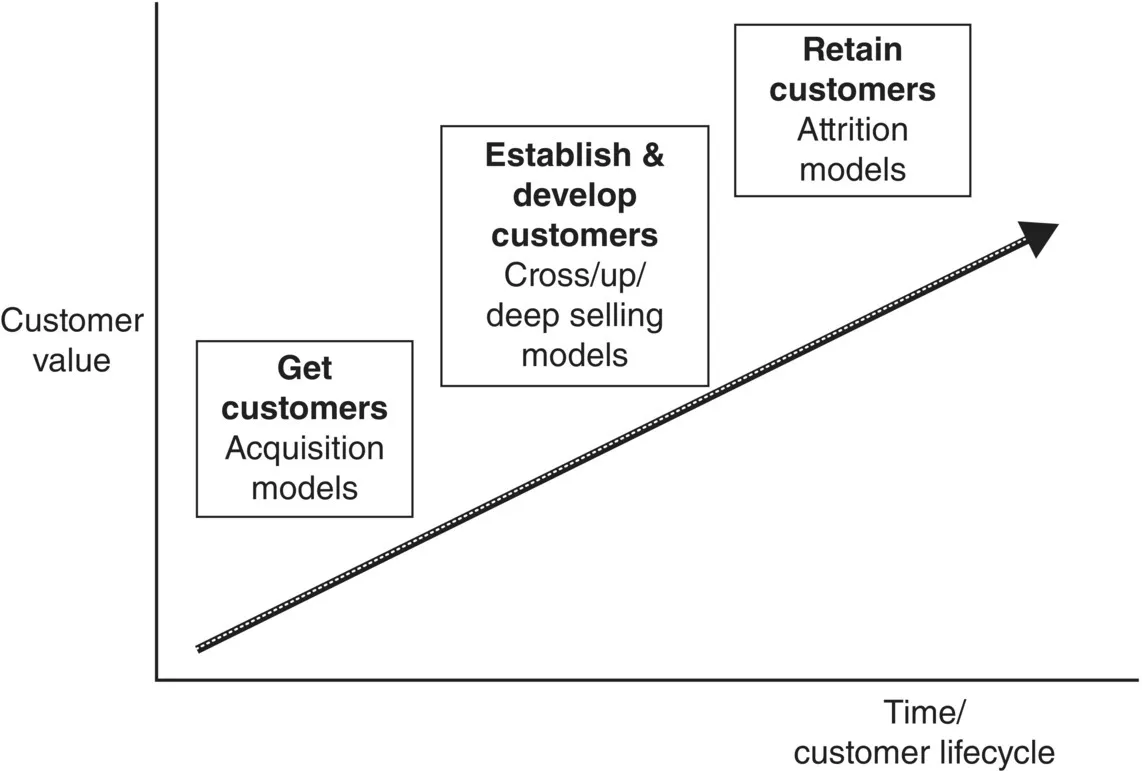
Data mining can provide customer insight which is vital for these objectives and for establishing an effective CRM strategy. It can lead to personalized interactions with customers and hence increased satisfaction and profitable customer relationships through data analysis. It can offer individualized and optimized customer management throughout all the phases of the customer life cycle, from acquisition and establishment of a strong relationship to attrition prevention and win-back of lost customers. Marketers strive to get a greater market share and a greater share of their customers. In plain words, they are responsible for getting, developing, and keeping the customers. Data mining can help them in all these tasks, as shown in Figure 1.1.
Figure 1.1Data mining and customer life cycle management.
Source: Tsiptsis and Chorianopoulos (2009). Reproduced with permission from Wiley
More specifically, the marketing activities that can be supported with the use of data mining include:
Customer segmentation
Segmentation is the process of dividing the customer base in distinct and homogeneous groups in order to develop differentiated marketing strategies according to their characteristics. There are many different segmentation types according to the specific criteria/attributes used for segmentation. In behavioral segmentation, customers are grouped based on behavioral and usage characteristics. Although behavioral segments can be created using business rules, this approach has inherent disadvantages. It can handle only a few segmentation fields, and its objectivity is questionable as it is based on the personal perceptions of a business expert. Data mining on the other hand can create data-driven behavioral segments. Clustering algorithms can analyze behavioral data, identify the natural groupings of customers, and suggest a grouping founded on observed data patterns. Provided it is properly built, it can uncover groups with distinct profiles and characteristics and lead to rich, actionable segmentation schemes with business meaning and value.
Data mining can also be used for the development of segmentation schemes based on the current or expected/estimated value of the customers. These segments are necessary in order to prioritize the customer handling and the marketing interventions according to the importance of each customer.
Direct marketing campaigns
Marketers carry out direct marketing campaigns to communicate a message to their customers through mail, Internet, e-mail, telemarketing (phone), and other direct channels in order to prevent churn (attrition) and drive customer acquisition and purchase of add-on products. More specifically, acquisition campaigns aim at drawing new and potentially valuable customers from the competition. Cross/deep/up-selling campaigns are rolled out to sell additional products, more of the same product, or alternative but more profitable products to the existing customers. Finally, retention campaigns aim at preventing valuable customers from terminating their relationship with the organization.
These campaigns, although potentially effective, when not refined can also lead to a huge waste of resources and to the annoyance of customers with unsolicited communication. Data mining and classification (propensity) models in particular can support the development of targeted marketing campaigns. They analyze the customer characteristics and recognize the profile of the target customers. New cases with similar profiles are then identified, assigned a high propensity score, and included in the target lists. Table 1.1 summarizes the use of data mining models in direct marketing campaigns.
Table 1.1 Data mining models and direct marketing campaigns
Source: Tsiptsis and Chorianopoulos (2009).
Business objective
Marketing campaign
Data mining models
Getting customers
Acquisition: finding new customers and expanding the customer base with new and potentially profitable customers
Acquisition classification models can be used to recognize potentially profitable prospect customers by finding “clones” of existing valuable customers in lists of contacts
Developing customers
Cross selling: promoting and selling additional products/services to existing customers
Up selling: offering and switching customers to premium products, other products more profitable than the ones that already have
Deep selling: increasing usage of the products/services that customers already have
Cross/up/deep-selling classification models can reveal the existing customers with purchase potentials
Retaining customers
Retention: prevention of voluntary churn, with priority given to presently or potentially valuable customers at risk
Voluntary attrition (churn) models can identify early churn signals and discern the customers with increased likelihood of voluntary churn
When properly built, propensity models can identify the right customers to contact and lead to campaign lists with increased concentrations of target customers. They outperform random selections as well as predictions based on business rules and personal intuitions.
Market basket and sequence analysis
Data mining and association models in particular can be used to identify related products, typically purchased together. These models can be used for market basket analysis and for the revealing of bundles of products/services that can be sold together. Sequence models take into account the order of actions/purchases ...
Table of contents
Cover
Title page
Table of Contents
Preface
Acknowledgments
1 An overview of data mining: The applications, the methodology, the algorithms, and the data
Part I: The Methodology
Part II: The Algorithms
Part III: The Case Studies
Bibliography
Index
End User License Agreement
Trusted by 375,005 students
Access to over 1.5 million titles for a fair monthly price.
Study more efficiently using our study tools.
Frequently asked questions
Yes, you can cancel anytime from the Subscription tab in your account settings on the Perlego website. Your subscription will stay active until the end of your current billing period. Learn how to cancel your subscription
No, books cannot be downloaded as external files, such as PDFs, for use outside of Perlego. However, you can download books within the Perlego app for offline reading on mobile or tablet. Learn how to download books offline
Perlego offers two plans: Essential and Complete
Essential is ideal for learners and professionals who enjoy exploring a wide range of subjects. Access the Essential Library with 800,000+ trusted titles and best-sellers across business, personal growth, and the humanities. Includes unlimited reading time and Standard Read Aloud voice.
Complete: Perfect for advanced learners and researchers needing full, unrestricted access. Unlock 1.5M+ books across hundreds of subjects, including academic and specialized titles. The Complete Plan also includes advanced features like Premium Read Aloud and Research Assistant.
Both plans are available with monthly, semester, or annual billing cycles.
We are an online textbook subscription service, where you can get access to an entire online library for less than the price of a single book per month. With over 1.5 million books across 990+ topics, we’ve got you covered! Learn about our mission
Look out for the read-aloud symbol on your next book to see if you can listen to it. The read-aloud tool reads text aloud for you, highlighting the text as it is being read. You can pause it, speed it up and slow it down. Learn more about Read Aloud
Yes! You can use the Perlego app on both iOS and Android devices to read anytime, anywhere — even offline. Perfect for commutes or when you’re on the go. Please note we cannot support devices running on iOS 13 and Android 7 or earlier. Learn more about using the app
Yes, you can access Effective CRM using Predictive Analytics by Antonios Chorianopoulos in PDF and/or ePUB format, as well as other popular books in Mathematics & Probability & Statistics. We have over 1.5 million books available in our catalogue for you to explore.