How can you communicate effectively and create meaningful interactions in an increasingly digital world? By teaching.
In Make Yourself Clear, educational experts and entrepreneurs Reshan Richards and Stephen J. Valentine explain the many parallels between teaching and business and offer companies, both large and small, concrete advice for building the teaching capacity of their salespeople, leaders, service professionals, and trainers.
The rise of digital communications has led to three emergent, often problematic, forces: automation, an increase in the speed and volume of information transfer, and an unmet need for people to feel more than satisfied in their interpersonal transactions, particularly between sellers and consumers.
Through a mix of research, anecdotes, case studies, and theoretical speculation, this book equips readers to build understanding within their current and future audiences by leveraging the tools, methods, and mindsets used by successful teachers. You will be equipped to understand others better, and in turn, to be better understood.
Make Yourself Clear is not prescriptive, nor does it suggest rigid steps, pillars, or frameworks. Instead, it provides immediately recognizable and relatable context, suggesting actions that can be tried, measured, tested, and iterated upon in any communication context that involves the exchange of information and ideas.
Ground your business communications in proven techniques
Profit from expert instruction given by those who have helped thousands of readers and workshop students
Develop your sales career by applying effective teaching practices to customer and colleague interactions
For educators, adopt the latest best practices into your teaching style
Backed by thorough research and extensive real-world testing, Make Yourself Clear opens a door to more productive communication and more effective interactions. It offers compelling and relevant insights to longtime fans of the work of Richards and Valentine and newcomers alike, leading to real and lasting benefits.
Teaching matters for business because learning fuels modern day organizations and entrepreneurs. It's not surprising, for example, to find that Adam Robinson is not only the cofounder of a successful test‐prep company, but also a chess master. He's a masterful learner, and most likely, through a combination of hard work, intuition, and natural aptitude, he cracked the codes of these two complicated systems and then mapped the fastest routes through them. His operating principle? “Outflanking and outsmarting the competition” (Robinson, 2018).
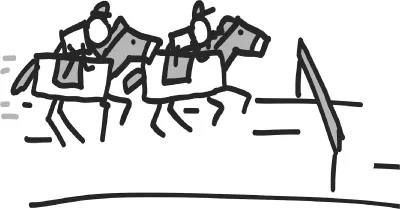
Folks like Robinson build off the parallels between the art of teaching and good business practices. One of his key insights originates with a behavioral study by psychology professor and decision researcher, Paul Slovic. Slovic studied the effects of information on eight professional horse handicappers, that is, people who bet on the outcomes of horse races for a living. Would knowing more help them to perform better?
In the first round of the experiment, they were given five pieces of information that they deemed most useful for their line of work and were asked to make predictions, based on the information, on the probable outcome of races. In the last round, they were given 40 pieces of information, and likewise, asked to use it to bet on horses.
Here's what happened:
[The] average accuracy of predictions remained the same regardless of how much information the handicappers had…Three…showed less accuracy as the amount of information increased, two improved their accuracy, and three were unchanged. All…expressed steadily increasing confidence in their judgments as more information was received. (Heuer, 1999)
The variance in accuracy is interesting, but the real story begins, as all good con jobs begin, at the point where confidence is built up in the mark. More information, more facts, more supposed insight, did not lead to better outcomes for the horse handicappers. Those inputs only led to increased certainty for them, only led to a situation in which they could con themselves into behaving in a way that would not, ultimately, help themselves.
The same ruts hold for investors, according to chessmaster Robinson. In a Q&A he did for the Tim Ferriss Podcast, he expounds upon Slovic's study, taking some swipes at human nature in the process. If, for example, he sees certain investors touting the fact that it “makes no sense” that a particular sector, say, energy, is trading at increasingly lower prices, he often concludes that the sector has lower to go because those same investors are “probably doubling down on their original decision to buy energy stocks.” Eventually, as a result of their confidence in their own narrative, “they'll be forced to throw in the towel and have to sell those energy stocks, driving prices still lower” (The Tim Ferris Show, 2018).
Robinson, importantly, is not saying that he can read the market or predict the future. He's simply stating that he himself prefers to bet on the fact that human reactions to the world are often based on their models of the world. Like some poker players, he prefers to play the people at the table rather than the cards in his hand. He prefers to watch where the people are likely to go wrong, and then work with that.
A Preoccupation of Seesaws
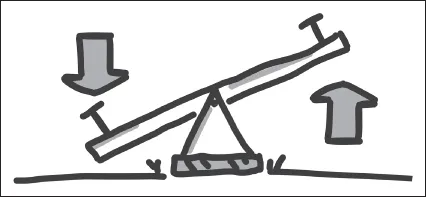
The overarching metaphor for this section is a seesaw. Yes, the dual‐player game wherein a long board is placed over a central pivot point, allowing one player to go up while the other goes down, and vice versa. Come to think of it, it is not really a game. It is more of a preoccupation, wherein both parties concentrate on the action, engrossed for as long as it holds their attention. While the board is in motion, there is no end and no beginning. When one person decides to stop – sometimes by rudely jumping off and sending the other person plummeting toward the dirt – the preoccupation ends. For the game to continue, both players have to be mutually invested in the outcome – and each other.
We will not mention a seesaw explicitly until further on, but we hope this image might help you to make meaning as you read. We are borrowing this move from some of the best teachers we know, ones who create mental frameworks for their lessons, often through extended analogies, to help students collect, store, and recall information.
Add Yourself to the Situation
In a business relationship or transaction, we're likely to go wrong when we remove ourselves from situations that require our presence.
Allowing a robot to answer your phone might save you money, but it can also cost you customers if they begin to feel alienated and so go looking for a company with a touch more like their own. Sending an email blast to hundreds (or thousands) of prospective customers for your software, even if it's personalized with their names in the salutation, may increase your yield of meetings, but it can also create a negative association with your name or company when you send your second or third touch point. Automatically scoring a check for understanding following a training on a new home insurance offering is easy to measure and convenient for sharing results, but it may certify too soon someone's readiness to use that training knowledge in the field.
While there may be reasons to automate certain transactions or business interactions, ineffective automation – or too much – reduces essential components of business relationships, making them inauthentic.
Authenticity, in an increasingly networked world, is an essential starting point for the ways in which we design our business interactions. And, admittedly, it's a bit squishy. Ask a neighbor, and she'll be likely to define it as “being yourself” or “a means by which you can establish trust.” Ask an academic, and you're likely to hear a long litany of words like “sincerity” and “irony,” along with their historical underpinnings. Ironically, if we're tracing authenticity's academic lineage, we'll find that it can be manufactured. We'll find that it can be fake. That, sincerely, it can be insincere.
For us, focused as we are on the interactions that drive sales, service, training, and leadership in companies large and small, authenticity happens for others when they know that a person – not a machine – is overseeing a transaction in which they are involved. A machine might help to move that transaction along; a machine might make that transaction more efficient; ultimately, though, in an authentic exchange, a human has oversight.
Bust Up Bias to Build Understanding
Robinson is not the only one who has the market cornered on watching where people are likely to go wrong. The best teachers do the same thing, and seeing it their way can help business professionals to cultivate deep and meaningful relationships.
The best teaching science suggests, as pro forma practice, uncovering flaws in learners' approach to material. It is one of the reasons successful teachers prefer to ask questions, offering plenty of “wait time” before calling on someone, rather than simply lecturing students on a topic.
From a learning science point of view, if you want to help people or change their minds or inspire action in them, you first have to find ways to disrupt their misunderstandings or biases, especially, and most critically, when both seem to be right or when both seem to be, for the most part, working tolerably well.
Here is something counterintuitive. The truth of a discipline is important, but it is nearly impossible to bring students – or clients, colleagues, customers, or managers – to that truth if you are only pointing at it or, worse, pounding them over the head with it with an insistence that the truth is worth knowing. When you are trying to teach people something, and you really want them to understand it, remember this: you learned whatever you're teaching because it became personal for you or stirred up an interest and commitment. Others will only learn it from you if they can access a similar well of motivation – enough to help them sidestep and even overcome their own baked‐in cognitive flaws.
To move a student toward the truth, then, as any good teacher will tell you, you have to be looking at the student, at the person in whom you are trying to build understanding. You cannot just reduce the person to a type; you have to be close to him or her. From educational literature, we recommend the analogy of peering “inside the black box” of understanding (Black & Wiliam, 1998). You need access to the box in order to figure out how to move people to knowledge, skills acquisition, or action.
For example, an effective math teacher knows that a student often has to overcome his or her own certainty. In mathematics, students have to learn to use valid procedures and to understand the concepts that underpin them. Difficulties can arise when students learn strategies that apply only in limited contexts and do not realize that they are inadequate elsewhere.
As such, a skillful teacher relies on one of the oldest technologies know to humankind: the artful question.
Questioning must then be designed to bring out these strategies for discussion and to explore problems in understanding the co...
Table of contents
COVER
TABLE OF CONTENTS
FOREWORD
ACKNOWLEDGMENTS
ABOUT THE AUTHORS
INTRODUCTION: WORKING AT THE INTERSECTION OF TEACHING AND BUSINESS
PART 1: AUTHENTICITY
PART 2: IMMEDIACY
PART 3: DELIGHT
CONCLUSION: CLOSING THE CLASS
AFTERWORD: HOW WE DESIGNED THIS READING EXPERIENCE
REFERENCES
INDEX
END USER LICENSE AGREEMENT
Trusted by 375,005 students
Access to over 1.5 million titles for a fair monthly price.
Study more efficiently using our study tools.
Frequently asked questions
Yes, you can cancel anytime from the Subscription tab in your account settings on the Perlego website. Your subscription will stay active until the end of your current billing period. Learn how to cancel your subscription
No, books cannot be downloaded as external files, such as PDFs, for use outside of Perlego. However, you can download books within the Perlego app for offline reading on mobile or tablet. Learn how to download books offline
Perlego offers two plans: Essential and Complete
Essential is ideal for learners and professionals who enjoy exploring a wide range of subjects. Access the Essential Library with 800,000+ trusted titles and best-sellers across business, personal growth, and the humanities. Includes unlimited reading time and Standard Read Aloud voice.
Complete: Perfect for advanced learners and researchers needing full, unrestricted access. Unlock 1.5M+ books across hundreds of subjects, including academic and specialized titles. The Complete Plan also includes advanced features like Premium Read Aloud and Research Assistant.
Both plans are available with monthly, semester, or annual billing cycles.
We are an online textbook subscription service, where you can get access to an entire online library for less than the price of a single book per month. With over 1.5 million books across 990+ topics, we’ve got you covered! Learn about our mission
Look out for the read-aloud symbol on your next book to see if you can listen to it. The read-aloud tool reads text aloud for you, highlighting the text as it is being read. You can pause it, speed it up and slow it down. Learn more about Read Aloud
Yes! You can use the Perlego app on both iOS and Android devices to read anytime, anywhere — even offline. Perfect for commutes or when you’re on the go. Please note we cannot support devices running on iOS 13 and Android 7 or earlier. Learn more about using the app
Yes, you can access Make Yourself Clear by Dr. Reshan Richards,Dr. Stephen J. Valentine,Stephen J. Valentine in PDF and/or ePUB format, as well as other popular books in Business & Leadership. We have over 1.5 million books available in our catalogue for you to explore.