A practical and accessible guide to managing a successful project
Effective Project Management is based around an activities and action check list approach to project management. It provides a guide to the basic principles and the disciplines that managers need to master in order to be successful. The author's check lists approach (based on his years of practical experience on projects) ensure that project managers are following valid processes, helping them to be innovative in their approach to developing plans and resolving problems. In addition, the author's check list pick and mix format is designed to be flexible in order to meet the individual needs of the reader.
Effective Project Management also contains some information on the theories underpinning project management. Knowledge of the theory helps in the understanding of how project management works in practice. In addition to the book's check lists of what activities need to be performed, the author offers suggestions on how tasks could be carried out.
This important resource:
Covers a wide range of project management topics including the project management process, programme and portfolio management, initiating and contracting a project, personal skills and more
Offers a highly accessible guide to the author's verified check list approach
Presents flexible guidelines applicable for a wide range projects
Includes guidance for project managers at all levels of experience
Written for project managers working on engineering or construction projects, Effective Project Management reviews all aspects of a project from initiation and execution to project completion together with the specialist topics and personal skills needed to manage projects effectively.
Projects can be anything: a capital facility, an information system, a piece of research, a company merger, an organizational change, launching a product, or decommissioning a facility, and so on. They can range from capital intensive technological and infrastructure investments to labour‐intensive health care. All projects types need a description, a scope, and the associated specifications for the quality required, and they cannot be realized without a team of people to develop them. The fundamental characteristic of all projects is that they create and cause change. As such, they come up against resistance. Consequently, leadership is needed in the form of a project manager, and a project management process is required to control them. (See Section B.)
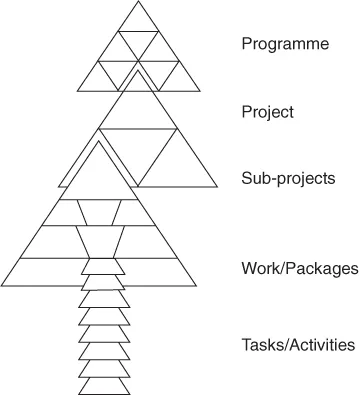
There is a hierarchy to projects determined by their size, complexity, and the inherent risks (see Figure I.A.1). At the lowest hierarchical level are the routines, tasks that are so common and so well developed in a function that methods of working have ironed out all the difficulties. Next in the hierarchy are those frequently occurring packages of work – small projects that are very similar and can be developed without too much specialized management and theoretically do not present any significant risks. There are lots of them in an organization and they can be performed without any real difficulty. These are called the runners.
Figure I.A.1
At the next level of the hierarchy are larger projects that the organization performs reasonably regularly; they are very similar or replicate previous projects. Naturally, they are called repeaters. The development of repeaters has become more specialized, less routine, and more individually project‐focused. As a consequence they have a higher risk of failure. They need someone experienced in project management because the real risk with them is that people assume they are repeats. The reality is that they have differences that, if ignored, could cause project failure. Then come the projects that are infrequent and more unusual, they become strangers to an organizations normal method of working. They are large projects and are high risk projects as far as the organization is concerned. As a consequence, they need someone to manage them, who is skilled and experienced in project management. Finally, the mega project, the first of a kind, the once‐in‐a‐career opportunity are the aliens, consisting of a programme of large projects. (Part II addresses programme management).
‘Every project begins on paper as an ideal, as a vision of perfection and quickly becomes mired in the confusion of budget, size and opposition of NIMBY’s'.2 Consequently, the best way to start a project is to carry out a feasibility study that results in a clear brief and statement of the requirements (see Part III). Nevertheless, there are features that are common to all projects regardless of size.
1 Characteristics
1.1 Unique Non‐repetitive
A primary characteristic of projects: a product, a development, a task, or a deliverable is that they are unique and are non‐repetitive.
1.2 Phases
Secondly, because projects start with a unique idea or concept, they go through a series of growth phases in order to achieve an outcome.
1.3 Risk
Projects are risky due to the very uniqueness of their nature. The risks are then compounded by the changes that can occur during the project's development. The severity, impact and consequences of the risks incurred are related to the hierarchical position of the project, as described above.
1.4 Business Objectives
Projects come into being because they will provide benefits to an owner and a return on their investment; they have a purpose. The business requirements of a project become the owner's objectives. They then get translated into specific objectives for the management of the project (see Section B).
1.5 Liable to Changes
Projects almost invariably change in scope, often by very large factors, due to changing business requirements and market conditions.
It is typically necessary to reduce the costs involved in order to make the project financially viable and to make the business case acceptable. This will usually mean reducing the scope or specification of the project – see Figure ...
Table of contents
Cover
Table of Contents
Dedication
Preface
Acknowledgements
Introduction
Part I: Projects and Their Management
Part II: Programme Management
Part III: Feasibility and Contracting
Part IV: Project Execution
Part V: Specialist Topics
Part VI: Skills Check Lists
Abbreviations
Index
End User License Agreement
Trusted by 375,005 students
Access to over 1.5 million titles for a fair monthly price.
Study more efficiently using our study tools.
Frequently asked questions
Yes, you can cancel anytime from the Subscription tab in your account settings on the Perlego website. Your subscription will stay active until the end of your current billing period. Learn how to cancel your subscription
No, books cannot be downloaded as external files, such as PDFs, for use outside of Perlego. However, you can download books within the Perlego app for offline reading on mobile or tablet. Learn how to download books offline
Perlego offers two plans: Essential and Complete
Essential is ideal for learners and professionals who enjoy exploring a wide range of subjects. Access the Essential Library with 800,000+ trusted titles and best-sellers across business, personal growth, and the humanities. Includes unlimited reading time and Standard Read Aloud voice.
Complete: Perfect for advanced learners and researchers needing full, unrestricted access. Unlock 1.5M+ books across hundreds of subjects, including academic and specialized titles. The Complete Plan also includes advanced features like Premium Read Aloud and Research Assistant.
Both plans are available with monthly, semester, or annual billing cycles.
We are an online textbook subscription service, where you can get access to an entire online library for less than the price of a single book per month. With over 1.5 million books across 990+ topics, we’ve got you covered! Learn about our mission
Look out for the read-aloud symbol on your next book to see if you can listen to it. The read-aloud tool reads text aloud for you, highlighting the text as it is being read. You can pause it, speed it up and slow it down. Learn more about Read Aloud
Yes! You can use the Perlego app on both iOS and Android devices to read anytime, anywhere — even offline. Perfect for commutes or when you’re on the go. Please note we cannot support devices running on iOS 13 and Android 7 or earlier. Learn more about using the app
Yes, you can access Effective Project Management by Garth G.F. Ward in PDF and/or ePUB format, as well as other popular books in Technology & Engineering & Construction & Architectural Engineering. We have over 1.5 million books available in our catalogue for you to explore.