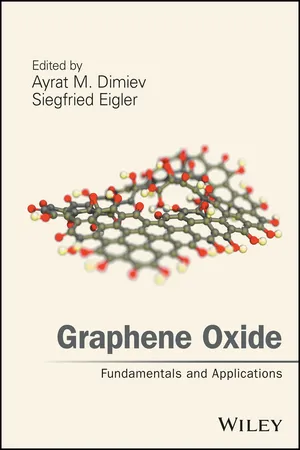
Due to its unique properties, graphene oxide has become one of the most studied materials of the last decade and a great variety of applications have been reported in areas such as sensors, catalysis and biomedical applications.
This comprehensive volume systematically describes the fundamental aspects and applications of graphene oxide. The book is designed as an introduction to the topic, so each chapter begins with a discussion on fundamental concepts, then proceeds to review and summarize recent advances in the field. Divided into two parts, the first part covers fundamental aspects of graphene oxide and includes chapters on formation and chemical structure, characterization methods, reduction methods, rheology and optical properties of graphene oxide solutions. Part Two covers numerous graphene oxide applications including field effect transistors, transparent conductive films, sensors, energy harvesting and storage, membranes, composite materials, catalysis and biomedical applications. In each case the differences and advantages of graphene oxide over its non-oxidised counterpart are discussed. The book concludes with a chapter on the challenges of industrial-scale graphene oxide production.
Graphene Oxide: Fundamentals and Applications is a valuable reference for academic researchers, and industry scientists interested in graphene oxide, graphene and other carbon materials.
eBook - ePub
Graphene Oxide
Fundamentals and Applications
- English
- ePUB (mobile friendly)
- Available on iOS & Android
eBook - ePub
Graphene Oxide
Fundamentals and Applications
About this book
Information
Part I
Fundamentals
1
Graphite Oxide Story – From the Beginning Till the Graphene Hype
Anton Lerf
1.1 Introduction
The formation of graphite oxide (GO) was described for the first time by Brodie in a short note that appeared in 1855 in Annales de Chimie in French [1]. Another preparation method – the reaction of graphite with potassium chlorate in fuming nitric acid, now known as the “Brodie method” – and a detailed description of the composition and the chemical properties of the new compound were published in 1859 in the Philosophical Transactions of the Royal Society of London [2]. One year later this paper was published in both French and German translations [3, 4]. The titles of all these papers [1–4] do not give any hint of a new carbon compound. The title of the English version is as follows: “On the atomic weight of graphite”. The new compound was called “oxyde de graphite” in the first publication, and “graphitic acid” in the later papers. It is also worth mentioning that Brodie himself did not cite his first work on the new compound.
The actual aim of Brodie’s scientific work presented in his publications was to differentiate by means of chemical methods various forms of carbon with dissimilar properties but all called graphite. Among the reactions described in the second paper, there was also the treatment of graphite with a mixture of concentrated nitric and sulfuric acids, leading to the graphite sulfate intercalation compound. The graphite intercalation compound was described for the first time by Schafhäutl [5] (pp. 155–157) in 1840, but it was hidden in two other publications devoted almost exclusively to iron–carbon steels. This might be the reason why Brodie was not aware of this data, and did not cite it. On the other hand, the content of the first paper had been presented before in the London and Edinburgh Philosophical Magazine. In the paper of 1859, Schafhäutl [6] (pp. 300–301) complained that nobody took notice of his result.
The circumstances of the beginning of the GO story have been outlined in extenso because of their curiousness. In 1865 Gottschalk [7] reproduced and confirmed the results of Brodie. In his publication the term “graphitic acid” appeared for the first time in the title: “Beiträge zur Kenntnis der Graphitsäure” (“Contributions to the knowledge of graphitic acid”). GO received greater attention only due to the publication of Berthelot [8] in 1870 in which he proclaimed Brodie’s procedure for the preparation of GO as a method to distinguish different forms of graphitic carbon, although Brodie had already described the different behavior of various graphite forms toward oxidation reactions earlier.
In 1898 Staudenmaier [9] discussed in detail the problems and disadvantages of the various preparation methods existing up to the end of the nineteenth century. He also described his trials to find more convenient and less dangerous preparation methods, and presented the new preparation method which is named after him to the present day.
Of utmost importance is the publication of Kohlschütter and Haenni in 1919 [10]. It marks the end of the classical research on GO, which was based on classical chemical analysis and a careful description of the reaction behavior. On the one hand, it carefully reviews and evaluates all the previous publications on the topic. Based on crystallographic considerations, reproducing the results of Brodie [2] and Weinschenk [11], the authors consider the close structural correlation between graphite and GO as evidence for a “topotactic” relation. This paper presents new data for the formation of GO, its thermal decomposition and chemical reduction, and the products of chemical reduction. Also, in this publication, the authors discarded their own previous pessimistic view that GO could be nothing other than an adsorption of CO and CO2 at graphite surfaces.
A new period of GO research was opened by Hofmann in 1928 [12] and by Hofmann and Frenzel in 1930 [13] by applying for the first time powder X‐ray diffraction (XRD) to GO. Based on these investigations and chemical considerations, Hofmann and his school of researchers gave the first structural model of GO to find general acceptance. This period of research started in 1928, continued through 1930 and 1934 with the first structural models by Thiele [14] and Hofmann et al. [15], and ended in 1969 with a new structural model proposed by Scholz and Boehm [16]. During this period, GO structural models were modified several times, mainly due to the debate between Hofmann and Thiele, and due to the application of new spectroscopy methods allowing the proof of assumptions about the functional groups playing a role in the chemistry of GO.
The third period of activity on GO was initiated by the first application of magic angle spinning nuclear magnetic resonance (MAS NMR) on 13C by Mermoux et al. in 1989–1991 [17, 18]. In the extended publication [18], the authors questioned the structural model of Scholz and Boehm [16] and credited the model of Ruess [19] as the one that best fitted their data. However, later this interpretation was questioned again [20]. The interpretation of the 60 ppm signal as originating from epoxide functions revitalized the first model of Hofmann et al. [15], with some modifications [20]. This model has been confirmed in various studies [21], but is now again questioned by a two‐component model [22].
Graphite oxide was a laboratory c...
Table of contents
- Cover
- Title Page
- Table of Contents
- About the Editors
- List of Contributors
- Foreword
- Preface
- Part I: Fundamentals
- Part II: Applications
- Vocabulary
- Index
- End User License Agreement
Trusted by 375,005 students
Access to over 1.5 million titles for a fair monthly price.
Study more efficiently using our study tools.
Frequently asked questions
Yes, you can cancel anytime from the Subscription tab in your account settings on the Perlego website. Your subscription will stay active until the end of your current billing period. Learn how to cancel your subscription
No, books cannot be downloaded as external files, such as PDFs, for use outside of Perlego. However, you can download books within the Perlego app for offline reading on mobile or tablet. Learn how to download books offline
Perlego offers two plans: Essential and Complete
- Essential is ideal for learners and professionals who enjoy exploring a wide range of subjects. Access the Essential Library with 800,000+ trusted titles and best-sellers across business, personal growth, and the humanities. Includes unlimited reading time and Standard Read Aloud voice.
- Complete: Perfect for advanced learners and researchers needing full, unrestricted access. Unlock 1.5M+ books across hundreds of subjects, including academic and specialized titles. The Complete Plan also includes advanced features like Premium Read Aloud and Research Assistant.
We are an online textbook subscription service, where you can get access to an entire online library for less than the price of a single book per month. With over 1.5 million books across 990+ topics, we’ve got you covered! Learn about our mission
Look out for the read-aloud symbol on your next book to see if you can listen to it. The read-aloud tool reads text aloud for you, highlighting the text as it is being read. You can pause it, speed it up and slow it down. Learn more about Read Aloud
Yes! You can use the Perlego app on both iOS and Android devices to read anytime, anywhere — even offline. Perfect for commutes or when you’re on the go.
Please note we cannot support devices running on iOS 13 and Android 7 or earlier. Learn more about using the app
Please note we cannot support devices running on iOS 13 and Android 7 or earlier. Learn more about using the app
Yes, you can access Graphene Oxide by Ayrat M. Dimiev, Siegfied Eigler, Ayrat M. Dimiev,Siegfied Eigler in PDF and/or ePUB format, as well as other popular books in Naturwissenschaften & Physikalische & theoretische Chemie. We have over 1.5 million books available in our catalogue for you to explore.