A newly updated, lavishly illustrated account of the ANZACs involvement in the Western Front—complete with walking and driving tours of 28 battlefields.
With rare photographs and documents from the Australian War Memorial archive and extensive travel information, this is the most comprehensive guide to the battlefields of the Western Front on the market. Every chapter covers not just the battles, but the often larger-than-life personalities who took part in them. Following a chronological order from 1916 through 1918, the book leads readers through every major engagement the Australian and New Zealanders fought in and includes tactical considerations and extracts from the personal diaries of soldiers.
Anzacs On The Western Front: The Australian War Memorial Battlefield Guide is the perfect book for anyone who wants to explore the battlefields of the Western Front, either in-person or from the comfort of home. It does far more than show where the lines that generals drew on their maps actually ran on the ground and retrace the footsteps of the men advancing towards them. It is a graphic and wide-ranging record of the Australian and New Zealand achievements, and of the huge sacrifices both nations made, in what is still arguably the most grueling episode in their history.
A complete guide to the ANZAC battlefields on the Western Front—featuring short essays on important personalities and events, details on relevant cemeteries, museums, memorials and nearby places of interest, and general travel information.
Carefully researched and illustrated with colorful maps and both modern and period photographs.
Includes information about the Sir John Monash Centre near Villers-Bretonneux in France—a new interpretative museum set to open on Anzac Day 2018, coinciding with the centenary of the Year of Victory 1918.
Anzacs On The Western Front: The Australian War Memorial Battlefield Guide is the perfect book for historians, history buffs, military enthusiasts, and Australians and New Zealanders who want to explore the military history and battlefields of their heritage.
Trusted by 375,005 students
Access to over 1.5 million titles for a fair monthly price.
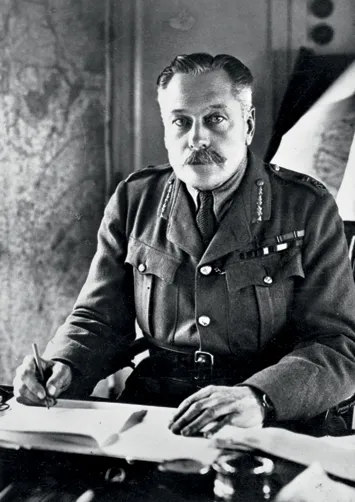
‘Splendid, fine physique, very hard and determined looking … The Australians are also mad keen to kill Germans and to start doing it at once’, the BEF’s commander-in-chief, General Sir Douglas Haig, wrote after reviewing the 7th Brigade on 27 March 1916. It had just arrived on the Western Front. Six weeks later, the New Zealand Division and the 2nd and 1st Australian Divisions of I ANZAC were side by side in that order on the right flank of the Second Army. They held the 15 kilometres of front in French Flanders that stretched from the River Lys and past the town of Armentières to a point opposite the Sugarloaf, a German salient near the village of Fromelles. Called the Bois-Grenier sector — although the Australians knew it as the Fleurbaix sector, after the half-ruined village two kilometres behind the line — the area had seen no serious fighting for almost a year. The BEF used it as a ‘nursery’ where new formations could be introduced to trench warfare. In June and July respectively, the 4th and 5th Australian Divisions also received their baptism of fire there, as did the 3rd, in November.
The line
In contrast to the precipitous terrain at ANZAC on the Gallipoli peninsula, the nursery was barely above sea level and ironing-board flat. Where ANZAC was parched, the nursery was covered by coarse, scrubby grass that had choked the crops in the abandoned fields. Where the opposing trenches at ANZAC were virtually on top of one another, the width of no-man’s-land in the nursery varied from as little as 70 metres to as much as 450 metres. As the water table was 45 centimetres below the surface, diggings soon filled with slush. Both sides built upwards.
Though referred to as a trench, the front line was really a breastwork of earth-filled sandbags. The support line was 70 metres to 90 metres rearwards, supposedly far enough back to prevent both lines being bombarded simultaneously. If the Germans broke into the front line, reserves would concentrate for counterattacks in the appropriately named reserve line another 450 metres back. Communication trenches, spaced 230 metres apart and often dubbed ‘avenues’, led to the front-line system. Comprising posts and trenches that would only be garrisoned in an emergency, the second line was 1.5 kilometres further in rear. This was the standard arrangement for the trenches along the entire Western Front. In what was also standard, the Germans held the high ground, in this case the Aubers Ridge, along which their second line ran through the villages of Aubers, Fromelles and Le Maisnil. It was more like a flattened speed bump than a ridge but it still gave the Germans excellent views.
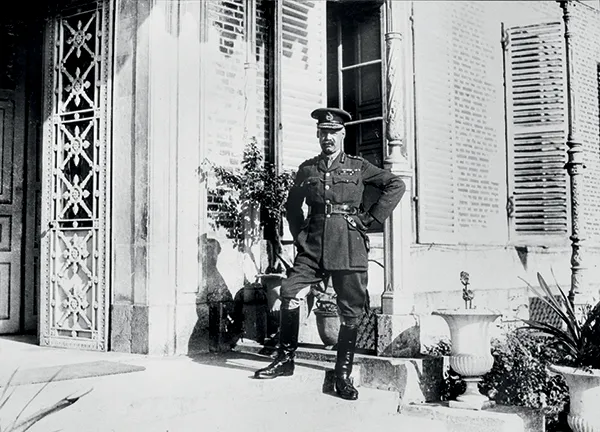
General Sir Douglas Haig. He was promoted field marshal on 1 January 1917.
Heaven after hell?
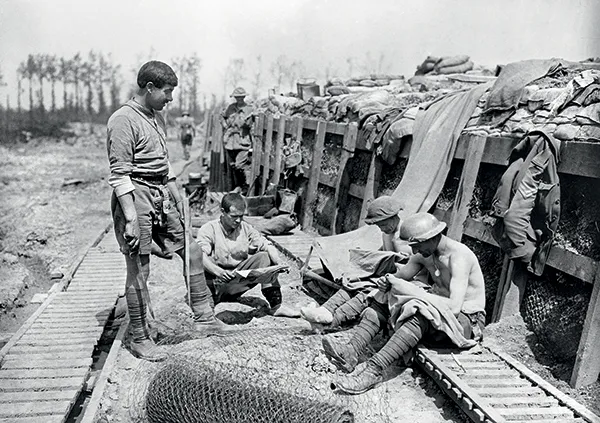
Charles Bean, the Australian Official Correspondent and, later, Official Historian, wrote of the early days in the nursery that ‘the sound of a rifle shot rarely broke the silence’. One ANZAC veteran likened it to ‘heaven after hell’. At ANZAC everything had been scarce except for the unvarying ration of corned beef, apricot jam, cheese and biscuit, and there was no safe area where battalions could rest. In the nursery water was piped forward, and fresh meals were brought up from field kitchens. After leaving the line, battalions walked through green fields to billets in villages and farms for reasonably frequent breaks. Field baths gave temporary relief from lice, although the rats were worse than on Gallipoli. Each village had its own estaminet selling wine and beer.
The one similarity with ANZAC and, for that matter, the rest of the Western Front, was the routine in the line. Day began as it ended, with stand-to, when all men were on alert to repel any German attempt to take advantage of the change from night to day routine and vice versa. After an officer had checked the cleanliness of weapons, the men would be stood down, leaving sentries to keep watch. Some of the remainder did fatigues, perhaps thickening the traverses that gave breastwork and trench the zigzag shape necessary to prevent an attacker firing along them and to localise shell or bomb explosions. Others rested. But machine-guns were manned continually and trained on selected points in the German line opposite. Night was the most active period. Patrols went out into no-man’s-land and increased fatigue parties did the repair and porterage tasks that were too hazardous by day.
Heaven after hell. Australians relax at Bois-Grenier, probably in the reserve-line breastwork. The front-line breastwork would have been higher. One man catches up on the news while two others hunt the lice in their shirts.
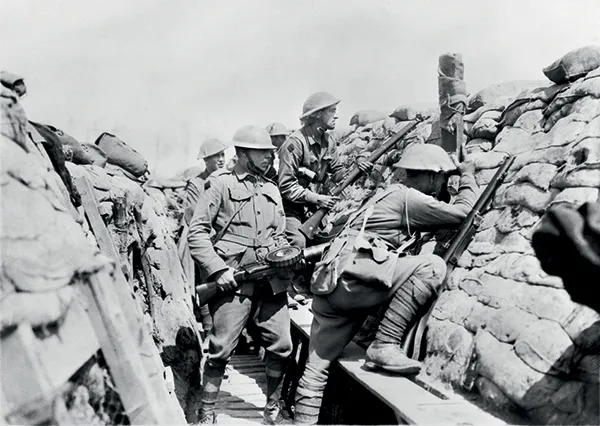
Starting with steel helmets to protect heads against shrapnel and splinters, equipment and weapons that would have been godsends at ANZAC were issued. Each battalion received four Lewis light machine-guns. By the end of the war, the same battalion would have close to 50. In place of the crude bomb improvised from a jam tin filled with odd bits of metal came the Mills bomb, whose segmented ovoid body burst into numerous small fragments each capable of killing. The standard issue per division was 52 000. Two four-tube batteries of light Stokes mortars went to each brigade. Setting up in the support line, mortar teams could lob 22 bombs per minute onto targets pinpointed by observers in the front line. The three field artillery brigades in each division received additional guns and were augmented by a howitzer brigade, whose high-angle fire had greater reach than the flatter trajectory fire of the field-guns.
The enemy
Those who cared to think about the capabilities of these new weapons realised that the Western Front, appearances in the nursery notwithstanding, would be much tougher than ANZAC. The omnipresence of aircraft was new. Gas masks, which came in handy at ANZAC to ward off the stench, now had to be employed for their true purpose. The German medium trench mortar or minenwerfer seemed more plentiful than the Stokes and was much more destructive. German snipers were deadly and could not be suppressed. German shells fell suddenly and accurately.
Steel-helmeted soldiers from the 2nd Australian Division at Bois-Grenier. The man on the left wields a newly issued Lewis-gun. Standing on the firestep, the next man peers over the parapet. As this would have been suicidal in the front line, the photo was probably taken in the support line. The order and cleanliness also suggest a staged shot.
The Australians might have impressed Haig with their keenness to kill Germans immediately but the Germans got in first. On 5 May they raided the 20th Battalion in the Bridoux Salient, near Bois-Grenier, inflicting well over 100 casualties and taking 10 prisoners as well as two Stokes mortars. As the Stokes were still secret, both Haig and the commander of the Second Army, General Sir Herbert Plumer, were livid. The Australians were embarrassed for a long time. On 30 May the 9th and 11th Battalions lost 131 men when the Germans struck at Cordonnerie Farm, three kilometres from Bridoux. Six of the eight German casualties were due to a grenade that accidentally went off when they returned to their line. Major-General Gordon Legge, the commander of the 2nd Australian Division, admitted that the initiative lay with the enemy, who was ‘somewhat superior in the offensive’. For that matter, the Germans were making the running along the entire Western Front.
Strategy
The Allied plan for 1916 had called for simultaneous summer offensives on the Eastern and Italian fronts, and on the Western Front, where the British and French would attack astride the Somme River. But in February 1916 the Germans launched a massive offensive against the French at Verdun, a historic fortress town on the Meuse River for which they hoped France would fight to the last man and, ultimately, ‘bleed to death’. According to the German calculus, Britain would be unwilling to fight on alone in the west, while Russia was tottering in the east. The Allied plan began to unravel as the French appealed for help to relieve the pressure at Verdun, while the Italians were in trouble against the Austrians. Named after the Russian general who conceived it, the famous Brusilov offensive helped the Italians but ended up costing over a million men. It hastened Russia’s collapse in 1917. Still, the Russians had done their bit. Ground down at Verdun, the French had to skimp on theirs. By mid-June they could only spare 16 divisions for the Somme offensive instead of the 39 originally offered. The BEF had to assume the main role. Haig gave the task to General Sir Henry Rawlinson’s Fourth Army.Meanwhile the rest of the BEF was to carry out as many raids as possible in order to divert German attention from Rawlinson’s preparations and wear down divisions the Germans might use as reinforcements after the offensive began.
General Sir Henry Rawlinson.
Raids
I ANZAC’s first offensive action had been a raid. These ‘minor trench operations’ were originally intended to identify the Germans opposite, usually by taking a prisoner, in the belief that a new formation signified imminent activi...
Table of contents
Cover
Title Page
Copyright
Foreword
Preface
About the author
Acknowledgements
Note to second edition
Introduction
CHAPTER 1 1916 Bois-Grenier/Fleurbaix
CHAPTER 2 1916 Fromelles
CHAPTER 3 1916 Somme: Pozières/Mouquet Farm
CHAPTER 4 1916 Somme: New Zealanders at Flers
CHAPTER 5 1916–17 Somme: Australians at Flers and Gueudecourt
CHAPTER 6 1917 Australian Advance, German Counterattack
CHAPTER 7 1917 Bullecourt
CHAPTER 8 1917 Ypres
CHAPTER 9 1917 Messines
CHAPTER 10 1917 Menin Road
CHAPTER 11 1917 Polygon Wood
CHAPTER 12 1917 Broodseinde
CHAPTER 13 1917 Passchendaele
CHAPTER 14 1918 From La Signy Farm to Puisieux
CHAPTER 15 1918 Dernancourt and Morlancourt
CHAPTER 16 1918 Villers-Bretonneux
CHAPTER 17 1918 Hazebrouck
CHAPTER 18 1918 Hamel
CHAPTER 19 1918 The German Army's black day
CHAPTER 20 1918 Somme South
CHAPTER 21 1918 Somme North
CHAPTER 22 1918 Mont St Quentin and Péronne
CHAPTER 23 1918 Hindenburg Outpost Line
CHAPTER 24 1918 Hindenburg Line
CHAPTER 25 1918 Montbrehain
CHAPTER 26 1918 The New Zealanders at Bapaume
CHAPTER 27 1918 The New Zealand Advance
CHAPTER 28 1918 The New Zealanders at Le Quesnoy
Useful information
Glossary
Select bibliography
Sources of illustrations
Index
EULA
Frequently asked questions
Yes, you can cancel anytime from the Subscription tab in your account settings on the Perlego website. Your subscription will stay active until the end of your current billing period. Learn how to cancel your subscription
No, books cannot be downloaded as external files, such as PDFs, for use outside of Perlego. However, you can download books within the Perlego app for offline reading on mobile or tablet. Learn how to download books offline
Perlego offers two plans: Essential and Complete
Essential is ideal for learners and professionals who enjoy exploring a wide range of subjects. Access the Essential Library with 800,000+ trusted titles and best-sellers across business, personal growth, and the humanities. Includes unlimited reading time and Standard Read Aloud voice.
Complete: Perfect for advanced learners and researchers needing full, unrestricted access. Unlock 1.5M+ books across hundreds of subjects, including academic and specialized titles. The Complete Plan also includes advanced features like Premium Read Aloud and Research Assistant.
Both plans are available with monthly, semester, or annual billing cycles.
We are an online textbook subscription service, where you can get access to an entire online library for less than the price of a single book per month. With over 1.5 million books across 990+ topics, we’ve got you covered! Learn about our mission
Look out for the read-aloud symbol on your next book to see if you can listen to it. The read-aloud tool reads text aloud for you, highlighting the text as it is being read. You can pause it, speed it up and slow it down. Learn more about Read Aloud
Yes! You can use the Perlego app on both iOS and Android devices to read anytime, anywhere — even offline. Perfect for commutes or when you’re on the go. Please note we cannot support devices running on iOS 13 and Android 7 or earlier. Learn more about using the app
Yes, you can access ANZACS on the Western Front by Peter Pedersen,Chris Roberts in PDF and/or ePUB format, as well as other popular books in History & Australian & Oceanian History. We have over 1.5 million books available in our catalogue for you to explore.