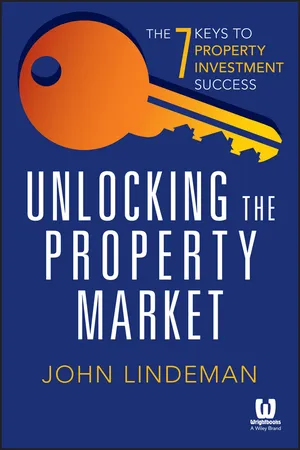
Brimming with fresh content designed to suit current trends in the market, Unlocking the Property Market shares expert property market analyst John Lindeman's tips and techniques on where to buy, what to buy, how much to pay, and when to sell. Written with your needs in mind, Lindeman reveals the seven keys to property investment success and shows you how to unlock the property market's secrets.
The media talks up a housing market boom one minute and then warns of a crash the next, but the housing market's behaviour is predictable. Housing prices move slowly upwards, and then they stagnate for some years—and may even fall for a year or two. However, there are always suburbs in any market that go against the grain and offer property investors a chance to secure the highest returns in the shortest possible time in any market condition. To find these properties, follow John Lindeman in Unlocking the Property Market and successfully discover the seven keys to property investment success including:
Understand how the market works and find locations with the best growth potential
Know where and when to buy and the best time to sell
Narrow down your property search, decide what to buy and determine how much to pay.
If you're a private housing investor or just starting out in the field looking for authoritative, accessible information on the topic, Unlocking the Property Market gives you the confidence and know-how to successfully obtain the best possible results from property investment.
This key unlocks the door to the secrets of the housing market, showing how to get the greatest benefits when you invest in residential property. You will:
see which of the 15 000 suburbs and towns in Australia are shooting stars with high imminent price-growth potential
discover where the income-generating cash cows are
learn how to find long shots if you are prepared to speculate
discover how these outcomes are generated by the three demand dynamics of the housing market:
people
purchasing power
properties
see how these demand dynamics work together to cause price and rent changes.
Many investors think that accurately predicting the property market is next to impossible. They believe that no-one is clever enough to pick the best time to buy or sell, because the housing market seems to behave in strange and unexpected ways. They rely instead on hearsay, gut feelings or speculation, and, while a few strike it lucky, most end up with results way below their expectations.
Such experiences have led many investors to adopt the buy and hold method, also known as time in the market. This ‘safety first’ strategy is based on the belief that housing prices always rise over time and that this growth evens out, so it doesn't really matter where you buy an investment property or whether prices fall for a year or two, because prices will eventually go up everywhere and, over time, all areas of the market will eventually achieve the same rate of price-growth.
This idea is simple and anyone can use it. Some experts take this notion a step further, by claiming that house prices double in value every eight or so years. On what basis are such statements made? They are built on the past performance of the housing market. Experts promoting the buy and hold theory often produce charts such as Figure 1.1, showing that house prices did indeed double in price every eight years during the 1970s and 1980s.
You can see why this theory has become so popular. If property prices double every eight years, you need to do little more than find a property in your price bracket. The location is not crucial or even important because, once a property is secured, you only need to hold and hope. But surely, if we are going to base future housing performance on the past performance of the market, we should first check to see whether our current economic, social and financial conditions are roughly the same as those prevailing during the period we are using for comparison.
Figure 1.1: house prices doubled in value every eight years from 1967 to 1990
Source: Australian National Library's online Trove facility and Mitchell Library archives.
When we do this, we find that the years from 1970 to 1990 were not typical at all, and certainly nothing like what we are experiencing or likely to experience in the foreseeable future. The 1970s and 1980s witnessed the highest inflation levels in our history; many of those years had double-digit inflation, which was responsible for much of the house price-growth. There was little real price-growth. Those who analyse the past to predict the future ignore this fact completely. Maybe they don't really understand the long-term performance of the housing market at all, or just maybe they promote this theory because it gets them off the hook. Imagine you buy a property and the price starts to fall, and keeps falling for several years. What happens if you complain to whoever advised you? They'll tell you to wait, and assure you that growth will come because it always has in the past. If prices keep falling, they may hope that you'll forget who it was that gave you such bad advice and they'll be off the hook completely.
This focus on past performance is also pushed by project marketers and developers, who use high past price-growth as an indicator of expected growth. ‘Get in quick,’ they'll tell you, ‘or you'll miss out. These properties are selling like hot cakes.’ But does past performance guarantee future growth? Some of the best-performing suburbs and towns from 2000 to 2010, where house and unit prices regularly rose by well over 10 per cent per annum, such as the Gold Coast, Mackay, Gladstone, Moranbah and Bowen, suffered massive price falls in the following years. Investors who bought in those towns at the peak of the boom in 2010 then watched in dismay as rental vacancies shot up and prices plummeted by over 50 per cent. Relying on past performance to predict the future is like trying to drive a car by looking through the rear-view mirror. It's a good method to see where you've been, but completely useless at showing you which direction the road ahead is taking.
What we've learned from historical data
The only way that past performance is going to tell us anything at all about the behaviour of the housing market is if we go back not just forty or so years, but far enough to see how it performed through economic booms, recessions and depressions, periods of high and low inflation, war and peace, easy housing finance and no finance, high population growth and low growth. In short, we need to go back in time as far as the data allows us. Luckily some academics have done just that and we can share in what they discovered. Here are their studies:
Stapledon, Nigel, Long Term Housing Prices in Australia and some Economic Perspectives. Sydney: University of NSW, 2008.
Eichholtz, Piet, M. A., A Long Run House Price Index: The Herengracht Index 1628–2008. Maastricht: Real Estate Economics, 2010.
Lindeman, John, Mastering the Australian Housing Market. Melbourne: Wrightbooks, 2011.
Conefrey, Thomas, and Karl Whelan, Demand and Prices in the US Housing Market. Dublin: Central Bank of Ireland, 2012.
The Herengracht study analysed nearly four hundred years of house price movements in Amsterdam, while Stapledon's study at the University of NSW researched over one hundred and twenty years of house price changes in Sydney. My own study, published in my previous book, Mastering the Australian Housing Market, covered Australian capital city house price movements from 1901 to 2010, while Thomas Conefrey and Karl Whelan analysed the performance of the US housing market from 1968 to 2012. All of these studies came to three very similar and quite amazing conclusions about how the housing market performs over long periods of time. The following pages summarise these findings.
House prices do not double every eight years
Figure 1.2 shows the performance of the Australian capital city housing market since 1903, and it provides a far more sombre picture than that promoted by the buy and hold advocates...
Table of contents
Cover
Title Page
Copyright
Dedication
Foreword
About the author
Introduction
Key 1: Understand how the housing market works
Key 2: Find areas with the best growth potential
Key 3: Discover where and when to buy
Key 4: Narrow down your search
Key 5: Decide what to buy
Key 6: Determine how much to pay
Key 7: Know the best time to sell
Further resources
Glossary
Index
Advert
EULA
Trusted by 375,005 students
Access to over 1.5 million titles for a fair monthly price.
Study more efficiently using our study tools.
Frequently asked questions
Yes, you can cancel anytime from the Subscription tab in your account settings on the Perlego website. Your subscription will stay active until the end of your current billing period. Learn how to cancel your subscription
No, books cannot be downloaded as external files, such as PDFs, for use outside of Perlego. However, you can download books within the Perlego app for offline reading on mobile or tablet. Learn how to download books offline
Perlego offers two plans: Essential and Complete
Essential is ideal for learners and professionals who enjoy exploring a wide range of subjects. Access the Essential Library with 800,000+ trusted titles and best-sellers across business, personal growth, and the humanities. Includes unlimited reading time and Standard Read Aloud voice.
Complete: Perfect for advanced learners and researchers needing full, unrestricted access. Unlock 1.5M+ books across hundreds of subjects, including academic and specialized titles. The Complete Plan also includes advanced features like Premium Read Aloud and Research Assistant.
Both plans are available with monthly, semester, or annual billing cycles.
We are an online textbook subscription service, where you can get access to an entire online library for less than the price of a single book per month. With over 1.5 million books across 990+ topics, we’ve got you covered! Learn about our mission
Look out for the read-aloud symbol on your next book to see if you can listen to it. The read-aloud tool reads text aloud for you, highlighting the text as it is being read. You can pause it, speed it up and slow it down. Learn more about Read Aloud
Yes! You can use the Perlego app on both iOS and Android devices to read anytime, anywhere — even offline. Perfect for commutes or when you’re on the go. Please note we cannot support devices running on iOS 13 and Android 7 or earlier. Learn more about using the app
Yes, you can access Unlocking the Property Market by John Lindeman in PDF and/or ePUB format, as well as other popular books in Business & Real Estate. We have over 1.5 million books available in our catalogue for you to explore.