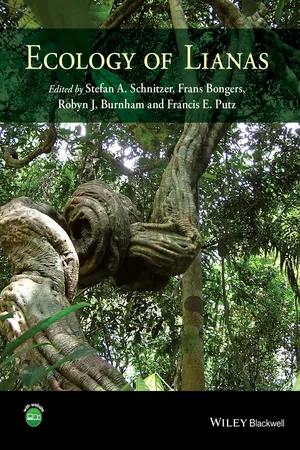
Lianas are woody vines that were the focus of intense study by early ecologists, such as Darwin, who devoted an entire book to the natural history of climbing plants. Over the past quarter century, there has been a resurgence in the study of lianas, and liana are again recognized as important components of many forests, particularly in the tropics. The increasing amount of research on lianas has resulted in a fundamentally deeper understanding of liana ecology, evolution, and life-history, as well as the myriad roles lianas play in forest dynamics and functioning.
This book provides insight into the ecology and evolution of lianas, their anatomy, physiology, and natural history, their global abundance and distribution, and their wide-ranging effects on the myriad organisms that inhabit tropical and temperate forests.
- English
- ePUB (mobile friendly)
- Available on iOS & Android
eBook - ePub
Ecology of Lianas
About this book
Information
Part I
Introduction
Chapter 1
The past, present, and potential future of liana ecology
Stefan A. Schnitzer,1,2 Francis E. Putz,3 Frans Bongers,4 and Kristina Kroening1
1 University of Wisconsin-Milwaukee, Milwaukee, WI, USA
2 Smithsonian Tropical Research Institute, Balboa, Republic of Panama
3 University of Florida, Gainesville, FL, USA
4 Wageningen University and Research Centre, Wageningen, The Netherlands
Overview
Over the past decade there has been increasing recognition of the substantial contribution of lianas to tropical and temperate forest dynamics, diversity, management, and ecosystem function. The increased interest in the ecology of lianas has apparently led to a significant increase in the number of publications focused on liana ecology. We quantified the change in this publication rate using the comprehensive and searchable database of liana publications found at: www.LianaEcologyProject.com. We compared liana publication trends to the background rate of general ecology publications from 1900–2005 using the 72 journals in JSTOR. We found a 22-fold jump in liana ecology publications over the past three decades, whereas the increase in all general ecology publications was approximately a twofold increase over a similar period.
The rapid rise in the liana publication rate reflects the increasing recognition of the importance of lianas in tropical forest dynamics, diversity, and regeneration. One of the major findings to emerge from these new studies is that lianas reduce tree recruitment, growth, reproduction, and survival, effects that, in turn, reduce tree diversity. Furthermore, the effects of lianas can cascade across trophic levels and alter fundamental ecosystem processes. A second major finding is that liana abundance, biomass, and productivity have increased substantially in neotropical forests. There are now 12 studies documenting striking increases in lianas relative to trees over the past 30 years—a phenomenon that has serious implications for the future of tropical forests.
The increasing importance of lianas as a key component of tropical forests calls for a deeper understanding of liana ecology and life-history, as well as the myriad roles lianas play in tropical forest dynamics and functioning. Increases in liana density and biomass may impose important changes on tropical forests, particularly on tree growth and survival, as well as on ecosystem properties. Increasing liana abundance also raises new challenges for forest managers, resulting in the need for thoughtful liana management plans for tropical forest timber tree production. In terms of basic research, lianas provide an excellent alternative to trees for the study of ecological theory, and thus the entire field of ecology (as well as the study of lianas) will benefit when the study of lianas moves beyond the realm of applied ecology and a tropical curiosity, and becomes part of the body of mainstream ecological research.
Introduction
Lianas are a conspicuous component of many forests, particularly in the tropics, and their importance has been noted in the literature since Darwin's (1865) publication, “On the movements and habits of climbing plants.” Darwin and others recognized the unique ability of lianas to use tree stems as trellises to climb to the forest canopy. Once in the canopy, lianas produce large numbers of leaves that cover those of their host-trees, thus competing for light (Putz 1983; Gerwing & Farias 2000). Lianas also compete intensely with trees for belowground resources—primarily water and nutrients (e.g., Dillenburg et al. 1993, Schnitzer et al. 2005; Toledo-Aceves, Chapter 12 in this volume). Thus, lianas limit tree growth, fecundity, and survival (Putz 1984; Wright et al. 2005; Ingwell et al. 2010; Schnitzer & Carson 2010; Ladwig & Meiners, Chapter 15 in this volume; van der Heijden et al., Chapter 13 in this volume). Lianas also can be aggressive invaders, and both native and exotic lianas are among the world's most noxious weeds (e.g., Horvitz & Koop 2004; Forseth & Innis 2004; Leicht-Young & Pavlovic, Chapter 28 in this volume). Additionally, lianas have long been exploited by humans as food (e.g., passion fruits, gourds, legumes), construction material (ropes), stimulants (e.g., guarana from Paullinia cupana), medicines (e.g., curare from Strychnos toxifera and Chondrodendron tomentosum), and for the production of alcoholic beverages such as wine and cognac from grapes (Vitis spp.) and beer from hops (Humulus lupulus).
In the ecological literature, lianas were largely ignored historically while studies of trees abounded (Schnitzer & Bongers 2002). More recently, lianas have been recognized as important and integral components of forests, particularly in the tropics (e.g., Isnard & Silk 2009; Paul & Yavitt 2010; Schnitzer & Bongers 2011; van der Heijden et al. 2013; Wyka et al. 2013), and the renewed scientific interest in lianas is reflected in a rapidly rising publication rate. However, since the number of publications in all areas of ecology is increasing, it is difficult to evaluate whether the rate of liana-related publications is actually rising faster than the background rate of the entire spectrum of ecology publications.
We evaluated whether the spate of new publications on liana ecology reflects growing interest in this particular growth-form, or whether the increase is an artifact of the general escalation in ecological publishing, by comparing the rate of peer-reviewed, liana-specific publications over the past century to that of general ecology publications. We compiled a comprehensive list of over 650 liana publications from 1865 until 2009 using extensive literature searches, which is available in the comprehensive and searchable liana database at the Liana Ecology Project website: www.LianaEcologyProject.com. We classified liana publications as being either focused primarily on liana ecology or publications that included lianas but in which lianas were not the main emphasis of the study. Since both metrics yielded similar results, we used only the former in our analyses. We excluded herbaceous vines, rattans and other climbing palms, as well as non-ecology/environmental publications in our analyses, even though these publications, as well as publications after 2009, are included in the www.LianaEcologyProject.com database. For a metric of all ecology publications, we examined the 72 journals in JSTOR from 1900 until 2005 and searched for all publications with the term “Ecology” in the title, abstract, or keywords.
Exponentially increasing liana publication rate
Liana publication rate was extremely low until the 1980s, after which it began a rapid rise (Fig. 1.1A). The highest number of publication was in 2009, the last complete year of our literature survey, during which 44 liana-specific articles were published, along with 12 additional publications that included lianas, but in which lianas were not the focus of the study (56 total publications in 2009). The rate of increase in liana publications was much greater than for all ecological publications, whose rate also increased over the past century, with the steepest annual increase beginning in the early 1960s, followed by a steady linear increase thereafter (Fig. 1.1B). For example, the number of liana publications increased 22-fold between 1980 and 2009 (Fig. 1.1C), compared to the twofold increase in the number of all ecology publications over a similar period (Fig. 1.1D).

Fig. 1.1 The annual number of publications focused on liana ecology from 1940 until 2009 (A) versus the number of general ecological topics from 1940 until 2005 (B). The number of liana publications was estimated using extensive literature searches. The number of general ecological publications was calculated by searching the 72 journals in JSTOR for all publications with the term “Ecology” in which the title, abstract, or keywords were included. Data were collected from 1865–2009 for lianas and from 1900–2005 for general ecological publications, but graphing data starting in 1940 was sufficient to accurately portray the patterns. The different panels per column use the same data, but focus on different time periods. Exponential and linear curves, where appropriate, were fitted to the data. Liana publi...
Table of contents
- Cover
- About the companion website
- Title Page
- Copyright
- Contributors
- Foreword
- Preface
- Acknowledgements
- Part I: Introduction
- Part II: Patterns of Liana Demography and Distribution: From local to Global
- Part III: Liana–Tree Competition: Community and Ecosystem Level Effects
- Part IV: Liana Evolution
- Part V: Liana Anatomy, Physiology, and Biomechanics
- Part VI: Liana–Animal Interactions
- Part VII: Lianas and Forest Management and Conservation
- Index
- Access to Companion Site
- End User License Agreement
Trusted by 375,005 students
Access to over 1.5 million titles for a fair monthly price.
Study more efficiently using our study tools.
Frequently asked questions
Yes, you can cancel anytime from the Subscription tab in your account settings on the Perlego website. Your subscription will stay active until the end of your current billing period. Learn how to cancel your subscription
No, books cannot be downloaded as external files, such as PDFs, for use outside of Perlego. However, you can download books within the Perlego app for offline reading on mobile or tablet. Learn how to download books offline
Perlego offers two plans: Essential and Complete
- Essential is ideal for learners and professionals who enjoy exploring a wide range of subjects. Access the Essential Library with 800,000+ trusted titles and best-sellers across business, personal growth, and the humanities. Includes unlimited reading time and Standard Read Aloud voice.
- Complete: Perfect for advanced learners and researchers needing full, unrestricted access. Unlock 1.5M+ books across hundreds of subjects, including academic and specialized titles. The Complete Plan also includes advanced features like Premium Read Aloud and Research Assistant.
We are an online textbook subscription service, where you can get access to an entire online library for less than the price of a single book per month. With over 1.5 million books across 990+ topics, we’ve got you covered! Learn about our mission
Look out for the read-aloud symbol on your next book to see if you can listen to it. The read-aloud tool reads text aloud for you, highlighting the text as it is being read. You can pause it, speed it up and slow it down. Learn more about Read Aloud
Yes! You can use the Perlego app on both iOS and Android devices to read anytime, anywhere — even offline. Perfect for commutes or when you’re on the go.
Please note we cannot support devices running on iOS 13 and Android 7 or earlier. Learn more about using the app
Please note we cannot support devices running on iOS 13 and Android 7 or earlier. Learn more about using the app
Yes, you can access Ecology of Lianas by Stefan Schnitzer,Frans Bongers,Robyn J. Burnham,Francis E. Putz in PDF and/or ePUB format, as well as other popular books in Biological Sciences & Ecology. We have over 1.5 million books available in our catalogue for you to explore.