Combining experimental techniques of polarized light analysis with techniques based on theoretical or statistical models to study faults or buried interfaces of mechatronic systems, the authors define the range of validity of measurements of carbon nanotube properties. The combination of theory and pratical methods presented throughout this book provide the reader with an insight into the current understanding of physicochemical processes affecting the properties of materials at the nanoscale.
eBook - ePub
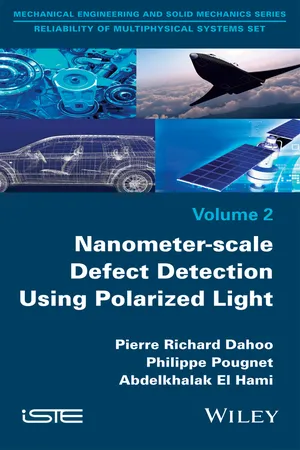
Nanometer-scale Defect Detection Using Polarized Light
- English
- ePUB (mobile friendly)
- Available on iOS & Android
eBook - ePub
Nanometer-scale Defect Detection Using Polarized Light
About this book
This book describes the methods used to detect material defects at the nanoscale. The authors present different theories, polarization states and interactions of light with matter, in particular optical techniques using polarized light.
Trusted by 375,005 students
Access to over 1.5 million titles for a fair monthly price.
Study more efficiently using our study tools.
Information
1
Uncertainties
Taking into account uncertainty in the design process is an innovative approach. This includes dimensioning the structure of the systems, the use of safety coefficients and the most advanced techniques to calculate reliability. The aim is to design a system that statistically achieves the best performance since the system is subject to variations. For a given risk probability, satisfactory system performance can be targeted which has low sensitivity to uncertainties and respects a minimum performance threshold. From a mathematical point of view, an innovative approach to system design can be considered as an optimization problem under constraints. In this chapter, various methods are presented to calculate systems subject to uncertainties.
1.1. Introduction
The methods used to take uncertainties into account are mathematical and statistical tools that make it possible to model and analyze systems whose parameters or use conditions are likely to vary. These methods are used to optimize the design and to balance cost and performance.
These methods are based on:
- – the development of an approximate mathematical model of the physical system under study;
- – the identification and characterization of the sources of uncertainty in the model parameters;
- – the study of the propagation of these uncertainties and their impact on the output signal (response) of the system.
Analysis and estimation of the statistics (moments, distribution parameters, etc.) of the system response are performed in the next step. The methods used to analyze the propagation of uncertainties vary according to the mathematical tools on which they are based. These methods include a reliability based design approach, a probabilistic approach based on design of experiments, and a set based approach.
1.2. The reliability based design approach
The reliability based design approach is based on modeling uncertainties. Depending on the methods used, uncertainties are modeled by random variables, stochastic fields or stochastic processes. These methods make it possible to study and analyze the variability of a system response and to minimize its variability.
The most common methods are the Monte Carlo (MC) method, perturbation method and polynomial chaos method [ELH 13].
1.2.1. The MC method
1.2.1.1. Origin
The first use of this mathematical tool dates back to Fermi’s research on the characterization of new molecules in 1930. The MC method has been applied, since 1940, by Von Neumann et al. to perform simulations in the field of atomic physics. The MC method is a powerful and very general mathematical tool. Its field of applications has widened because of the processing power of today’s computers.
1.2.1.2. Principle
The MC method is a calculation technique which proceeds by successively solving a determinist system equation in which uncertain parameters are modeled by random variables.
The MC method is used when the problem under study is too complex to solve by using an analytical resolution method. It generates random draws for all uncertain parameters in accordance with their probability distribution laws. The precision of the random generators is very important because for each draw a deterministic calculation is performed using the number of parameters defined by this generator.
1.2.1.3. Advantages and disadvantages
The main advantage of the MC method is that it can be very easily implemented. Potentially, this method can be applied to any system, whatever their dimensions or complexity. The results obtained by this method are exact in a statistical sense, that is their uncertainty decreases as the number of draws increases. This uncertainty of precision for a given confidence level is defined by the Bienaymé–Chebyshev inequality. A reasonable precision requires a large number of draws. This sometimes makes the MC method very costly in terms of calculation time, which is the main disadvantage of this method.
1.2.1.4. Remark
The simplicity of the MC method has made its application popular in the field of engineering sciences. This is a powerful but costly method. Its results are often used to validate new methods that are developed in the framework of fundamental research. It is applied in Chapter 9 in order to characterize carbon nanotubes.
1.2.2. The perturbation method
1.2.2.1. Principle
The perturbation method is another technique used to s...
Table of contents
- Cover
- Table of Contents
- Title
- Copyright
- Preface
- 1 Uncertainties
- 2 Reliability-based Design Optimization
- 3 The Wave–Particle Nature of Light
- 4 The Polarization States of Light
- 5 Interaction of Light and Matter
- 6 Experimentation and Theoretical Models
- 7 Defects in a Heterogeneous Medium
- 8 Defects at the Interfaces
- 9 Application to Nanomaterials
- Bibliography
- Index
- End User License Agreement
Frequently asked questions
Yes, you can cancel anytime from the Subscription tab in your account settings on the Perlego website. Your subscription will stay active until the end of your current billing period. Learn how to cancel your subscription
No, books cannot be downloaded as external files, such as PDFs, for use outside of Perlego. However, you can download books within the Perlego app for offline reading on mobile or tablet. Learn how to download books offline
Perlego offers two plans: Essential and Complete
- Essential is ideal for learners and professionals who enjoy exploring a wide range of subjects. Access the Essential Library with 800,000+ trusted titles and best-sellers across business, personal growth, and the humanities. Includes unlimited reading time and Standard Read Aloud voice.
- Complete: Perfect for advanced learners and researchers needing full, unrestricted access. Unlock 1.5M+ books across hundreds of subjects, including academic and specialized titles. The Complete Plan also includes advanced features like Premium Read Aloud and Research Assistant.
We are an online textbook subscription service, where you can get access to an entire online library for less than the price of a single book per month. With over 1.5 million books across 990+ topics, we’ve got you covered! Learn about our mission
Look out for the read-aloud symbol on your next book to see if you can listen to it. The read-aloud tool reads text aloud for you, highlighting the text as it is being read. You can pause it, speed it up and slow it down. Learn more about Read Aloud
Yes! You can use the Perlego app on both iOS and Android devices to read anytime, anywhere — even offline. Perfect for commutes or when you’re on the go.
Please note we cannot support devices running on iOS 13 and Android 7 or earlier. Learn more about using the app
Please note we cannot support devices running on iOS 13 and Android 7 or earlier. Learn more about using the app
Yes, you can access Nanometer-scale Defect Detection Using Polarized Light by Pierre-Richard Dahoo,Philippe Pougnet,Abdelkhalak El Hami in PDF and/or ePUB format, as well as other popular books in Technology & Engineering & Nanotechnology & MEMS. We have over 1.5 million books available in our catalogue for you to explore.