A new lean and agile model for more effective change management
Rapid Organizational Change gets right to the heart of the change initiative problem, and offers a time- and money-saving solution. The fact that so many change initiatives fail or underperform can be traced back to one major issue: pace. While most change management models stress the importance of timeliness, they remain bound to an organization-wide approach to execution.. By targeting change efforts at specific mid-level layers of management, this book helps you achieve the desired outcome more efficiently while saving time, effort and money. Full of practical advice and real-world examples, this book is your action guide to making change happen in a meaningful way. You'll learn how to continually develop great leadership at the institutional level, and gain real, actionable guidance on putting more women in management positions to help you grab that competitive advantage.
Today's disruptive technologies and macro-economic patterns have elevated organizational agility to the rank of survival skill. Change is a constant in business, but it's now coming faster than ever; this book gives you the strategies you need to keep from being left behind.
Target mid-level managers for faster change
Institute perpetual leadership development outside of HR
Correct gender inequality in management positions
Utilize your best resources to gain competitive advantage
Most change management models have the same inherent problem: by the time new processes and strategies trickle down to every manager and staff member, the opportunity has passed and the change can no longer be effective for its intended purpose. Rapid Organizational Change lays out a new shortcut to help your organization stay out in front.
Many CEOs of companies complain of resistance to change in their organizations. The problem of resistance to change appears to be particularly acute in Japan. In fact, many CEOs of companies in Japan lament that the Japanese are the most resistant to organizational change of any people in the world. I often hear this even from business leaders who are Japanese themselves!
Most CEOs have been able to build a leadership team around them whose members are change‐oriented and like‐minded in thinking. Sometimes that team extends to one or two layers of management below. Yet, it is frequently the rest of the organization that is viewed as remaining stubbornly recalcitrant. But is it really?
What is Refraction Anyway?
My father is one of the world's foremost experts on wave phenomena. A brilliant mathematician who found his calling in the field of geophysics, he developed methods for imaging the interior of the Earth using sound waves propagated from the surface. I remember seeing printouts on the walls of my father's study, showing the different geological layers deep in the interior of the Earth—where there is hard rock, soft rock, water, and even oil! Other printouts showed how the different layers bend, reflect, and dampen the sound waves.
It is the difference in substance from one layer to the next that alters the waves when they pass from a layer of one substance to another. A wave may be bent, and change direction. Or it may be partially deflected back up to the surface, with a weakened wave continuing downward. Some waves dissipate entirely. So the waves that reach deeper into the Earth are really distortions of the ones that came from the surface, perhaps weakened, if they reach the deeper layers at all. In the physical world, the bending of waves is called refraction.
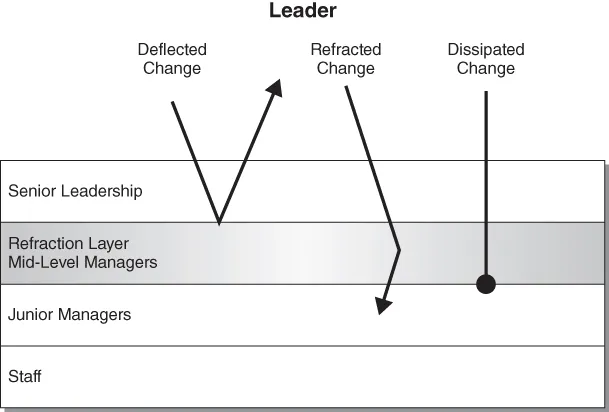
The layers of management and staff within a company are not unlike the geological layers of the Earth, and refraction occurs in companies as well. However, it is not a difference in physical substance that refracts waves of change, but rather a difference in thinking at different levels of management. The waves of change a leader attempts to propagate down through the company behave much like sound waves propagating down through the layers of the Earth. They may bend and change direction, be partially deflected, or dissipate entirely. So the waves of change that reach deeper levels of the company become distortions of the change that a leader had intended, and sometimes never reach the deeper levels at all. See Figure 1.1.
FIGURE 1.1 Deflecting, refracting, and dissipating waves of change
In geophysics, interpreting the feedback of sound waves at the surface is a technically difficult problem, because refraction layers deep in the Earth mask what is below and alter waves that return to the surface. In companies, it can be just as tricky for a leader to interpret the feedback returning to the top, because refraction layers in management frequently mask what transpires below. From the top, it can look as if the entire organization is resistant to change. However, I have found that what can, at first glance, appear as widespread recalcitrance in the organization, is rarely actually the case. On the contrary, more often than not, most managers and staff are open to change.
In my experience, what may appear to be widespread resistance to change is in fact limited to a refraction layer of mid‐level managers. Resolve the issues with the refraction layer first, and the organization beneath is freed to change. Leave the refraction layer intact and, no matter how forceful your attempts to promote change, it is very likely that they will inevitably fail. The mistake that most leaders make is rolling out change to the company as a whole once the leadership team is aligned and on‐board, taking much time, effort, and energy, without first paying heed to refraction layers. Without addressing refraction layers first, the great energy and time spent on complex change efforts is squandered.
The problem is that most approaches to change treat a company as an entity of uniform substance, whereas an organization is more akin to the diversity of substance in geology. Typical approaches to organizational change tend to be elaborate and multi‐staged. We have become accustomed to change being a long, hard process, fraught with risk of failure, because this is what we have been told and what we have experienced. However, it does not need to be that way.
I have never met a CEO who talked about change as something less than an urgent priority. By identifying and eliminating refraction layers first, leaders can achieve change in their organizations with maximum speed and efficiency of effort, and dramatically increase likelihood of sustainability and success. This book provides not only tools for doing so, but also methods and processes to help ensure refraction layers do not develop in the first place.
Leadership Proximity Trumps Leadership Rank
Leadership starts at the top but lives or dies in the middle. Staff take their cues from their immediate managers, no matter what a CEO might proclaim or communicate from their lofty perch. After all, it is their immediate managers whom they must serve every day, who evaluate their performance, who hold sway over their remuneration and promotion, and who can make a workday exciting, uneventful, or otherwise an unbearable form of hell. While staff may be open to the change the CEO desires, they will tend to behave in accordance with the priorities of their immediate manager, or at least avoid behaving in a way that they might oppose.
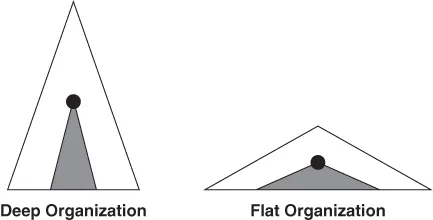
All it takes is one recalcitrant mid‐level manager to block movement toward change of everyone down their reporting line. That can be a huge swath of the organization, depending on the level of the mid‐level manager, and how flat the organization is. The more levels of staff below the manager, the deeper the impact. The flatter the organization, the wider the impact. A recalcitrant manager is like an object blocking a source of light waves. The shadow cast depends on the proximity of the object to the source. In this case, the source is the leader and the light is waves of change. I call this the principle of projection. See Figure 1.2.
FIGURE 1.2 Principle of projection
Change simply does not work its way from the bottom up. The greatest mistake I see leaders make is focusing efforts on the more junior managers and staff when it is more senior‐level ones that hold sway. I have seen many companies go to great lengths to communicate new direction, new methods, and new thinking throughout the organization down to junior staff, seeking “buy‐in”—all of which is wasted because a handful of mid‐level managers simply don't buy‐in. CEO roadshows to explain the changes, the need for change, and the merits for changing are all for naught. Training and orientation workshops will have little effect. Even revised performance evaluation schemes will not be effective when it is the immediate manager who conducts the review. None of these tools are effective among staff and managers whose immediate manager is not on‐board.
Layers of Sedimentary Rock
Several managers at the same middle level who have relatively uniform thinking in resisting change form a layer of sedimentary rock within the organization that will block change for all layers below. When a group of managers think in a similar way, they reinforce each other's certainty in the correctness of their point of view, making the refraction layer only that much more difficult to penetrate.
Why do these layers of sedimentary rock form in the first place? I have often heard leaders lay the blame of recalcitrance at the feet of the mid‐level managers themselves. While individual recalcitrance is certainly an individual's choice, the causes of formation of refraction layers often lie with choices a leader may make, not with the mid‐level managers. Below are four such causes over which a leader has direct control.
Overprotection of labor—by choice!
In many countries, including Japan, there are strong protective labor laws and regulations. It is convenient to blame government for the results of overprotecting labor. Government regulation is more often an excuse for leaders to avoid the sometimes uncomfortable task of removing non‐performing managers, rather than an actual impediment.
CEOs in Japan, whether Japanese or foreign, often tell me that it is “illegal” to fire anyone in Japan. Yet, this is definitely not the case. Termination in Japan is a matter of procedure, time, and money—like everywhere else in the world, no matter how strict or liberal the labor laws. Even in countries like France, which has highly protective labor laws, it is possible to remove non‐performers, although it may require a longer process or cost more to do so than in countries with less restrictive laws.
When a Japanese CEO tells me that firing is illegal, I believe it is partly because of the tradition of lifetime employment from which they may come. Firing is distasteful for most people anywhere in the world, but particularly distasteful in Japan where employment for many had once been for life. In Japan, firing is viewed almost as an end‐of‐the‐world level calamity by many. There is a gravity to firing in Japan that does not exist elsewhere. The legal justification merely makes it easier to avoid confronting the uncomfortable idea that the business may be better off without someone—and perhaps the employee will be better off as well!
When I ask a foreign CEO what makes them think firing someone is illegal, the typical response is, “My Japanese HR director told me so!” I believe many Japanese HR directors are loath to deal with terminations for many of the same reasons as Japanese CEOs, and exaggerate the difficulties and risks of doing so, particularly to their non‐Japanese bosses.
As such, non‐performers and even destructive employees are often left in place, promoted, or transferred laterally so they become someone else's problem. Or in the case of Japan, they become part of “windowsill gangs”—non‐performing managers who are simply sidelined and given limited responsibility—and a metaphorical desk by the window so they can look outside and not become completely bored as they whittle the time away during a business day. However, these practices create layer upon layer of sedimentary rock within an organization and buttress refraction.
For example, an executive client of mine had actually proposed taking a non‐performing manager and promoting him to a position of head of strategic planning inside the company, the rationale being that the strategic planning group was not that important or influential (a view which, you will certainly agree, is an issue in itself!). However, the non‐performing manager would still have staff in the strategic planning group, some of whom were young, talented, and enthusiastic, and had potential to create a lot of value for the company. Any zeal for growth, ambitious targets, and excitement at the prospect of change emanating from above would never reach this group under that manager. And it gets worse … I pointed out to the executive how the staff under the non‐performing manager would wither. Their skills would atrophy. They would become demoralized and cynical. They would fail to grow and achieve their full potential, and might even leave the company! The...
Table of contents
Cover
Title Page
Table of Contents
Preface
Acknowledgments
About the Author
CHAPTER 1: The Refraction Layer
CHAPTER 2: The Myth of Uniqueness
CHAPTER 3: Growth‐Oriented Thinking – The Key to Anti‐Refraction
CHAPTER 4: The Zen of Hiring
CHAPTER 5: Breaking the Iron Rice Bowl
CHAPTER 6: From Process‐Driven Thinking to Thinking‐Driven Process
CHAPTER 7: Eliminating Performance Gaps
CHAPTER 8: They Got It Wrong! It's NOT a Marathon, but Lots of Sprints!
CHAPTER 9: Perpetual Leadership Bench
Index
End User License Agreement
Trusted by 375,005 students
Access to over 1.5 million titles for a fair monthly price.
Study more efficiently using our study tools.
Frequently asked questions
Yes, you can cancel anytime from the Subscription tab in your account settings on the Perlego website. Your subscription will stay active until the end of your current billing period. Learn how to cancel your subscription
No, books cannot be downloaded as external files, such as PDFs, for use outside of Perlego. However, you can download books within the Perlego app for offline reading on mobile or tablet. Learn how to download books offline
Perlego offers two plans: Essential and Complete
Essential is ideal for learners and professionals who enjoy exploring a wide range of subjects. Access the Essential Library with 800,000+ trusted titles and best-sellers across business, personal growth, and the humanities. Includes unlimited reading time and Standard Read Aloud voice.
Complete: Perfect for advanced learners and researchers needing full, unrestricted access. Unlock 1.5M+ books across hundreds of subjects, including academic and specialized titles. The Complete Plan also includes advanced features like Premium Read Aloud and Research Assistant.
Both plans are available with monthly, semester, or annual billing cycles.
We are an online textbook subscription service, where you can get access to an entire online library for less than the price of a single book per month. With over 1.5 million books across 990+ topics, we’ve got you covered! Learn about our mission
Look out for the read-aloud symbol on your next book to see if you can listen to it. The read-aloud tool reads text aloud for you, highlighting the text as it is being read. You can pause it, speed it up and slow it down. Learn more about Read Aloud
Yes! You can use the Perlego app on both iOS and Android devices to read anytime, anywhere — even offline. Perfect for commutes or when you’re on the go. Please note we cannot support devices running on iOS 13 and Android 7 or earlier. Learn more about using the app
Yes, you can access Rapid Organizational Change by Steven Bleistein in PDF and/or ePUB format, as well as other popular books in Business & Finance. We have over 1.5 million books available in our catalogue for you to explore.