This book offers the reader the keys for a successful understanding, integration and usage of satellite systems in addition to next generation terrestrial networks. The DVB-S2/RCS system is used to illustrate the integration challenges. The presentation uses a system approach, i.e. it tackles the terrestrial and satellite telecommunication systems' complexity with a high level approach, focusing on the systems' components and on their interactions. Several scenarios present the different paths that can be followed for the integration of satellite systems in terrestrial networks. Quality of Service management techniques in terrestrial and satellite systems and the solutions to help them to interoperate are provided. Inter-system mobility solutions and performance problems are then addressed. The solutions proposed in this book have been developed within the framework of European and French funded research projects and tested with simulated or real testbeds.
eBook - ePub
Satellite and Terrestrial Hybrid Networks
- English
- ePUB (mobile friendly)
- Available on iOS & Android
eBook - ePub
Satellite and Terrestrial Hybrid Networks
About this book
Information
1
Satellite and Terrestrial Hybrid Networks
1.1. Designing satellite and terrestrial hybrid networks
The satellite is a suitable medium for filling in white zones and gray areas due to its wide coverage and accessibility from areas which are not covered by terrestrial infrastructure.
The development of very high-speed access has led to the emergence of new services and uses, which are more and more frequently based on highly demanding audiovisual media for communication purposes. In the short and medium term, in a context where information and communication technologies are assuming increasingly important positions in all sectors and in people’s daily lives, it is becoming vital for telecommunication operators to be aware of improvements to existing services on the networks and to have the flexibility to rapidly integrate such new services made possible by this very high-speed access.
The consequence of these efforts is that, for the satellite telecommunications operator, it is necessary to create hybrid systems to forge a convergence between broadcast networks and bidirectional satellites (for fixed and mobile services) on one hand, and terrestrial networks on the other hand, in order to provide higher quality and more transparent access with greater coverage for applications and services which are increasingly demanding in terms of network resources.
The first challenge to overcome with regard to these issues involves the “system” and the need to integrate an effective architecture which takes account of the convergence between satellite and terrestrial networks in an optimized and transparent way (to ensure the delivery of services).
Next-generation networks (NGNs) and next-generation access (NGA) specifications have provided such a convergence by using packet-switching (Internet Protocol (IP), multiprotocol label switching (MPLS), Ethernet, generic stream encapsulation (GSE)/return link encapsulation (RLE), etc.) as a means of interconnection. They look to eliminate the barriers between the various heterogeneous networks by connecting the services between themselves in a secure and accessible way. This is done by using different types of fixed or mobile access terminals, regardless of the underlying transport network. Services can, therefore, be generalized over all types of networks.
This convergence has an impact on the entire value chain and therefore on all of the various stakeholders involved, including service providers, network providers, access network providers, satellite operators, home networks and the terminals of the end user.
Modifications are necessary at different levels of the open systems interconnection (OSI) model and technological challenges need to be overcome. Several hybrid scenarios must be considered in which the satellite can play a technically, economically and socially useful role.
1.2. Hybrid scenarios
Over the last decade, a number of new access network technologies emerged for access to Internet services. At the same time, cellular networks, initially designed for mobile telephone and voice services, evolved to offer more advanced services and above all Internet access.
Moreover, the progress of mobile terminals (mobile telephones, smartphone, ultrabooks or laptops), whose size and weight have been significantly reduced, incorporate increasingly wireless network interfaces (3G/4G, WiFi, Bluetooth, near field communication (NFC), etc.) and communication capacity. These wireless communication technologies (WIMAX and 3G/4G-LTE) have given the user the ability to connect to services from anywhere, anytime, while enabling mobile Internet access.
This trend is so strong that the offer of an “always on” service is now one of the requirements for the design of new network infrastructures.
The NGN and 4G concepts are entirely in line with this approach. Services or applications are designed with no specific type of access network in mind (wireless, cellular, cable, optic, etc.), but are based on core IP technology, which is now a cornerstone of convergence between telephone and data services.
In NGNs or 4G networks, the “always on” paradigm is intended to give general mobility to service users, with a fully transparent change of access network as long as it is compatible.
Application, as well as the underlying protocols, must be consistent with the changes in networks. However, this requirement remains very ambitious since the networks are heterogeneous and potentially operated by a wide variety of stakeholders. Therefore, a number of economic (business, role model, etc.) and technical (quality of service (QoS), authentication, authorization and accounting (AAA), security, etc.) questions arise.
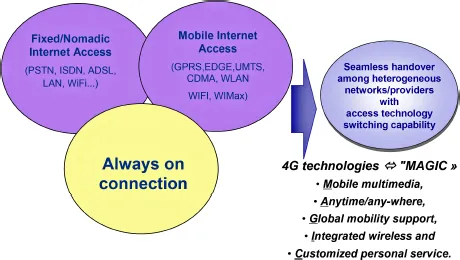
Figure 1.1. Trends with 4G/NGN
Therefore, it is crucial for satellite systems to follow this trend and demonstrate their compatibility with NGN/4G networks. This is of utmost importance for the satellite broadband market. Indeed, most stakeholders (industries, suppliers and research laboratories) are arguing for the integration of satellites into this architecture.
There are a number of cases where satellite/terrestrial hybrid networks would be particularly advantageous. As a supplement traditional terrestrial access technology, satellite systems offer a real benefit for mobile users, and in a more general sense, for the deployment of mobile networks. Satellite networks offer extremely wide coverage and a high accessibility rate, with capacity in terms of performance, QoS management or security, which is entirely comparable to traditional networks. Of course, satellite networks will not compete with terrestrial networks, but can supplement their coverage and offer an alternative solution which can be very useful when terrestrial infrastructure becomes ineffective (mass congestion and attack) or is destroyed (natural disaster), or is simply not available (no coverage).
Therefore, the typical use would now be mainly in the sectors of civil protection, military (theater of operations) or transport (maritime, aeronautical, railway, etc.).
The following section analyzes the impact of these uses on the overall architecture of the hybrid network, while remaining compatible with NGN/4G architectures (protocols and standards).
First, we will describe how the integration at the system level could be done, and then we will examine various scenario...
Table of contents
- Cover
- Table of Contents
- Title
- Copyright
- Acknowledgments
- Foreword
- List of Acronyms
- Introduction
- 1: Satellite and Terrestrial Hybrid Networks
- 2: Quality of Service on Next-Generation Terrestrial Networks
- 3: Quality of Service in DVB-S/RCS Satellite Networks
- 4: Integration of Satellites Into IMS QoS Architecture
- 5: Inter-system Mobility
- 6: The Transport Layer in Hybrid Networks
- Conclusion
- Bibliography
- Index
- End User License Agreement
Trusted by 375,005 students
Access to over 1.5 million titles for a fair monthly price.
Study more efficiently using our study tools.
Frequently asked questions
Yes, you can cancel anytime from the Subscription tab in your account settings on the Perlego website. Your subscription will stay active until the end of your current billing period. Learn how to cancel your subscription
No, books cannot be downloaded as external files, such as PDFs, for use outside of Perlego. However, you can download books within the Perlego app for offline reading on mobile or tablet. Learn how to download books offline
We are an online textbook subscription service, where you can get access to an entire online library for less than the price of a single book per month. With over 1.5 million books across 990+ topics, we’ve got you covered! Learn about our mission
Look out for the read-aloud symbol on your next book to see if you can listen to it. The read-aloud tool reads text aloud for you, highlighting the text as it is being read. You can pause it, speed it up and slow it down. Learn more about Read Aloud
Yes! You can use the Perlego app on both iOS and Android devices to read anytime, anywhere — even offline. Perfect for commutes or when you’re on the go.
Please note we cannot support devices running on iOS 13 and Android 7 or earlier. Learn more about using the app
Please note we cannot support devices running on iOS 13 and Android 7 or earlier. Learn more about using the app
Yes, you can access Satellite and Terrestrial Hybrid Networks by Pascal Berthou,Cédric Baudoin,Thierry Gayraud,Matthieu Gineste in PDF and/or ePUB format, as well as other popular books in Technology & Engineering & Electrical Engineering & Telecommunications. We have over 1.5 million books available in our catalogue for you to explore.