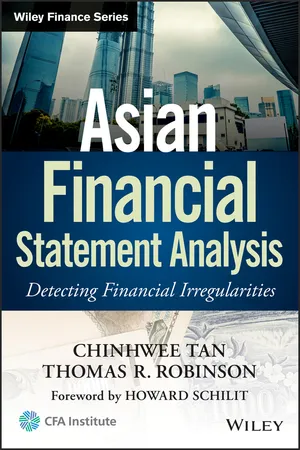
Gain a deeper understanding of Asian financial reporting and how to detect irregularities
The Asian region, and particularly China, is becoming a hotbed of investment activity. There have been quite a few accounting scandals in Asia in the recent years – now rivaling those we have seen in the Americas and Europe. Assessing potential or active overseas investments requires reliance on financial statements, the full parameters of which may vary from region to region. To effectively analyze statements, it is necessary to first understand the framework underlying these financial statements and then lay out a protocol for detecting irregularities. It's impossible to create and implement a practical plan without a deeper knowledge of the various factors at play.
Asian Statement Analysis: Detecting Financial Irregularities provides a framework for analysis that makes irregularities stand out. Authors Chin Hwee Tan and Thomas R. Robinson discuss international financial reporting standards, including characteristics particular to the Asian region. Tan and Robinson's combined background in academia and Asian finance give them a multi-modal perspective and position them as top authorities on the topic. In the book, they address issues such as:
Detection of irregularities independent of particular accounting rules
The most common irregularities in the Asian market
Similarities and differences between U.S. and Asian accounting techniques
An overarching framework for irregularity detection
The book uses real-world examples to illustrate the concepts presented, with the focus on Asian companies. As the first ever in-depth study on manipulation and irregularities in the Asian market, Asian Financial Statement Analysis: Detecting Financial Irregularities is uniquely positioned to be a valuable resource in the move toward the next phase of global reporting standards.
CHAPTER 1 A FRAMEWORK FOR EVALUATING FINANCIAL IRREGULARITIES
This chapter presents the basics of the accounting system, which creates the checks and balances essential to creating financial statements and detecting irregularities within them. The chapter demonstrates how the primary financial statements fit together and how this information can be used to detect problems and highlight where more questions are warranted. With this framework, you will have the basic tools to spot the warning signs in a company’s financials if something is amiss.
This chapter examines the framework of relationships between the main financial statements—known to accountants as the articulation of financial statements—and shows the reader how to evaluate the possibility that a company is engaged in accounting games. Due to these interrelationships, a company that overstates its profits on its income statement cannot do so without also overstating its assets or understating its liabilities on the balance sheet. If a company artificially reduces its liabilities to strengthen its perceived financial condition, it will likely need to reduce its assets as well. Should a company artificially inflate its operating cash flow with no corresponding increase in the actual cash balance, it will need to reduce its investing or financing cash flows.
The most common case of fraudulent activity is an overstatement of profits—the first example above. In these cases, an overstatement of assets usually occurs through accounts receivable from customers, inventory, or some sort of intangible or other unique asset. As a result, a common method of detecting fraudulent activity is to look for unusual increases in asset accounts that have not been adequately explained in the footnotes or by management. This chapter discusses how the interrelatedness of the financial statements may assist in picking up warning signs of accounting manipulation.
ARTICULATION OF FINANCIAL STATEMENTS
The three major financial statements of interest to the analyst1 are the income statement, the statement of cash flows, and the balance sheet.
The income statement shows the revenues from operating the business, the associated expenses, gains and losses, and the net profit over a period of time. It is a primary source for measuring the profitability of the business.
While profits are nice to have, you cannot pay employees, suppliers, creditors, and others with profits—payment requires cash. Another important statement is therefore the statement of cash flows, which presents the cash receipts, cash payments, and net cash flow of the business (typically separated into three activities—operating, investing, and financing). This statement helps assess how well the company is doing at converting profits into cash flow, investing for the future, and the sources of financing or repayment of capital.
The balance sheet, also known as the statement of financial position or statement of financial condition, shows a snapshot of the assets or resources of the business at a point in time and the claims against those resources by creditors (liabilities) and investors (owners’ equity). The balance sheet is also the core financial statement, which connects the other financial statements over time. The balance sheet reflects the so-called accounting equation, which has been with us for many hundreds of years and forces the articulation of financial statements. In the simplest terms, the accounting equation is as portrayed in Exhibit 1.1.
The accounting equation is a given and must always balance—hence the term balance sheet. The balance sheet depicts the accounting equation at a given point in time and must balance. If you ever come across a company whose balance sheet does not balance (one of the authors has seen this only twice in his 25-year career), your analysis becomes infinitely easier—discard this company’s financial statements and find another company to invest in (or sell this one short!).
EXHIBIT 1.1 The Accounting Equation for Financial Statements
Now let’s look at an extended version of the balance sheet in accounting equation format and how the income statement and cash flow statement fit into the balance sheet.
The top panel of Exhibit 1.2 shows the balance sheet at the beginning of the period and the end of the period (usually a year but sometimes quarterly or semiannually) and some of the common types of assets, liabilities, and owners’ equity. For example, common assets include cash, accounts receivables (amounts due from customers), inventory (goods held for sale), investments, property (such as land, buildings, and equipment), and other assets such as intangible assets, prepaid items, and deposits. Liabilities can be due in the short term or long term and can be monies owed to suppliers, banks, employees, and other creditors. Owners’ equity includes capital contributed by the owners, profits retained in the business not yet distributed to the owners (retained earnings), and some special items such as other comprehensive income (typically, gains and losses not yet reported on the income statement).
The middle panel presents an abbreviated form of the income statement. Note the distinction between revenues and expenses versus gains and losses. Revenues and expenses are reported on a gross basis and related to the main operating activities of the business. For example, if the business is a restaurant, then meals sold to customers are reported as revenues for the full amount received from customers with a separate expense reported on the income statement for the cost of the meal sold (both the revenue and expense are reported gross). However, if that same restaurant has an extra piece of equipment it is no longer using and sells that equipment to a used equipment dealer, then the sales price and remaining undepreciated cost of the equipment are netted to determine whether there is a gain or loss, and this net gain or loss is reported separately in the non-operating portion of the income statement. We will later see how some companies try to inflate revenues (but not profits) by reporting such sales in the operating section of the income statement.
The bottom panel presents an abbreviated cash flow statement. The net cash flows (cash received less cash paid) for operating, investing, and financing activities are each summarized and then totaled to arrive at the overall net cash flow of the company for the period.
The income and cash flow statements are directly tied to the change in the balance sheet over the period as shown in the upper panel. Any increase or decrease in net income from the income s...
Table of contents
Cover
Contents
Title
Copyright
Dedication
Foreword
Genesis of This Book
Acknowledgments
Introduction
Chapter 1: A Framework for Evaluating Financial Irregularities
Chapter 2: Detecting Overstated Earnings
Chapter 3: Detecting Overstated Financial Position
Chapter 6: Evaluating Corporate Governance and Related-Party Issues
Chapter 7: Summary and Guidance
About the Authors
Index
End User License Agreement
Trusted by 375,005 students
Access to over 1.5 million titles for a fair monthly price.
Study more efficiently using our study tools.
Frequently asked questions
Yes, you can cancel anytime from the Subscription tab in your account settings on the Perlego website. Your subscription will stay active until the end of your current billing period. Learn how to cancel your subscription
No, books cannot be downloaded as external files, such as PDFs, for use outside of Perlego. However, you can download books within the Perlego app for offline reading on mobile or tablet. Learn how to download books offline
Perlego offers two plans: Essential and Complete
Essential is ideal for learners and professionals who enjoy exploring a wide range of subjects. Access the Essential Library with 800,000+ trusted titles and best-sellers across business, personal growth, and the humanities. Includes unlimited reading time and Standard Read Aloud voice.
Complete: Perfect for advanced learners and researchers needing full, unrestricted access. Unlock 1.5M+ books across hundreds of subjects, including academic and specialized titles. The Complete Plan also includes advanced features like Premium Read Aloud and Research Assistant.
Both plans are available with monthly, semester, or annual billing cycles.
We are an online textbook subscription service, where you can get access to an entire online library for less than the price of a single book per month. With over 1.5 million books across 990+ topics, we’ve got you covered! Learn about our mission
Look out for the read-aloud symbol on your next book to see if you can listen to it. The read-aloud tool reads text aloud for you, highlighting the text as it is being read. You can pause it, speed it up and slow it down. Learn more about Read Aloud
Yes! You can use the Perlego app on both iOS and Android devices to read anytime, anywhere — even offline. Perfect for commutes or when you’re on the go. Please note we cannot support devices running on iOS 13 and Android 7 or earlier. Learn more about using the app
Yes, you can access Asian Financial Statement Analysis by ChinHwee Tan,Thomas R. Robinson in PDF and/or ePUB format, as well as other popular books in Business & Finance. We have over 1.5 million books available in our catalogue for you to explore.