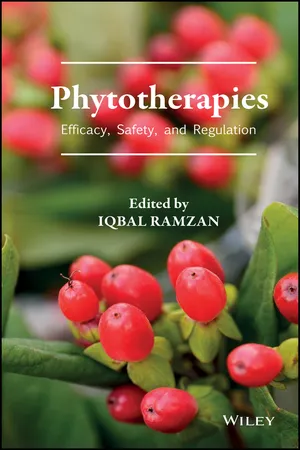
Covering fundamentals and new developments in phytotherapy, this book combines pharmaceutical sciences and chemistry with clinical issues.
• Helps readers better understand phytotherapy and learn the fundamentals of and how to analyze phytotherapeutic agents
• Discusses phytotherapy in modern medicine, chemoprevention of disease, and alternatives to western medicines for specific diseases
• Chapters summarizes the uses and applications of phytomedicines, by type like Chinese, Greco-Arab, Indian, European, and Ayurvedic
• Includes international regulatory perspectives and discusses emerging regulations for various established and emerging markets
- English
- ePUB (mobile friendly)
- Available on iOS & Android
eBook - ePub
About this book
Information
1
PHYTOTHERAPIES—PAST, PRESENT, AND FUTURE
IQBAL RAMZAN AND GEORGE Q. LI
Faculty of Pharmacy, The University of Sydney, Sydney, New South Wales, Australia
1.1 OVERVIEW OF PHYTOTHERAPY
1.1.1 Definition
Phytotherapy, or the use of herbal medicines to prevent or treat a disease, is a traditional medical practice based on medicinal plants. It is a branch of complementary and alternative medicine (CAM) or traditional medicine, which refers to traditional medicine systems and various forms of Indigenous medicine [1]. Many different cultures have developed herbal medicine systems, for example, Western herbal medicines, Chinese herbal medicines, Ayurvedic and Unani medicines, and Australian Indigenous medicines [2]. Phytotherapy is the basis of modern pharmaceutical science, with about 25% of the drugs prescribed today, such as digoxin, aspirin, and paclitaxel being derived from plants [3].
Western herbal medicine and orthodox medicine share to a large degree a common physiologic and diagnostic system, but they are different in many important ways as well. Herbs are complex mixtures of chemicals, which may have several distinct and concurrent pharmacological activities, while pharmaceutical drugs are mostly single chemical entities. Modern herbal medicines are becoming part of integrative clinical management in medical textbooks as exemplified in Natural Standard Herbal Pharmacotherapy [4].
Traditional Chinese Medicine (TCM) is another popular traditional medical system in China and worldwide. It includes various practices including Chinese herbal medicine, acupuncture, and massage, sharing a fundamental principle that the human body is part of the whole universe. The treatment goals are harmonization and balance using a holistic approach. The basic theories of TCM are Yin and Yang theory, Five-Element theory, Zang Fu (viscera and bowels) theory, Meridian, Qi, Blood and Fluid theory, Syndrome Differentiation, and Treatment theory. Detailed information on TCM can be found in textbooks on Chinese medicine [5–8]. For example, the blockage by Phlegm is closely related to excessive fat retention in metabolic syndrome and the management with herbal formulations and other modalities is to eliminate the Phlegm [9]. Treatment of diabetes with TCM focuses on nourishing Yin, clearing Heat, producing Body Fluid, and moistening Dryness using herbal formulae composed of herbs such as Rehmannia (Rehmannia glutinosa) and yam (Dioscorea opposita) [10].
Modernization of TCM and integration with orthodox medicine and science is a model accepted in China, covering education, clinical practice, and research. Modern pharmacologic and clinical studies have been used to examine claims of traditional practice; chemistry and chemical analysis are used for quality control of Chinese herbal medicines. Pharmacological and chemical studies have revealed connections between nature of herbal medicines and pharmacological activities, herbal tastes, and chemical components. For example, ephedra is warm as it contains ephedrine, a sympathomimetic amine; pungent herbs contain essential oils; sour herbs contain acid and tannins; sweet herbs contain sugars, proteins, and amino acids; bitter herbs contain alkaloids and glycosides; and salty herbs contain inorganic salts. Pharmacokinetic studies demonstrate a link between the tissue distribution of active chemical constituents and the attributive meridians of Chinese herbal medicines.
The World Health Organization (WHO) has a long-term interest in promoting traditional medicines and has produced a series of publications on global atlas [11], good agricultural practices [12], and monographs on selected medicinal plants [13], providing scientific information on the safety, efficacy, and quality control of widely used medicinal plants. The latest version of WHO Traditional Medicine Strategy (2014–2023) was developed to support Member States in harnessing the potential contribution of traditional medicine to health, wellness, and health care; and promoting the safe and effective use of traditional medicines by regulating, researching, and integrating traditional medicine products, practitioners, and practice into health systems [14].
1.1.2 International Trend in the Usage of Complementary Medicines
Complementary medicines have maintained their popularity in all regions of the world. The global market for herbal medicines is significant and growing rapidly. In China, traditional herbal preparations account for approximately 40% of the total health care delivered [1]. In the United States, over 42% of the population have used complementary or alternative medicine at least once. Total out-of-pocket expenditure relating to alternative therapies in 1997 was conservatively estimated at $27.0 billion, which is comparable with the projected 1997 out-of-pocket expenditure for all US physician services [15]. In the United Kingdom, estimate of annual out-of-pocket expenditure on practitioner visits in 1998 was £450 million [16].
In Australia, it has been reported that in 2000, 52% of the population used at least one nonmedically prescribed complementary medicine [17]. The estimated expense on complementary medicines was nearly twice the patient expenditure on pharmaceutical medicines during 1992–1993 [17]. The expenditure on alternative therapies in 2000 was $AUD 2.3 billion [18]. In 2005, the annual out-of-pocket expenditure was estimated to be $AUD 4.13 billion [19]. More recent studies have indicated that complementary medicines are finding a growing preference amongst patients with chronic or serious diseases who are looking for natural options to assist in the ongoing management of these conditions. For instance, St. John’s wort preparations have low rates of side effects and good compliance, comparatively low cost, making it worthy of consideration in the management of mild-to-moderate depression [20]. An overview of complementary medicines use and regulation in Australia is available in the Australian government’s commissioned report, Complementary Medicines in the Australian Health System [21].
1.2 PRECLINICAL RESEARCH ON PHYTOTHERAPIES
1.2.1 Pharmacognosy and Quality Standardization of Phytotherapies
Pharmacognosy is the study of medicinal materials, mainly plants, using theory and methods of modern sciences such as botany, zoology, chemistry, pharmacology, and traditional medicines to study the origin, production, harvesting and processing, identification and evaluation, chemical components, physical and chemical properties, resource development, pharmacology, toxicology, and therapeutic application of herbal medicines to ensure the quality of herbal materials and to develop new herbal resources. Its main focus is on the study of authentication and quality control of herbs [22].
Plant descriptions are used in the identification of herbal materials. They are first classified by the plant parts of origin, such as roots and rhizomes, stems, leaves, flowers, fruits, or whole herbs. Then the macroscopic and microscopic descriptions are included in each monograph. Some microscopic features reflect the secondary metabolites, starch granules, resin ducts, and oil cells. The macroscopic features are still very useful for authentication; for example, the colors of herbs such as yellow coptis, brown rhubarb, and black valerian are related to their alkaloid, anthraquinone, and iridoid contents, respectively.
Pharmacognosy, particularly correct identification and high quality of the herb, is the foundation of safety, clinical efficacy, and research on phytotherapy. It is a subject most relevant to professionals in testing laboratories, herbal dispensing, and regulatory bodies. Pharmacognosy is the principal discipline employed in national and international pharmacopeia in the form of the following topics: species identification using plant taxonomy, macroscopic identification using morphology, microscopic identification using anatomy, and quality control with analytical methods. The WHO monographs are examples of such comprehensive monographs [13], while British Pharmacopoeia used as statutory standards in Europe ...
Table of contents
- COVER
- TITLE PAGE
- TABLE OF CONTENTS
- LIST OF CONTRIBUTORS
- PREFACE
- 1 PHYTOTHERAPIES—PAST, PRESENT, AND FUTURE
- 2 QUALITY CONTROL AND QUALITY ASSURANCE OF PHYTOMEDICINES: KEY CONSIDERATIONS, METHODS, AND ANALYTICAL CHALLENGES
- 3 PRECLINICAL (IN VIVO) AND LABORATORY (IN VITRO) EVIDENCE OF PHYTOMEDICINE EFFICACY
- 4 CLINICAL EFFICACY TRIALS WITH NATURAL PRODUCTS AND HERBAL MEDICINES
- 5 NOVEL FORMULATIONS AND DRUG DELIVERY SYSTEMS FOR PHYTOTHERAPIES
- 6 PHYTOTHERAPIES USED BY INDIGENOUS POPULATIONS
- 7 PHYTOTHERAPIES FROM TRADITIONAL CHINESE MEDICINE
- 8 INTEGRATING TRADITIONAL GRECO-ARAB AND ISLAMIC DIET AND HERBAL MEDICINES IN RESEARCH AND CLINICAL PRACTICE
- 9 EVOLUTION OF HERBAL MEDICINES IN EUROPE AND ITS RELATIONSHIP WITH MODERN MEDICINE
- 10 CHEMICAL CLASSIFICATION AND CHEMISTRY OF PHYTOTHERAPEUTICS CONSTITUENTS
- 11 THERAPEUTIC POTENTIAL OF GINSENOSIDES IN MANAGEMENT OF ATHEROSCLEROSIS
- 12 PHYTOTHERAPY PHARMACOPHORES FOR MAJOR CELLULAR DRUG TARGETS
- 13 USE OF KAVA AS A PHYTOTHERAPEUTIC AGENT AND KAVA-RELATED HEPATOTOXICITY
- 14 PHYTOTHERAPIES AS NEW DRUG SOURCES: GOSSYPOL AND CURCUMIN
- 15 PHYTOTHERAPIES FOR THE MANAGEMENT OF OBESITY AND DIABETES
- 16 PHYTOTHERAPEUTICS FOR CANCER THERAPY
- 17 PHYTOMEDICINES FOR FATTY LIVER DISEASE AND FUNCTIONAL GASTROINTESTINAL CONDITIONS
- 18 PHYTOMEDICINES FOR INFLAMMATORY CONDITIONS
- 19 PHYTOTHERAPIES FOR INFECTIOUS DISEASES: ARE THESE REALLY USEFUL?
- 20 PHYTOMEDICINES FOR CNS DISORDERS: SAFETY ISSUES FOR USE WITH ANTIEPILEPTIC DRUGS
- 21 PHYTOTHERAPIES: DRUG INTERACTIONS IN CANCER
- 22 QUALITY USE OF MEDICINES
- 23 INTELLECTUAL PROPERTY AND PATENT ISSUES WITH PHYTOTHERAPY PRODUCTS
- 24 INTERNATIONAL REGULATORY STATUS OF PHYTOTHERAPIES
- INDEX
- END USER LICENSE AGREEMENT
Trusted by 375,005 students
Access to over 1.5 million titles for a fair monthly price.
Study more efficiently using our study tools.
Frequently asked questions
Yes, you can cancel anytime from the Subscription tab in your account settings on the Perlego website. Your subscription will stay active until the end of your current billing period. Learn how to cancel your subscription
No, books cannot be downloaded as external files, such as PDFs, for use outside of Perlego. However, you can download books within the Perlego app for offline reading on mobile or tablet. Learn how to download books offline
Perlego offers two plans: Essential and Complete
- Essential is ideal for learners and professionals who enjoy exploring a wide range of subjects. Access the Essential Library with 800,000+ trusted titles and best-sellers across business, personal growth, and the humanities. Includes unlimited reading time and Standard Read Aloud voice.
- Complete: Perfect for advanced learners and researchers needing full, unrestricted access. Unlock 1.5M+ books across hundreds of subjects, including academic and specialized titles. The Complete Plan also includes advanced features like Premium Read Aloud and Research Assistant.
We are an online textbook subscription service, where you can get access to an entire online library for less than the price of a single book per month. With over 1.5 million books across 990+ topics, we’ve got you covered! Learn about our mission
Look out for the read-aloud symbol on your next book to see if you can listen to it. The read-aloud tool reads text aloud for you, highlighting the text as it is being read. You can pause it, speed it up and slow it down. Learn more about Read Aloud
Yes! You can use the Perlego app on both iOS and Android devices to read anytime, anywhere — even offline. Perfect for commutes or when you’re on the go.
Please note we cannot support devices running on iOS 13 and Android 7 or earlier. Learn more about using the app
Please note we cannot support devices running on iOS 13 and Android 7 or earlier. Learn more about using the app
Yes, you can access Phytotherapies by Iqbal Ramzan in PDF and/or ePUB format, as well as other popular books in Medicine & Pharmacology. We have over 1.5 million books available in our catalogue for you to explore.