The book not only offers scientists and engineers a clear inter-disciplinary introduction and orientation to all major EHL problems and their solutions but, most importantly, it also provides numerical programs on specific application in engineering.
• A one-stop reference providing equations and their solutions to all major elastohydrodynamic lubrication (EHL) problems, plus numerical programs on specific applications in engineering • offers engineers and scientists a clear inter-disciplinary introduction and a concise program for practical engineering applications to most important EHL problems and their solutions • brings together a number of case studies in one text, each being solved using solution methods which share common features and methods
1 Basic equations of elastohydrodynamic lubrication
1.1 Basic equations
1.1.1 One-dimensional Reynolds equation of elastohydrodynamic lubrication
One-dimensional isothermal Reynolds equation of elastohydrodynamic lubrication (EHL) is given as follows [1, 2]:
(1.1)
Let us assume that the surfaces do not stretch and the density of lubricant does not change with time, the general form of the one-dimensional Reynolds equation of hydrodynamic lubrication can be written as follows:
(1.2)
where, the last term is obtained from
as we assume that the density of lubricant does not change with time.
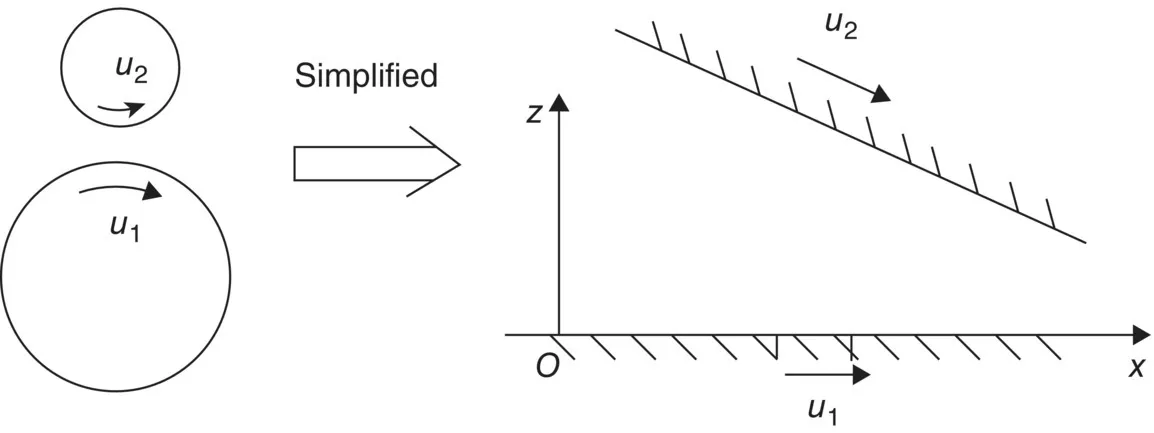
In order to transform the general form of Reynolds equation (1.2) into the EHL Reynolds equation (1.1), let us analyze the problem of two surfaces with the rolling speed, see Figure 1.1a. First, expand the surfaces as shown in Figure 1.1b, where we set the down surface to be horizontal and the up surface to be declined.
Figure 1.1 Velocity analysis of rolling problem: (a) two rolling cylinders and (b) simplified model
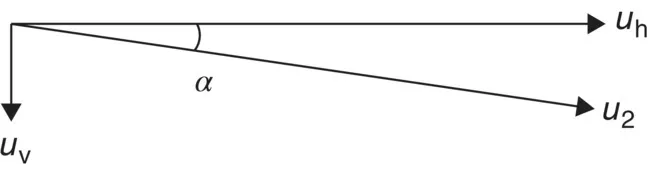
In order to substitute the velocities into the Reynolds equation (1.2), let us analyze the velocities given in Figure 1.1b. If set u is the velocity in the x direction and w in the z direction, we can see that on the down surface, u0 = u1 and w0 = 0. The velocity on the up surface can be decomposed into the horizontal and the vertical two components as shown in Figure 1.2.
Figure 1.2 Velocity decomposition of rolling problem
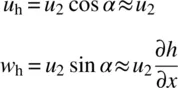
After decomposition, the two velocity components can be written as follows:
(1.3)
where, α is the declined angle of the up surface.
Because the declined angle α is very small, we can approximately take
and
. Therefore, we have
(1.4)
Substituting u0, uh, w0, and wh into the Reynolds equation (1.2), we have:
(1.5)
Let u1 + u2 = 2u...
Table of contents
Cover
Title page
Table of Contents
Preface
Introduction
Nomenclature
1 Basic equations of elastohydrodynamic lubrication
2 Numerical calculation method and program of elastic deformation
3 Numerical calculation method and program for energy equation
4 Numerical calculation method and program for isothermal EHL in line contact
5 Newton–Raphson method and programs to solve EHL problems in line contact
6 Numerical calculation method and program for isothermal EHL in point contact
7 Numerical calculation method and programs of multigrid method for isothermal EHL
8 Numerical calculation method and program for isothermal EHL in ellipse contact
9 Numerical calculation method and program for isothermal EHL in elliptical contact with two-dimensional velocities
10 Numerical calculation method and program for thermal EHL
11 Numerical calculation method and program for grease EHL
12 Numerical calculation method and program for EHL considering effect of electric double layer
13 Numerical calculation method and program for time-dependent EHL in line contact
14 Numerical calculation method and program for isothermal EHL with rough surface
15 Numerical calculation method and program for micropolar fluid EHL
References
Index
End User License Agreement
Trusted by 375,005 students
Access to over 1.5 million titles for a fair monthly price.
Study more efficiently using our study tools.
Frequently asked questions
Yes, you can cancel anytime from the Subscription tab in your account settings on the Perlego website. Your subscription will stay active until the end of your current billing period. Learn how to cancel your subscription
No, books cannot be downloaded as external files, such as PDFs, for use outside of Perlego. However, you can download books within the Perlego app for offline reading on mobile or tablet. Learn how to download books offline
Perlego offers two plans: Essential and Complete
Essential is ideal for learners and professionals who enjoy exploring a wide range of subjects. Access the Essential Library with 800,000+ trusted titles and best-sellers across business, personal growth, and the humanities. Includes unlimited reading time and Standard Read Aloud voice.
Complete: Perfect for advanced learners and researchers needing full, unrestricted access. Unlock 1.5M+ books across hundreds of subjects, including academic and specialized titles. The Complete Plan also includes advanced features like Premium Read Aloud and Research Assistant.
Both plans are available with monthly, semester, or annual billing cycles.
We are an online textbook subscription service, where you can get access to an entire online library for less than the price of a single book per month. With over 1.5 million books across 990+ topics, we’ve got you covered! Learn about our mission
Look out for the read-aloud symbol on your next book to see if you can listen to it. The read-aloud tool reads text aloud for you, highlighting the text as it is being read. You can pause it, speed it up and slow it down. Learn more about Read Aloud
Yes! You can use the Perlego app on both iOS and Android devices to read anytime, anywhere — even offline. Perfect for commutes or when you’re on the go. Please note we cannot support devices running on iOS 13 and Android 7 or earlier. Learn more about using the app
Yes, you can access Numerical Calculation of Elastohydrodynamic Lubrication by Ping Huang in PDF and/or ePUB format, as well as other popular books in Mathematics & Mathematical Analysis. We have over 1.5 million books available in our catalogue for you to explore.