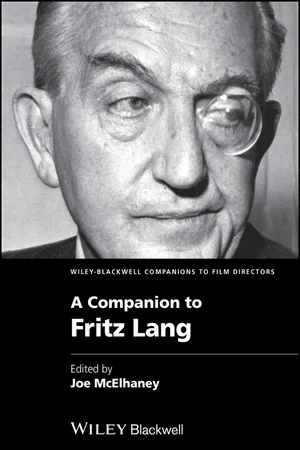
The publication of A Companion to Fritz Lang marks the first English-language edited collection on Lang’s body of work in over thirty years. In 1981, the British Film Institute published Stephen Jenkins’s Fritz Lang: The Image and the Look, a small volume (173 pages) comprised of one extended essay by Jenkins, written especially for the book, and four essays newly translated from the French but all of these having originally appeared between 1959 and 1978. Nonetheless, the literature on the cinema of Fritz Lang since then has not been lacking, either in volume or scholarly interest. In 1999, the British Film Institute published another volume on the director, this one entirely written by one scholar. Tom Gunning’s The Films of Fritz Lang: Allegories of Vision and Modernity is, in contrast to the more modest scale of the Jenkins volume, a voluminous work, over five hundred pages of allegorical close readings. Over the last dozen years, Gunning’s book, with its seductive notions of the “destiny-machine,” defined by Gunning as a type of literal and metaphoric machine that is also “a metonymy, a fragment which stands in for the whole systematic nature of the modern world” (10), has exerted an enormous influence on Lang criticism. Many of the essays in this book are indebted to Gunning in some form or other. As important as Gunning has been, though, his work does not stand alone. Aside from the literature on Lang published since the 1950s by the likes of Noël Burch, Jean Douchet, Lotte Eisner, and Frieda Grafe1 (as well as the publication of Patrick McGilligan’s biography, Fritz Lang: The Nature of the Beast, and the massive collection of Lang documents assembled by Rolf Aurich et al. in Fritz Lang: His Life and Work), the last two decades have given us the investigations by (among others) Paolo Bertetto, Jean-Loup Bourget, Bernard Eisenschitz, Thomas Elsaesser, Anton Kaes, and Lutz Koepnick, all of them producing vibrant readings and, in some instances, unearthing major archival material. But more recent interest in Lang is not simply academic.
When this volume was in its earliest stages, the complete two-and-a-half-hour version of Lang’s silent epic Metropolis (1927) was being shown around the world. This version, unseen since its early screenings in Germany, was long believed to have been lost. But in 2008, a 16 mm print of this version was discovered. More than eighty years after its Berlin premiere, Metropolis was enjoying an extraordinary international success, through both theatrical screenings and in DVD/Blu-ray. The discovery of this version of Metropolis was a capstone in a series of restorations and reissues of Lang’s German films that had been occurring over the previous two decades, particularly through the efforts of the Friedrich Wilhelm Murnau Foundation. Such Lang films as the two-part Spiders (1919 and 1920), Der müde Tod (1921), Dr. Mabuse, der Spieler (1922), Die Nibelungen (1924), Spies (1928), Woman in the Moon (1929), M (1931), and The Testament of Dr. Mabuse (1933) were being widely shown in definitive (or near-definitive) versions for the first time since their original German release. A similar restoration was given to the films that marked Lang’s brief return to Germany after World War II: The Tiger of Eschanpur (1959), The Indian Tomb (1959), and The Thousand Eyes of Dr. Mabuse (1960). Such early rarities as Harakiri (1919), The Wandering Shadow (1920), and Four Around the Woman (1921), while not all surviving in complete form, are now also easily available. Lang’s Hollywood films were, on the whole, less subject to the precarious nature of film preservation. But today, virtually all of them are accessible in some form, as is the film that was the product of Lang’s brief stay in Paris, immediately prior to his departure for Hollywood, Liliom (1934). The cinema of Fritz Lang, then, is everywhere.
Part One: Looking, Power, Interpretation
A Companion to Fritz Lang marks another significant addition to what will doubtless continue to be one of the most voluminous bibliographies of any filmmaker. This is certainly fitting, as Lang is a seminal figure in film history, the example of his work the site of seemingly infinite possibilities for historical, aesthetic, and political understandings on the very nature of cinema. The essays I have gathered and commissioned testify to these possibilities. And yet this volume begins on a somewhat defensive, if not polemical, note with Raymond Bellour’s “Why Lang Could Become Preferable to Hitchcock.” Bellour’s 1966 essay “On Fritz Lang” (available in Jenkins) remains one of the major general essays on the director. In “On Fritz Lang,” Bellour argues that for Lang, more than for any other filmmaker intent upon defining the essence of cinema, the cinema itself becomes “the ultimate metaphor” in which we find “a moral system bound up with appearances” but one in which the spectator “is thrown back on a vertiginous duplication of the symbolic duality of the theme.” With Lang, we have not simply a vision of the world but “a vision of vision” (“On Fritz Lang” 28). At the same time, and as his essay in this volume indicates, Bellour’s critical reputation has been significantly built upon essays that address another filmmaker, equally central to film history and ten years Lang’s junior: Alfred Hitchcock.
The names of Lang and Hitchcock have, for many years, been critically (if not mythologically) linked and for obvious reasons. Both filmmakers, in particular, frequently drew upon the spy and espionage genre, and upon various forms of the gothic. For Lang or Hitchcock, this occurred less through any particular investment in the genres themselves than through the possibilities to which the genres gave rise, in particular the genres’ emphasis on vision and the ambiguities of the act of looking. These, in turn, served as a pre-condition for an approach to the cinema that was at once formalist and metaphoric. Hitchcock cited Der müde Tod as a film that “made a special impression” upon him during the period before he had officially begun to direct, in 1925 (Truffaut 26). He also visited the set of Metropolis and quietly observed Lang at work (McGilligan 122). Nevertheless, Hitchcock was cautious about drawing too much attention to the connection between himself and Lang. When François Truffaut attempted to engage Hitchcock in a discussion of Spies, M, and the Mabuse films in relation to Hitchcock’s 1934 version of The Man Who Knew Too Much Hitchcock was typically impassive: “Mabuse – that’s a long time back”2 (Truffaut 91). Lang, though, could also reciprocate in terms of influence, often citing a sequence from Hitchcock’s first American film, Rebecca (1940), on his own Secret Beyond the Door (1947), both films part of a cycle of female-centered gothic melodramas being turned out in Hollywood during the forties. This did not, however, prevent Lang from privately sniping that Hitchcock “copied” his work (McGilligan 353). Hitchcock’s enormous commercial success after he arrived in Hollywood markedly contrasted with Lang’s own Hollywood reputation. In Germany, Lang was, along with F. W. Murnau and G. W. Pabst, its leading filmmaker. But his Hollywood reputation remained precarious throughout the two decades in which he made films in America, and he enjoyed neither the commercial success, creative control, or celebrity lavished on Hitchcock nor, in later years, the number of overt citations and homages in the work of other filmmakers. Moreover, even in academic circles, the literature on Hitchcock far outpaces that on Lang, and Hitchcock Studies (with its attendant literature, courses, conferences, websites) has become virtually a cottage industry.
With “Why Lang Could Become Preferable to Hitchcock,” Bellour establishes the possibility of Lang as a filmmaker not necessarily superior to Hitchcock; rather, in Lang we find a cinema that “at once remains within a social sphere of responsibility and detaches itself, alone, like a monolith.” In contrast to Hitchcock, for whom everything in this cinema of apparent trauma and the psychoanalytical is “oriented towards the past,” in Lang there is a cinema that “clings fiercely to the present.” Suspense in Hitchcock is “determined largely by its anchoring of point of view” in relation to individual characters. Lang, on the other hand, “responds by constantly capturing the anxiety of events, according to more or less discordant angles and viewpoints.” In Lang, we find a “social reality paralyzed by historical terror” and in which the gaze, frequently unreliable and subject to the intervention of the gaze of the camera itself – as well as the “virtual eye of the director” – is “always as if fractured, in proportion with the excess it conveys.” More than in Hitchcock, for whom questions of the social and the political, even of concrete experience, tend to be somewhat ironically suspended and closed in on themselves (Bellour compares their very different conceptions of violence and murder), Lang is attached to a gaze that “circulates endlessly” in its desire to project and delineate the social and political, if not material and metaphysical, onto the image.3
It is the question of a gaze that is less psychological and individualized than it is social, political, and metaphorical that dominates the essays of this book’s first extended section. As Bellour and other Lang critics have noted, the act of looking in Lang’s cinema is marked by its ambiguous sense of agency. In “While Not Looking: The Failure to See and Know in Dr. Mabuse, der Spieler and The Testament of Dr. Mabuse,” Frances Guerin takes this observation a step further. Guerin acknowledges the by-now accepted reading of the character of Dr. Mabuse as not simply a master criminal of many disguises. He is also a figure whose gaze upon the social and political landscape of the films is so all-encompassing that it serves as, on the one hand, a mirror of “surveillance mechanisms and the institution of subjugation in modernity” and, on the other, an extension of Lang’s control over his own films and of the cinematic apparatus itself: Mabuse as the ultimate metteur en scène. But in Dr. Mabuse, der Spieler, the narrative drive of the film is paradoxically bound up not simply with Mabuse’s control but equally with his failures, his inability or difficulties in seeing, knowing, controlling, all of this tied to a “circuitry of blindness.” Guerin argues that in Lang, “blindness and other forms of visual obfuscation are always the motivation and invocation of the cinema. It may be that this blindness is the twin that gives the cinema its visual power, that it is in a relationship of coexistence with looking, seeing, and revelation.” While attentive to questions of editing and framing, Guerin takes particular note of the use of light and various optical devices (such as masking and iris effects) that likewise engage in forms of concealing as much as revealing, as well as taking note of the use of sound in Testament.4 In the latter film (Lang’s second from the sound era), Guerin argues that “Mabuse is hiding behind a narrative driven forward by sounds” and in a film in which we are confronted with “a power that cannot be seen or touched.”5 For Guerin, the Mabuse films, with their seriality and popular culture iconography, are engaging with (and symptomatic of) the conflicts and contradictions of seeing, bewitchment, and blindness specific to the modernity of the Weimar era.
In “Symptom, Exhibition, Fear: Representations of Terror in the German Work of Fritz Lang,” Nicole Brenez concerns herself less with the question of the look, per se, than with how power itself becomes figured in Lang’s crime films, films which include not only the two Mabuse works but also Spies (with another master criminal at its center, Haghi, and played by the same actor who portrayed Mabuse, Rudolf Klein-Rogge) and M. “For what mobilizes Lang,” Brenez writes, “is not a man, a singular being, but a phenomenon.” As with Guerin, Brenez locates this phenomenon in the immediate social and political climate of the Weimar era and Brenez, too, pays particular attention to serialized narrative as crucial to the formation of Lang’s cinema, with its emphasis on effect and an ongoing cause. “Transmission and interception,” Brenez points out, “are the two major, complementary figures of Langian storytelling: every message becomes the object of a fatal interception; every message is a message of death.” Brenez, though, more specifically isolates these Lang films in relation to associative forms of political activity and secret organizations that have much of their basis in European culture immediately after World War I. “The rigorous and pessimistic character” of the Hegelian dimension of these films is one in which the State never functions as a stable politi...