- Provides a holistic approach to multiphase catalytic reactors from their modeling and design to their applications in industrial manufacturing of chemicals
- Covers theoretical aspects and examples of fixed-bed, fluidized-bed, trickle-bed, slurry, monolith and microchannel reactors
- Includes chapters covering experimental techniques and practical guidelines for lab-scale testing of multiphase reactors
- Includes mathematical content focused on design equations and empirical relationships characterizing different multiphase reactor types together with an assortment of computational tools
- Involves detailed coverage of multiphase reactor applications such as Fischer-Tropsch synthesis, fuel processing for fuel cells, hydrotreating of oil fractions and biofuels processing
eBook - ePub
Multiphase Catalytic Reactors
Theory, Design, Manufacturing, and Applications
- English
- ePUB (mobile friendly)
- Available on iOS & Android
eBook - ePub
Multiphase Catalytic Reactors
Theory, Design, Manufacturing, and Applications
About this book
Information
PART 1
Principles of catalytic reaction engineering
CHAPTER 1
Catalytic reactor types and their industrial significance
Zeynep Ilsen Önsan and Ahmet Kerim Avci
Department of Chemical Engineering, Boğaziçi University, Istanbul, Turkey
Abstract
The present chapter is aimed to provide a simplified overview of the catalytic reactors used in chemical industry. Each reactor type is described in terms of its key geometric properties, operating characteristics, advantages, and drawbacks among its alternatives and typical areas of use. The significance of the reactors is explained in the context of selected industrial examples. Industrial reactors that do not involve the use of solid catalysts are also discussed.
1.1 Introduction
Today’s chemical markets involve many different products with diverse physical and chemical properties. These products are produced in chemical plants with different architectures and characteristics. Despite these differences, general structure of a chemical plant can be described by three main groups of unit operations, namely, upstream operations, downstream operations, and the reaction section, as shown in Figure 1.1. Among these groups, the reactor is the most critical section that determines the plant profitability via metrics such as reactant conversion, product selectivity, and yield: high per‐pass conversions will reduce the operating expenses involved in product separation and purification steps as well as the recycling costs (Figure 1.1). At this stage selection of the appropriate reactor type and ensuring their efficient operation become critical issues to be addressed.
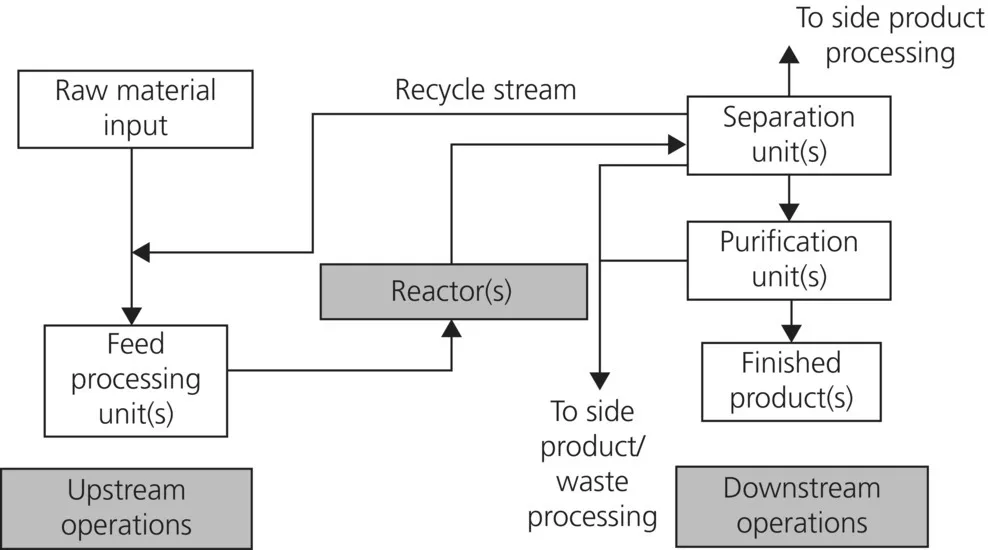
Figure 1.1 Outline of a chemical process.
In almost all reactors running in the chemical industry, the desired product throughput and quality are provided by catalysts, the functional materials that allow chemical synthesis to be carried out at economic scales by increasing the reaction rates. Owing to this critical feature, more than 98% of the today’s industrial chemistry is involved with catalysis. Since catalysts have direct impact on reactor performance, they have to be operated at their highest possible effectiveness, which is determined by the degree of internal and external heat and mass transport resistances defined and explained in detail in Chapter 2. At this stage, the function of the reactor is to provide conditions such that the catalyst particles can deliver the best possible performance (e.g., activity, selectivity, yield) at sufficient stability. For example, for a highly exothermic reaction system such as Fischer–Tropsch (FT) synthesis, heat transport/removal rates within the reactor should be very high to prevent undesired temperature elevations that can negatively affect product distribution and, more importantly, cause thermally induced deactivation of the catalysts. Considering the fact that transport rates are favored by good mixing of the reactive fluid at turbulent conditions, the selected reactor type should allow a wide operating window in terms ...
Table of contents
- Cover
- Title Page
- Table of Contents
- List of contributors
- Preface
- PART 1: Principles of catalytic reaction engineering
- PART 2: Two-phase catalytic reactors
- PART 3: Three-phase catalytic reactors
- PART 4: Structured reactors
- PART 5: Essential tools of reactor modeling and design
- PART 6: Industrial applications of multiphase reactors
- Index
- End User License Agreement
Trusted by 375,005 students
Access to over 1.5 million titles for a fair monthly price.
Study more efficiently using our study tools.
Frequently asked questions
Yes, you can cancel anytime from the Subscription tab in your account settings on the Perlego website. Your subscription will stay active until the end of your current billing period. Learn how to cancel your subscription
No, books cannot be downloaded as external files, such as PDFs, for use outside of Perlego. However, you can download books within the Perlego app for offline reading on mobile or tablet. Learn how to download books offline
Perlego offers two plans: Essential and Complete
- Essential is ideal for learners and professionals who enjoy exploring a wide range of subjects. Access the Essential Library with 800,000+ trusted titles and best-sellers across business, personal growth, and the humanities. Includes unlimited reading time and Standard Read Aloud voice.
- Complete: Perfect for advanced learners and researchers needing full, unrestricted access. Unlock 1.5M+ books across hundreds of subjects, including academic and specialized titles. The Complete Plan also includes advanced features like Premium Read Aloud and Research Assistant.
We are an online textbook subscription service, where you can get access to an entire online library for less than the price of a single book per month. With over 1.5 million books across 990+ topics, we’ve got you covered! Learn about our mission
Look out for the read-aloud symbol on your next book to see if you can listen to it. The read-aloud tool reads text aloud for you, highlighting the text as it is being read. You can pause it, speed it up and slow it down. Learn more about Read Aloud
Yes! You can use the Perlego app on both iOS and Android devices to read anytime, anywhere — even offline. Perfect for commutes or when you’re on the go.
Please note we cannot support devices running on iOS 13 and Android 7 or earlier. Learn more about using the app
Please note we cannot support devices running on iOS 13 and Android 7 or earlier. Learn more about using the app
Yes, you can access Multiphase Catalytic Reactors by Zeynep Ilsen Önsan,Ahmet Kerim Avci in PDF and/or ePUB format, as well as other popular books in Technology & Engineering & Power Resources. We have over 1.5 million books available in our catalogue for you to explore.