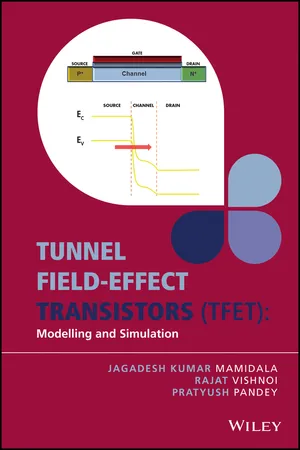
Tunnel Field-effect Transistors (TFET)
eBook - ePub

Tunnel Field-effect Transistors (TFET)

Modelling and Simulation

  1. English
  2. ePUB (mobile friendly)
  3. Available on iOS & Android
eBook - ePub

Tunnel Field-effect Transistors (TFET)

Modelling and Simulation

About this book

Research into Tunneling Field Effect Transistors (TFETs) has developed significantly in recent times, indicating their significance in low power integrated circuits. This book describes the qualitative and quantitative fundamental concepts of TFET functioning, the essential components of the problem of modelling the TFET, and outlines the most commonly used mathematical approaches for the same in a lucid language.

Divided into eight chapters, the topics covered include: Quantum Mechanics, Basics of Tunneling, The Tunnel FET, Drain current modelling of Tunnel FET: The task and its challenges, Modeling the Surface Potential in TFETs, Modelling the Drain Current, and Device simulation using Technology Computer Aided Design (TCAD). The information is well organized, describing different phenomena in the TFETs using simple and logical explanations.

Key features:

* Enables readers to understand the basic concepts of TFET functioning and modelling in order to read, understand, and critically analyse current research on the topic with ease.

*Includes state-of-the-art work on TFETs, attempting to cover all the recent research articles published on the subject.

* Discusses the basic physics behind tunneling, as well as the device physics of the TFETs.

* Provides detailed discussion on device simulations along with device physics so as to enable researchers to carry forward their study on TFETs.

Primarily targeted at new and practicing researchers and post graduate students, the book would particularly be useful for researchers who are working in the area of compact and analytical modelling of semiconductor devices.

Tools to learn more effectively

Saving Books

Saving Books

Keyword Search

Keyword Search

Annotating Text

Annotating Text

Listen to it instead

Listen to it instead

1
Quantum mechanics

1.1 Introduction to quantum mechanics

Before attempting to investigate the workings of a tunnelling field-effect transistor, it is essential to be familiar with the concept of tunnelling. Tunnelling is a quantum phenomenon, with no counterpart in the everyday physics one encounters, or the physics that one applies while dealing with devices a few hundred nanometres in length. The initial two chapters will, therefore, help us develop an understanding of quantum phenomena. In this chapter, we will present an introduction to the field of quantum mechanics and the next chapter will discuss the phenomenon of tunnelling in detail.
The chapter begins with a description of a landmark experiment that conclusively proved the wave nature of particles, after which we will study the concept of wavefunctions and how to use Schrodinger’s equation to obtain them. A few basic problems will be presented so that the readers may familiarise themselves with basic quantum concepts.

1.1.1 The double slit experiment

There are many experiments that led to the conception of quantum mechanics – blackbody radiation, the Stern Gerlach experiment, the photoelectric effect, the line spectrum, etc. However, for our purposes we will concentrate on one of the landmark experiments, that is the double slit experiment, which demonstrated the fundamental quantum nature (i.e. both wave and particle) of electrons.
You would have read that only waves can undergo superposition, and not particles. Superposition is the fundamental principle behind the occurrence of interference – therefore, if something exhibits interference, it must have a wave nature. The double slit experiment is famously associated with Thomas Young, who used it for the first time in the early nineteenth century to prove the wave nature of light. Before this experiment was performed, light had been associated with a particle nature (since the times of Newton), and the fact that it underwent interference was conclusive proof of its wave nature.
However, the behaviour of light that led Newton and others to believe that it had a particle nature could not be reconciled with this newly formed wave picture. It took another century of research and experiments to establish a rather astonishing result regarding the behaviour of light – that it displays both particle and wave natures. The particle nature leads to phenomena such as the photoelectric effect and rectilinear propagation of light in ray optics; the wave nature explained the interference and diffraction of light.
While this dual nature (that is both particle and wave natures) of light was being worked out, many people were, independently, studying the behaviour of subatomic particles. Phenomenon like the discrete line spectrum of hydrogen, the observed distribution of blackbody radiation, etc., could not be explained by any established theory. Theoretical physicists were in a quandary. At this point, de Broglie hypothesised that, just like light, particles possess a dual nature as well. When de Broglie made this hypothesis, there was little evidence to support his claim. A few years later, Davisson and Germer experimentally observed that electrons underwent d...

Table of contents

  1. Cover
  2. Title Page
  3. Table of Contents
  4. Preface
  5. 1 Quantum mechanics
  6. 2 Basics of tunnelling
  7. 3 The tunnel FET
  8. 4 Drain current modelling of tunnel FET: the task and its challenges
  9. 5 Modelling the surface potential in TFETs
  10. 6 Modelling the drain current
  11. 7 Device simulation using ATLAS
  12. 8 Simulation of TFETs
  13. Index
  14. End User License Agreement

Frequently asked questions

Yes, you can cancel anytime from the Subscription tab in your account settings on the Perlego website. Your subscription will stay active until the end of your current billing period. Learn how to cancel your subscription
No, books cannot be downloaded as external files, such as PDFs, for use outside of Perlego. However, you can download books within the Perlego app for offline reading on mobile or tablet. Learn how to download books offline
Perlego offers two plans: Essential and Complete
  • Essential is ideal for learners and professionals who enjoy exploring a wide range of subjects. Access the Essential Library with 800,000+ trusted titles and best-sellers across business, personal growth, and the humanities. Includes unlimited reading time and Standard Read Aloud voice.
  • Complete: Perfect for advanced learners and researchers needing full, unrestricted access. Unlock 1.4M+ books across hundreds of subjects, including academic and specialized titles. The Complete Plan also includes advanced features like Premium Read Aloud and Research Assistant.
Both plans are available with monthly, semester, or annual billing cycles.
We are an online textbook subscription service, where you can get access to an entire online library for less than the price of a single book per month. With over 1 million books across 990+ topics, we’ve got you covered! Learn about our mission
Look out for the read-aloud symbol on your next book to see if you can listen to it. The read-aloud tool reads text aloud for you, highlighting the text as it is being read. You can pause it, speed it up and slow it down. Learn more about Read Aloud
Yes! You can use the Perlego app on both iOS and Android devices to read anytime, anywhere — even offline. Perfect for commutes or when you’re on the go.
Please note we cannot support devices running on iOS 13 and Android 7 or earlier. Learn more about using the app
Yes, you can access Tunnel Field-effect Transistors (TFET) by Jagadesh Kumar Mamidala,Rajat Vishnoi,Pratyush Pandey in PDF and/or ePUB format, as well as other popular books in Technology & Engineering & Electrical Engineering & Telecommunications. We have over one million books available in our catalogue for you to explore.