Collectively, your workers are your company's most important and most valuable asset. To make the most of this asset, nothing beats quantitative performance and investment measurement. Learning and Development is an 80 billion-dollar industry, and every valuable employee represents a sizable investment on the part of your company. To keep your business moving forward, effective management of human capital is crucial. It generates plenty of data, and deep analysis of this data helps you provide feedback and make adjustments to capitalize on the combined knowledge, skills, and creativity of your workers. Developing Human Capital: Using Analytics to Plan and Optimize Your Learning and Development Investments provides a guidebook for collecting, organizing, and analyzing the data surrounding human capital so you can make the most of your employees' potential.
Use predictive analysis to optimize human capital investments
Learn effective study design and alignment
Get the tools you need for measurement, surveys, and analysis
Decide what to measure and how to measure it
Outline your company's current and future analytics technology needs
Map data sources, and overcome barriers to data collection
Authors Gene Pease, Bonnie Beresford, and Lew Walker provide case studies in which major companies applied human capital analytics to guide people decisions, and expand upon the role of analytics in Learning and Development. Developing Human Capital: Using Analytics to Plan and Optimize Your Learning and Development Investments is an essential guide to 21st century human resources and management practices, and can keep you from squandering your company's most valuable resource.
Learning and development (L&D) generally represents an organization’s single largest investment in its people. The American Society for Training & Development (ASTD) estimates that U.S. organizations spent over $150 billion on training in 2011.1 Our intent with this book is to show you how you can use analytics to better manage the learning and development needs of a thriving organization in a rapidly changing environment. It is no coincidence that the field of human capital analytics is growing in popularity at a time when organizations are managing up to five generational cohorts in the workplace. These generational groups represent different backgrounds, ideals, challenges, and opportunities, many of which can be better understood through the various analytical tactics presented in this book. It’s going to take the evidence and insights from analytics for organizations to effectively manage their workforces—and their human capital—for competitive advantage.
DEFINING THE GENERATIONS
Despite what the buzz around the Baby Boomers and the Millennials may have you believe, there are five generations in the current workforce:
Traditionalists (born prior to 1946)
Baby Boomers (born between 1946 and 1964)
Generation X (born between 1965 and 1976)
Millennials (born between 1977 and 1997)
Generation 2020 (born after 1997)2
For the purposes of our discussion, in this chapter we focus on the three generations with the largest employee presences at the majority of organizations: Boomers, Xers, and Millennials, as well as some of the attendant changes and significant issues facing the workforce. For a more detailed discussion of the future workplace, we highly recommend Jeanne Meister and Karie Willyerd’s book, The 2020 Workplace.3
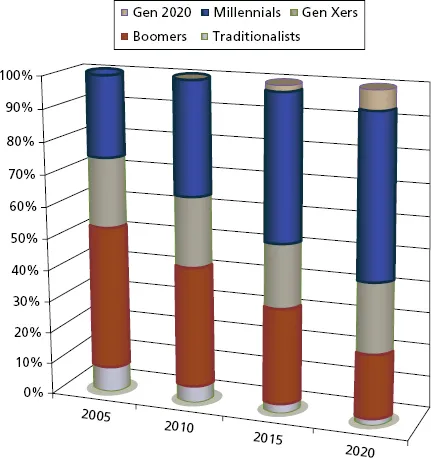
Figure 1.1 shows how these workforce populations have shifted (and are projected to shift) over time.
Figure 1.1 Workforce Populations
While each generation is made up of individuals with unique belief systems and life experiences, we can assume a number of generalizations about each generation based on their collective experiences. As the generation of drugs, sex, and rock ‘n’ roll, the Baby Boomers came of age during the era of the Vietnam War and Watergate. In their youth, they took to the streets for human rights and the women’s movement. They are said to be optimistic, competitive, and questioners of authority. At work, they’re motivated by money, they work long hours at the expense of their personal lives, and they pursue upward career mobility.
Generation X is the skeptical generation. They saw the divorce rate triple as they grew up, with parents working long hours at the expense of family life. Experiencing life in a single-parent household became commonplace. Gen Xers were often latchkey children, left to their own devices after school. As adults, they tend to distrust institutions and be highly adaptive to change. In the office, Xers are known for following their hearts. They’re motivated by freedom and prefer to be judged on their output instead of the number of hours spent at their desks. Their families are just as important as their careers, and they’re unconcerned about lateral moves and career plateaus.
Millennials were the first generation raised from day one with technology, experiencing the expansion of its capabilities and reach into everyday life as they grew up. They’ve been influenced by a diversifying population, violence ranging from gang activity to terrorist attacks, and large-scale natural disasters. Millennials are known for their technological savvy, their concern for global affairs, and their short attention spans. In the workplace, they crave feedback, fulfillment, and flexibility. They’ve echoed Generation X’s equal-parts emphasis on career and family.4
PROJECTED GAPS AS THE GENERATIONS SHIFT
As with any changing of the guard, there are institutional concerns accompanying the generational shift. One is the loss of institutional knowledge. While many Boomers have built their careers within one organization or industry, the younger generations tend to jump from company to company as opportunities arise. Many learning leaders are grappling with the challenges of retaining the institutional knowledge that departs with the retiring Boomers, not to mention the transient workforces that are the hallmark of so many organizations today (more on this later).
Certain industries are also suffering from a shortage of skilled workers in particular job roles. These jobs tend to be on the ends of the educational spectrum: highly specialized sectors and labor-intensive positions. High schools have shifted their emphasis from vocational skills to preparation for four-year colleges, which is one factor in the shortfall of laborers. For example, the aging population of skilled-trade workers (e.g., welders or machine operators) is not being replaced by younger workers. In 2012, 53 percent of skilled-trade workers were over the age of 44; by contrast, in the overall workforce only 44 percent of workers were over age 44.5 On the other end, the health care, manufacturing, and technology industries are struggling to fill open job positions. The Bureau of Labor Statistics counts 3.5 million job openings at a paradoxical time of high unemployment, reflecting the difficulty of filling certain types of positions.6
CHASING DOWN RETIREMENT
Retirement was once a shining beacon at the end of one’s career path; today, it’s a shifting, elusive state that some mature workers may never attain. For many Boomers, retirement is simply not economically feasible. Others aren’t interested in facing another 20-plus years of life without gainful employment. A Deloitte study found that 48 percent of Baby Boomers plan to keep working past age 65.7 As life expectancies increase, wealth declines, and government policy shifts, the definition of retirement for the Boomers has changed.
When the Boomers leave the workplace primarily through retirement, they leave with significant institutional knowledge, most of which is in their heads from years of on-the-job experience. So the question is: How do you capture this knowledge?
On one hand, the gap in numbers of skilled workers is helped by delayed retirements. Many workers are entering a state of semiretirement, in which they work part-time or as independent consultants.8 These types of arrangements buy time for organizations to shift institutional knowledge to the younger generations, particularly when the older workers are encouraged to serve as mentors to their younger colleagues. On the other hand, delayed retirements can create frustrating roadblocks to career advancement for younger workers, particularly those in Generation X.
To assist in this knowledge transfer, organizations are investing in knowledge management systems, centralized repositories of knowledge and history that can be accessed. Millennials are comfortable and well versed in using platforms such as Google and Wikiped...
Table of contents
Cover
Contents
Title
Copyright
Foreword
Preface
Acknowledgments
Introduction
Chapter 1: The New Workforce
Chapter 2: The Need for a Strategy
Chapter 3: Establishing a Measurement Framework
Chapter 4: Planning for Success
Chapter 5: Curriculum Alignment
Chapter 6: Measurement Alignment
Chapter 7: Improving on the Basics
Chapter 8: Hard Evidence Using Advanced Analytics
Chapter 9: Optimization through Predictive Analytics
Chapter 10: In Conclusion—Get Started
Appendix A: Talent Development Reporting Principles (TDRp): Managing Learning like a Business to Deliver Greater Impact, Effectiveness, and Efficiency
Appendix B: What It Takes
Appendix C: Measurement Plan: Blueprints for Measurement
Appendix D: Using Bloom’s Taxonomy
Appendix E: Guidelines for Creating Multiple Choice Questions
Appendix F: Getting Your Feet Wet in Data: Preparing and Cleaning the Data Set
Appendix G: How Many Participants Do You Need in a Study?
Glossary
About the Authors
Index
End User License Agreement
Trusted by 375,005 students
Access to over 1.5 million titles for a fair monthly price.
Study more efficiently using our study tools.
Frequently asked questions
Yes, you can cancel anytime from the Subscription tab in your account settings on the Perlego website. Your subscription will stay active until the end of your current billing period. Learn how to cancel your subscription
No, books cannot be downloaded as external files, such as PDFs, for use outside of Perlego. However, you can download books within the Perlego app for offline reading on mobile or tablet. Learn how to download books offline
Perlego offers two plans: Essential and Complete
Essential is ideal for learners and professionals who enjoy exploring a wide range of subjects. Access the Essential Library with 800,000+ trusted titles and best-sellers across business, personal growth, and the humanities. Includes unlimited reading time and Standard Read Aloud voice.
Complete: Perfect for advanced learners and researchers needing full, unrestricted access. Unlock 1.5M+ books across hundreds of subjects, including academic and specialized titles. The Complete Plan also includes advanced features like Premium Read Aloud and Research Assistant.
Both plans are available with monthly, semester, or annual billing cycles.
We are an online textbook subscription service, where you can get access to an entire online library for less than the price of a single book per month. With over 1.5 million books across 990+ topics, we’ve got you covered! Learn about our mission
Look out for the read-aloud symbol on your next book to see if you can listen to it. The read-aloud tool reads text aloud for you, highlighting the text as it is being read. You can pause it, speed it up and slow it down. Learn more about Read Aloud
Yes! You can use the Perlego app on both iOS and Android devices to read anytime, anywhere — even offline. Perfect for commutes or when you’re on the go. Please note we cannot support devices running on iOS 13 and Android 7 or earlier. Learn more about using the app
Yes, you can access Developing Human Capital by Gene Pease,Barbara Beresford,Lew Walker in PDF and/or ePUB format, as well as other popular books in Business & Decision Making. We have over 1.5 million books available in our catalogue for you to explore.