Practical Medical Microbiology for Clinicians
eBook - ePub

Practical Medical Microbiology for Clinicians

  1. English
  2. ePUB (mobile friendly)
  3. Available on iOS & Android
eBook - ePub

Practical Medical Microbiology for Clinicians

About this book

Infectious diseases constitute a major portion of illnesses worldwide, and microbiology is a main pillar of clinical infectious disease practice. Knowledge of viruses, bacteria, fungi, and parasites is integral to practice in clinical infectious disease.

Practical Medical Microbiology is an invaluable reference for medical microbiology instructors. Drs. Berkowitz and Jerris are experienced teachers in the fields of infectious diseases and microbiology respectively, and provide expert insight into microorganisms that affect patients, how organisms are related to each other, and how they are isolated and identified in the microbiology laboratory. The text also is designed to provide clinicians the knowledge they need to facilitate communication with the microbiologist in their laboratory.

The text takes a systematic approach to medical microbiology, describing taxonomy of human pathogens and consideration of organisms within specific taxonomic groups. The text tackles main clinical infections caused by different organisms, and supplements these descriptions with clinical case studies, in order to demonstrate the effects of various organisms.

Practical Medical Microbiology is an invaluable resource for students, teachers, and researchers studying clinical microbiology, medical microbiology, infectious diseases, and virology.
Frequently asked questions

Yes, you can cancel anytime from the Subscription tab in your account settings on the Perlego website. Your subscription will stay active until the end of your current billing period. Learn how to cancel your subscription.
No, books cannot be downloaded as external files, such as PDFs, for use outside of Perlego. However, you can download books within the Perlego app for offline reading on mobile or tablet. Learn more here.
Perlego offers two plans: Essential and Complete
  • Essential is ideal for learners and professionals who enjoy exploring a wide range of subjects. Access the Essential Library with 800,000+ trusted titles and best-sellers across business, personal growth, and the humanities. Includes unlimited reading time and Standard Read Aloud voice.
  • Complete: Perfect for advanced learners and researchers needing full, unrestricted access. Unlock 1.4M+ books across hundreds of subjects, including academic and specialized titles. The Complete Plan also includes advanced features like Premium Read Aloud and Research Assistant.
Both plans are available with monthly, semester, or annual billing cycles.
We are an online textbook subscription service, where you can get access to an entire online library for less than the price of a single book per month. With over 1 million books across 1000+ topics, weโ€™ve got you covered! Learn more here.
Look out for the read-aloud symbol on your next book to see if you can listen to it. The read-aloud tool reads text aloud for you, highlighting the text as it is being read. You can pause it, speed it up and slow it down. Learn more here.
Yes! You can use the Perlego app on both iOS or Android devices to read anytime, anywhere โ€” even offline. Perfect for commutes or when youโ€™re on the go.
Please note we cannot support devices running on iOS 13 and Android 7 or earlier. Learn more about using the app.
Yes, you can access Practical Medical Microbiology for Clinicians by Frank E. Berkowitz,Robert C. Jerris in PDF and/or ePUB format, as well as other popular books in Sciences biologiques & Microbiologie. We have over one million books available in our catalogue for you to explore.

Information

Year
2015
Print ISBN
9781119066743
eBook ISBN
9781119067115

SECTION III
Bacteriology

CHAPTER 9
Bacteriology

Structure of bacteria

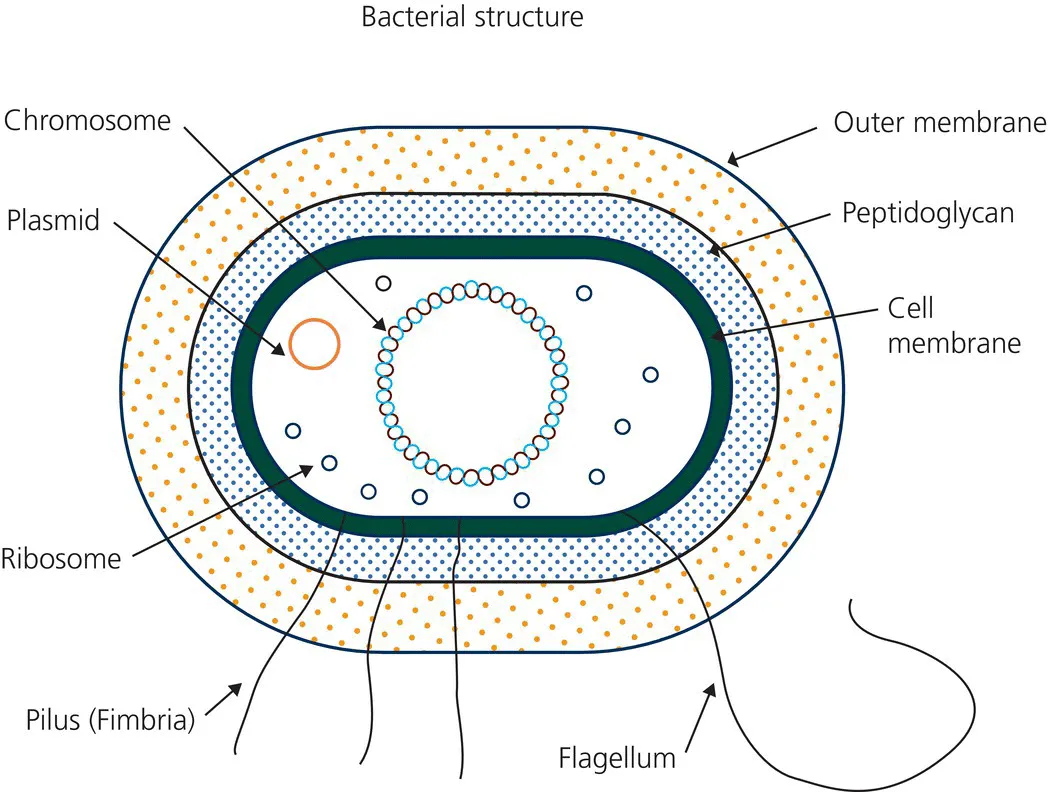
Bacteria are prokaryotes, i.e. they do not have a nuclear membrane. They have a cell wall, a cell membrane, a chromosome, and ribosomes. In addition, some bacteria have flagella (singular flagellum), which enables these bacteria to move, and some have fimbriae (singular fimbria), also called pili (singular pilus), which enable the bacteria to adhere to epithelial surfaces (see virulence factors, later in this chapter), and to pass genetic material to other bacteria (see conjugation, later in this chapter). The basic structure of a bacterial cell is shown in Fig. 9.1.
Structure of a bacterial cell displaying the chromosome, plasmid, ribosome, pilus (fimbria), flagellum, cell membrane, peptidoglycan, and outer membrane.
Fig. 9.1 Structure of a bacterial cell.
Bacteria have a single chromosome which is arranged in a circle, and which is supercoiled, which reduces its volume. DNA replication occurs in both directions. In addition, they may have pieces of extrachromosomal DNA, called plasmids. These may contain genes for virulence factors or antibiotic resistance. The ribosomes, where proteins are synthesized, consist of 30S and 50S subunits. These are targets of antibiotics that inhibit protein synthesis.
There are three main shapes of bacteria: round โ€“ coccus (cocci); rod-shaped โ€“ bacillus/rod (bacilli/rods); spiral โ€“ spirochete(s).

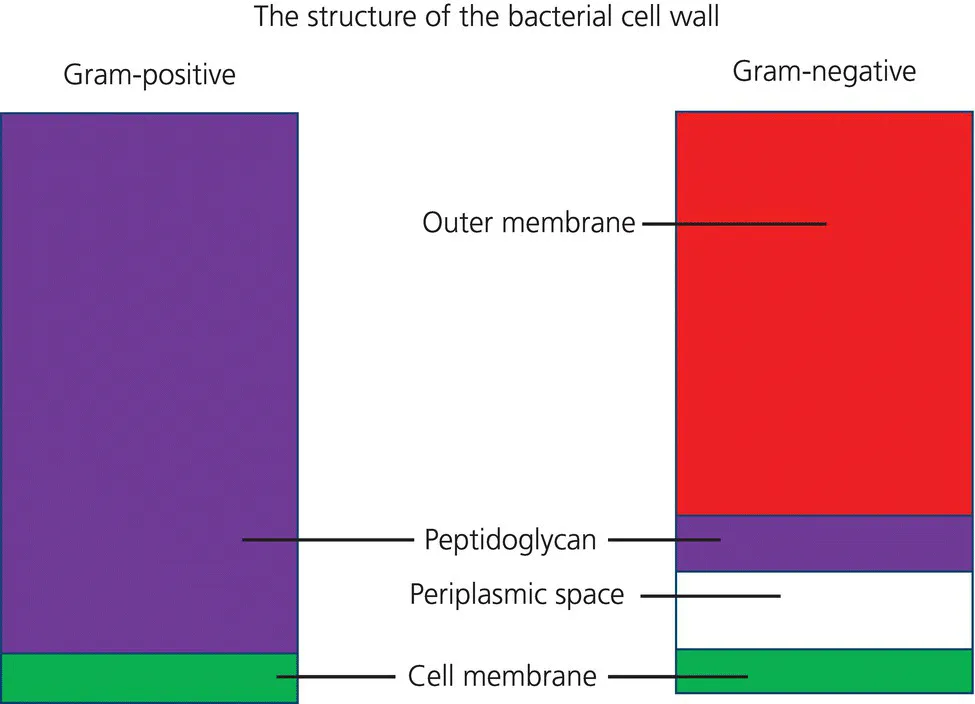
Cell wall (Fig. 9.2)

2 Vertical rectangles depicting the basic structure of Gram-positive (left) and Gram-negative (right): outer membrane (red), peptidoglycan (violet), periplasmic space (white), and cell membrane (green).
Fig. 9.2 Basic structure of Gram-positive and Gram-negative cell walls.
This is a rigid structure, composed of cross-linked carbohydrates, that gives the organism shape and prevents osmotic injury. Enzymes necessary for its synthesis are present in the cell membrane. These are called penicillin-binding proteins and are targets of ฮฒ-lactam antibiotics. In Gram-positive bacteria, the cell wall consists of about 40 layers of peptidoglycan, while in Gram-negative bacteria, it consists of 3โ€“4 layers of peptidoglycan, outside which there is a complex lipid membrane called the outer membrane. A component of this membrane is endotoxin. Channels called porins allow macromolecules to pass through the outer membrane.

Genetic changes

Bacteria can change their genetic composition over a short period of time by the following mechanisms.
  • Mutation: because bacteria have short generation times, mutations during replication can accumulate rapidly. Some of these may give the organisms a survival advantage.
  • Acquisition of genetic material, by various mechanisms.
    • Conjugation: this is by the transfer of plasmids from a donor bacterial cell to a recipient cell. The plasmid DNA can replicate as does that of the chromosome. A plasmid that can be integrated into the chromosome is called an episome.
    • Transformation: this is the acquisition of DNA from the environment. This phenomenon was first demonstrated when live non-encapsulated pneumococci were mixed in a medium with dead encapsulated pneumococci. The live pneumococci acquired the ability to make capsules, indicating their ability to take up genetic material from the medium. This observation contributed to the discovery of the structure of DNA.
    • Transduction: this is the process by which a bacteriophage (a virus infecting a bacterium) introduces DNA into the bacterial cell. This DNA can be incorporated into the bacterial DNA (in which case it is called lysogenic), or it may remain in the cytosol, in which case it will replicate and cause lysis of the bacterial cell (lytic). An example of genetic material conferred by a bacteriophage is the gene for diphtheria toxin production in Corynebacterium diphtheria (see Chapter 12).
Pieces of genetic material that can move from a plasmid to a chromosome or to another plasmid are called transposons. Genes that can be carried in these genetic elements contain information that can convey antibiotic resistance and virulence. Groups of virulence genes constitute a pathogenicity island.

Bacteria...

Table of contents

  1. Cover
  2. Title Page
  3. Table of Contents
  4. Preface
  5. Acknowledgments
  6. SECTION I: Laboratory methods in clinical microbiology
  7. SECTION II: Prions and viruses
  8. SECTION III: Bacteriology
  9. SECTION IV: Mycology
  10. SECTION V: Parasitology
  11. SECTION VI: Clinical cases
  12. SECTION VII: Appendices
  13. Index
  14. End User License Agreement