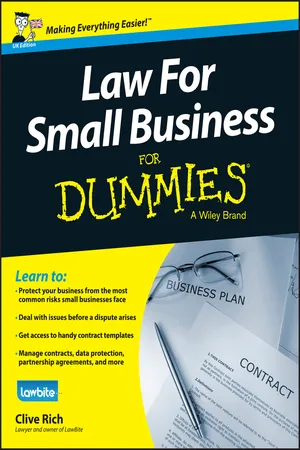
- English
- ePUB (mobile friendly)
- Available on iOS & Android
Law for Small Business For Dummies, UK Edition
About this book
Written in plain-English for business people without any legal training, Law For Small Business For Dummies covers everything you need to be aware of regarding the law when you're starting and running your own business. Cutting through the jargon that can make even the pros scratch their heads, this book quickly gets you up-to-speed on the key areas of business law, including contracts, websites, intellectual property, data protection and partnership agreements. Plus, you'll find out how small business law applies to advertising and marketing, confidentiality agreements, the sale and supply of goods (including e-commerce), negligence and product liability.
There were 526,000 new businesses registered in the UK in 2013āand, at some point, all of them will be faced with legal risks that could make the difference between success and failure. One claim could wipe out a fledgling business' profits, and hit even big businesses harder than they could ever imagine. If you're the owner of a new business and need to get a handle on the ins and outs of small business lawāand don't have the budget to employ an in-house legal advisorāthis trusted, approachable guide is your answer.
- Covers the laws surrounding the most common risks small businesses face
- Addresses how to deal with legal issues before a potentially costly dispute arises
- Provides access to handy sample contract templates on Dummies.com
- Serves as your own in-house legal advisorāat a fraction of the cost
If you're an existing business owner or an aspiring entrepreneur thinking about starting your own business, Law For Small Business For Dummies gives you answers to questions you didn't even know to ask!
Frequently asked questions
- Essential is ideal for learners and professionals who enjoy exploring a wide range of subjects. Access the Essential Library with 800,000+ trusted titles and best-sellers across business, personal growth, and the humanities. Includes unlimited reading time and Standard Read Aloud voice.
- Complete: Perfect for advanced learners and researchers needing full, unrestricted access. Unlock 1.4M+ books across hundreds of subjects, including academic and specialized titles. The Complete Plan also includes advanced features like Premium Read Aloud and Research Assistant.
Please note we cannot support devices running on iOS 13 and Android 7 or earlier. Learn more about using the app.
Information
Getting Started with Legal Requirements


www.dummies.com to discover more and do more with For Dummies books. 


Starting Your Legal Journey: Business Structures and Initial Research


Deciding on Your Trading Structure
- Sole trader
- Partnership (including a limited liability partnership)
- Limited liability company
Going it alone: Sole trader
Advantages
- Autonomy and control: The sole trader is truly independent and is in full control of the business and how itās conducted and any earned profits. You can therefore fully realise and develop your vision for the business without interference. Great!

- Low administrative burden: The lack of a formal setting-up structure makes for a cost-effective process requiring less paperwork. Usually, you donāt need specialist legal or accountancy advice.
- Less statutory obligations: The Companies Acts donāt apply to sole traders, and you have no requirement to file annual accounts or fulfil the other administrative burdens that fall on limited companies (see the later section āProtecting your liability: Limited companyā for details).
- Flexibility: As a sole trader, you can make decisions quickly because you donāt need to consult anyone. Similarly, you can implement new decisions or ideas instantly.
- Personal reputation: A sole trader can build up an invaluable rapport with customers as the āfaceā of the business.
- Privacy: Personal details of the sole trader, including address and profits, arenāt in the public domain, because you donāt have to register with Companies House (flip to the later āChecking Companies Houseā section for more details).
- Great for testing a new business idea: Setting up as a sole trader is an inexpensive way to determine whether your business idea has true potential before you leave full-time employment.
If youāre an employee of someone else though, check that you arenāt breaching your employment contract by, for example, potentially competing with your employer or using confidential information.
- Earning potential: You retain any profits earned as the sole trader and (after tax) donāt have to share them. When youāve got your cake, you can eat it all yourself!
- Ability to adapt: If you begin your business as a sole trader, you can transition it into a limited liability company (see the āProtecting your liability: Limited companyā section later in this chapter) if it expands to a sufficient degree. No bar exists to incorporating the business at a later date by turning it into a limited company.
Disadvantages
- Personal liability: As a sole trader you can be held personally liable for losses suffered by the business, because no distinction exists between your personal and business assets. This disadvantage is a real ābiggieā ā donāt underestimate its significance. If youāre a sole trader, you can end up funding the losses of the business out of your own savings, pension or house. Ouch! For this reason, you need to get your official Terms and Conditions (T&Cs) sorted to minimise your liabilities ā check out Chapters 6 and 12 for your website T&Cs and other customer contracts, respectively, whatever business structure you choose.

- Status or prestige: An inherent snobbery exists regarding the sole-trader arrangement. Whether justifiable or not, sole traders are perceived as being less professional in nature and lacking professional credibility. Certain larger companies adhere to a strict policy of only dealing with limited companies.
- Sole burden of responsibility: A sole trader must operate as a ājack of all tradesā. Whether you have an aptitude for a particular area or not, youāre required to fulfil all aspects of the business, such as administration (invoicing, filing, replying to customer queries and complaints) and finances (tax and National Insurance), as well as carrying responsibility for the core businessās operation. Life can seem like a daily triathlon, followed by a decathlon, followed by a marathon.
- Financial support or funding: Sole traders have to rely on their own personal credit rating when seeking financial support. Potential lenders donāt look on them favourably or as a secure option, which can cause difficulti...
Table of contents
- Cover
- Title Page
- Table of Contents
- Introduction
- Part I: Getting Started with Legal Requirements
- Part II: Launching Your Business ā Legal Essentials
- Part III: Growing the Business ā The Legal Blueprint
- Part IV: Staying in Business ā Legal Pitfalls
- Part V: Exiting Successfully ā Legal Secrets
- Part VI: The Part of Tens
- About the Author
- Cheat Sheet
- Advertisement Page
- Connect with Dummies
- End User License Agreement
