How to win market leadership in a fast-changing world
In the past, companies could pick a strategy and stick with it, maintaining a competitive edge for years. But today, companies surge ahead, fall behind, or even disappear in mere months. If you and your company are going to thrive for the long run, you need to continuously evolve, change, and stay a step ahead of your competition.
The ability to see and capitalize on new opportunities is the cornerstone of agility. Successful technology-based firms like Google, Tesla, and Amazon have all mastered agility within their core business practices, but companies in any sector can—and must—learn to spot new opportunities and make the right choices about what to invest in, what to change, and what to abandon.
The Agility Advantage first shows how to identify those aspects of your business where agility is most crucial—where the business environment is changing fast—and which elements have the greatest impact on the customer's decision to buy. Amanda Setili then shows how to master the three components of agility:
Market agility: Gain ideas from your most demanding and forward-thinking customers and from outside your industry. Engage, observe, and mix with customers to identify the opportunities created by their changing demands.
Decision agility: Anticipate the changes that may affect you and turn even troubling trends into opportunities. Design your strategy to maximize learning and to manage risk. Generate diverse alternatives and make fast, fact-based decisions about which to pursue.
Execution agility: Build new capabilities, shed what doesn't fit, and take the first steps in a new direction. Experiment, then reinforce and build on what works. Enlist and inspire your organization around a compelling purpose and grant employees the autonomy and resources to continuously adapt and adjust course.
The future will present more opportunities but narrower windows to capture them. With a wealth of valuable information and practical strategies, The Agility Advantage is essential reading to help any organization adapt and thrive—both today and tomorrow.
Chapter One What Is Agility—and Why Is It Valuable?
During the post–World War II boom in home appliances in 1951, General Electric (GE) broke ground on its Appliance Park in Louisville, Kentucky. The complex quickly grew to include six factory buildings the size of shopping malls, and became so immense that it had its own fire department, its own power plant—even its own ZIP code. In 1953, GE purchased a UNIVAC computer to handle payroll, becoming the first business in the world to own a computer (only governments had owned them up until that time).1 By 1955, Appliance Park employed sixteen thousand workers, and by 1973, twenty-three thousand. During the 1960s, the workers at Appliance Park were turning out sixty thousand appliances each week.
However, something funny happened along the way to the present day.
To cut costs, many American manufacturers moved their factories offshore—to places like Taiwan, Malaysia, the Philippines, Mexico, and China. GE was not immune to this shift; in fact, the company became convinced that to remain competitive, it had no choice but to follow its rivals. This, coupled with ongoing labor disputes, sealed the deal. By 2011, employment at Appliance Park had plunged to just 1,863 people.
However, the cost equation that once made offshoring appear so attractive for U.S. manufacturers has recently been turned upside down. For many, the expected cost savings of offshoring did not materialize. Sure, the overseas factory is lower cost when things are humming along in steady state. But it doesn't take many “unexpected” costs—such as expediting rush orders, flying managers and engineers back and forth to fix problems, or dealing with the repercussions of quality or safety problems—to erase the benefit. Further, contracting with overseas manufacturers requires locking in the design and the assembly process—spelling everything out. Making changes is a big deal when you are managing an outside entity, and a fourteen-hour flight is required just to go observe the process and the people running it.
Further, the cost advantages that led domestic companies to move offshore have in large part receded. Chinese wages, in dollars, rose by a factor of five between 2000 and 2012. Over the same period, oil prices grew threefold, which increased freight costs. Natural gas prices in the United States are now four times lower than in Asia, providing U.S. factories with an energy cost advantage. Relations between U.S. employers and unions have eased, and due to advances in automation, labor is a far smaller proportion of overall product cost than in times past. From a cost perspective, offshoring is not as attractive as it once was; as a result, a growing number of American companies are bringing their manufacturing operations back to the United States. According to Jeffrey Immelt, CEO of GE, offshoring is becoming “outdated as a business model for GE Appliances.”2
Immelt definitely put his money where his mouth is, investing $800 million in the revitalization of GE's Louisville appliance manufacturing plants. During the course of 2012, GE opened new assembly lines at Appliance Park to manufacture high-end refrigerators and low-energy water heaters. The company added additional assembly lines in 2013 to produce front-loading washing machines and dryers, along with stainless-steel dishwashers.
But making these changes wasn't easy. During the twenty-year period when Chinese and Mexican contract manufacturers, not Kentuckians, were building most of GE's appliances, GE lost expertise in how to build its own products. However, this problem became an opportunity for the company's design and manufacturing engineers and line workers to start with a clean sheet of paper. For example, GE discovered through careful redesign that it could beat the price of the Chinese version of its GeoSpring energy-efficient water heater by 20 percent—delivering its product at a retail price of $1,299 versus $1,599 for the Chinese unit.
This unexpected advantage came about in large part because GE's assembly workers collaborated directly with its designers, engineers, marketers, and others, working in an open, collegial, and self-critical way. More important than the substantial cost reduction, however, is the shorter product development cycle that collocating manufacturing with other functions enables. The ever-quickening pace of product innovation across multiple industries, along with the incorporation of ever-smarter electronics into formerly mature products like home appliances, has significantly shrunk GE's product life cycle. Just a few years ago, an appliance design stayed competitive for seven years; GE's managers now expect a model to last no more than two or three. The factory has become a laboratory for innovation, able to evolve to meet shifting customer demand and to adapt to changing competitive environments.
Delivery times also declined dramatically thanks to the shift back to U.S. manufacturing. Whereas transit time from the Chinese factory to U.S. retailers was five weeks, GE can now move appliances from the Appliance Park factory to Lowe's and Home Depot warehouses in thirty minutes. The company can react to changes in customer demand in days rather than weeks, scaling production up and down in response to increased or declining need. This responsiveness can make a huge difference as competitors roll out new models more frequently. Imagine the savings in inventory costs and in avoiding deep discounting to unload obsolete inventory.
The net result? GE hired seventeen hundred additional U.S. hourly employees in 2012, along with five hundred new engineers and designers from 2009 through the end of 2012. And at the beginning of 2013, the company derived 55 percent of its $5 billion in annual appliance revenue from U.S.-built products. This number is expected to grow to 75 percent by the end of 2014. That's a remarkably fast shift for a huge company like GE. But it goes to show that even the largest businesses can move with great agility if they apply the right approach.
What Is Agility?
In my work with organizations in every industry, I have discovered that the most consistently successful companies—with success defined in terms of growth and profitability—are the most agile. Like GE, these organizations are able to see and respond to changes in the marketplace more capably and quickly than their competitors.
In years past, companies could pick a strategy and stick with it. Perseverance was rewarded. Once they established competitive advantage—whether through lower costs, higher quality, or a superior customer relationship—they could often maintain it for years, even decades. Nowadays, however, change comes faster, and companies can surge ahead of or fall behind competitors in mere months.
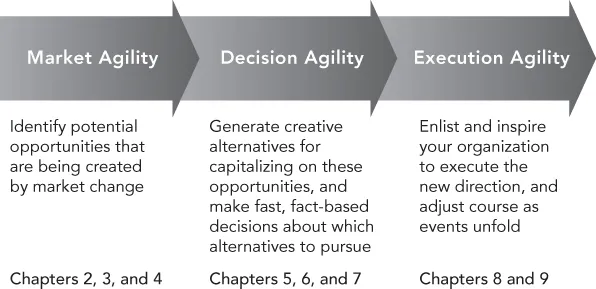
As I mentioned in the Preface, agility is the ability to see and capitalize on new opportunities quickly. It has three components:
Market agility
Decision agility
Execution agility
Each of these components is addressed in the chapters of this book, as shown in Figure 1.1.
Figure 1.1 Components of Agility
Each company has unique challenges that threaten its ability to be agile. Some excel at gaining market insights and identifying opportunities, but get bogged down in the decision-making stage and let opportunities pass them by. Others falter in the execution stage. Some execute superbly, but miss market signals—and head fast in the wrong direction as a result. This book will help you strengthen your capabilities across all three areas, so that you can move faster than the market.
BlackBerry (formerly RIM) had a “blinding confidence”3 in its core product, believing that its large installed base, proprietary network, and superior security features would enable it to maintain market dominance. But the company was too slow to improve, and saw its share of the smartphone market drop from over 40 percent in 2008 to only 5 percent in 2013. BlackBerry's market capitalization is now only about one-twentieth of its peak.
In a similar vein, Microsoft once dominated the technology industry. Since 2000, however, the company has struggled in almost every arena it has entered, including e-books, music players, search, and social networking. Newer players such as Google and Facebook have raced by Microsoft and radically changed the way we live. Although Microsoft recognized growth opportunities, it was unable to take the right action quickly enough. As a result, Microsoft's market capitalization has increas...
Table of contents
Cover
Title Page
Copyright
Dedication
Preface
Chapter One: What Is Agility—and Why Is It Valuable?
Chapter Two: See Through Your Customers' Eyes: How to See What Your Competitor Can't
Chapter Three: Right Customers, Right Value, Right Time: Identify Your Most Attractive Customers and Pivot with Them
Chapter Four: Love the Problem: Dig Deep to Find New Insights
Chapter Five: Turn Trends into Opportunities: Stop Preparing for the Future and Create It
Chapter Six: Create Breakthrough Strategies: Generate Creative Alternatives for Capitalizing on the Changes You See
Chapter Seven: Manage Uncertainty: Be Courageous, Anticipate What Might Happen, and Address Risks Head-On
Chapter Eight: Turning a Strategic Corner: Take the First Steps, Shed What Doesn't Fit, Experiment, and Reinforce
Chapter Nine: Agility as a Way of Life: Leverage the Power of Purpose, Autonomy, and Continuous Adaptation
Conclusion
Acknowledgments
About the Author
More from Wiley
Index
End User License Agreement
Trusted by 375,005 students
Access to over 1.5 million titles for a fair monthly price.
Study more efficiently using our study tools.
Frequently asked questions
Yes, you can cancel anytime from the Subscription tab in your account settings on the Perlego website. Your subscription will stay active until the end of your current billing period. Learn how to cancel your subscription
No, books cannot be downloaded as external files, such as PDFs, for use outside of Perlego. However, you can download books within the Perlego app for offline reading on mobile or tablet. Learn how to download books offline
Perlego offers two plans: Essential and Complete
Essential is ideal for learners and professionals who enjoy exploring a wide range of subjects. Access the Essential Library with 800,000+ trusted titles and best-sellers across business, personal growth, and the humanities. Includes unlimited reading time and Standard Read Aloud voice.
Complete: Perfect for advanced learners and researchers needing full, unrestricted access. Unlock 1.5M+ books across hundreds of subjects, including academic and specialized titles. The Complete Plan also includes advanced features like Premium Read Aloud and Research Assistant.
Both plans are available with monthly, semester, or annual billing cycles.
We are an online textbook subscription service, where you can get access to an entire online library for less than the price of a single book per month. With over 1.5 million books across 990+ topics, we’ve got you covered! Learn about our mission
Look out for the read-aloud symbol on your next book to see if you can listen to it. The read-aloud tool reads text aloud for you, highlighting the text as it is being read. You can pause it, speed it up and slow it down. Learn more about Read Aloud
Yes! You can use the Perlego app on both iOS and Android devices to read anytime, anywhere — even offline. Perfect for commutes or when you’re on the go. Please note we cannot support devices running on iOS 13 and Android 7 or earlier. Learn more about using the app
Yes, you can access The Agility Advantage by Amanda Setili in PDF and/or ePUB format, as well as other popular books in Business & Business General. We have over 1.5 million books available in our catalogue for you to explore.