Ground Rules in Humanitarian Design
eBook - ePub

Ground Rules in Humanitarian Design

  1. English
  2. ePUB (mobile friendly)
  3. Available on iOS & Android
eBook - ePub

Ground Rules in Humanitarian Design

About this book

Delve deep into the complex issues surrounding humanitarian design

Ground Rules in Humanitarian Design establishes essential foundations for thinking about humanitarian design and its role in global change. Outlining a vital framework for designing for impoverished and disaster-stricken communities, this informative guide explores the integration of culture, art, architecture, economy, ecology, health, and education. Experts on land, health, water, housing, education, and planning weigh in with best practices and critical considerations during the design process, and discussion of the environmental considerations and local materials/skills will broaden your understanding of this nuanced specialty. Richly illustrated, this guide combines graphic documentation of projects, maps, and data-tracking developments from Asia, Africa, and the Americas to underscore the complexities of this emerging and evolving field.

The ambition to provide humanitarian architecture for areas in acute need is driving design innovation worldwide among both practitioners and educators. This book provides an indispensable resource for those engaged in the search for the sustainable inclusion of cultural code and compassion as a technology for design innovation.

  • Learn how to approach the problem of humanitarian design
  • Understand the cultural factors that play into development
  • Develop a new framework for planning post-disaster design
  • See how humanitarian design is pushing the industry forward

While still in college, students are being given the opportunity to directly participate in programmes that provide vital facilities for communities abroad. While these international initiatives remain largely ad hoc, this book provides parameters for engagement and establishes best practices for approaching these projects with a global perspective. With expert insight and practical strategies on the ground, Ground Rules in Humanitarian Design is an essential resource for architects at any level.

Frequently asked questions

Yes, you can cancel anytime from the Subscription tab in your account settings on the Perlego website. Your subscription will stay active until the end of your current billing period. Learn how to cancel your subscription.
No, books cannot be downloaded as external files, such as PDFs, for use outside of Perlego. However, you can download books within the Perlego app for offline reading on mobile or tablet. Learn more here.
Perlego offers two plans: Essential and Complete
  • Essential is ideal for learners and professionals who enjoy exploring a wide range of subjects. Access the Essential Library with 800,000+ trusted titles and best-sellers across business, personal growth, and the humanities. Includes unlimited reading time and Standard Read Aloud voice.
  • Complete: Perfect for advanced learners and researchers needing full, unrestricted access. Unlock 1.4M+ books across hundreds of subjects, including academic and specialized titles. The Complete Plan also includes advanced features like Premium Read Aloud and Research Assistant.
Both plans are available with monthly, semester, or annual billing cycles.
We are an online textbook subscription service, where you can get access to an entire online library for less than the price of a single book per month. With over 1 million books across 1000+ topics, we’ve got you covered! Learn more here.
Look out for the read-aloud symbol on your next book to see if you can listen to it. The read-aloud tool reads text aloud for you, highlighting the text as it is being read. You can pause it, speed it up and slow it down. Learn more here.
Yes! You can use the Perlego app on both iOS or Android devices to read anytime, anywhere — even offline. Perfect for commutes or when you’re on the go.
Please note we cannot support devices running on iOS 13 and Android 7 or earlier. Learn more about using the app.
Yes, you can access Ground Rules in Humanitarian Design by Alice Min Soo Chun,Irene E. Brisson in PDF and/or ePUB format, as well as other popular books in Architecture & Architecture General. We have over one million books available in our catalogue for you to explore.

Information

Publisher
Wiley
Year
2015
Print ISBN
9781118361597
eBook ISBN
9781118361436

1
Histories of Humanitarian Design and Aid

The essence of humanitarian design, which may be shifting to the label of public interest design, is long and deep in our professions, but has moved in and out of different identities, and been carried forward by proponents of varying moral impulses. In ‘Notes for Definition' the authors begin to sketch out the forking and reconverging histories of the idea. What we can claim is that fundamentally, building has always focused on the provision of comfort and utility and providing for people's ‘life and safety'. In some sense, all design is humanitarian design because it is expected to provide all of these things; but time and again shelter available to different populations fails to live up to the same standards of comfort and care. Humanitarian design is, unfortunately, a necessary genre of architecture that takes as its focus the marginalised, underserved, crisis-threatened people of the world, because mainstream practices and industries have failed them.
The history of humanitarian design is in some sense challenging to trace, as in various utopian or idealistic guises it tends towards an ahistorical point of view. Given our current struggles, the argument may be made that historical methods have failed to sustainably open a space for the current problem solver. As any historian – or engineer for that matter – will tell you, prior failures are the beginnings of a solution. And more radically, it is possible that prior strategies were not flawed but their implementation, context or simple lack of interest from necessary parties at past moments may have doomed them. We must understand why and where humanitarian design, by many names, has improved people's situations, harmed natural ecosystems, caused relief, conflict and so forth in order to move forward in heady and enthusiastic times.
1.0.01.tif
Dilapidated tower block. © Imageplus/Corbis.

Humanitarian Design

Notes for a Definition


Christian Hubert and Ioanna Theocharopoulou
Christian Hubert and Ioanna Theocharopoulou both ground and destabilise the basic definition and history of what this volume discusses at great length as ‘humanitarian design’. Looking at the historical genealogies of appropriate technologies and ‘good' design, as well as the contemporary discourse and emerging practices of participatory citizenship, Hubert and Theocharopoulou position humanitarian design within a broader social movement, rooted in late 19th- and 20th-century experimentation but once again emerging at the forefront of professional exploration, and argue it is important to substantively acknowledge the human component of its current manifestation.
We must elevate ‘design for the greater good' beyond charity and toward a socially sustainable and economically viable model taught in design schools and executed in design firms, one that defines the ways in which we prototype, relate to clients, distribute, measure, and understand. We must be designers of empowerment and rewrite our own job descriptions. We must design with communities, rather than for clients, and rethink what we're designing in the first place, not just how we design the same old things. We must constantly find ways to do things better, through both our designs themselves and the ways in which we operate as designers.
Emily Pilloton1
Is there such a thing as humanitarian design? Can design thinking that typically only responds to crises help provide new models of more equitable and socially responsible living? To think through these questions, it is important to uncouple the phrase humanitarian design from too close an identification with benevolent or charitable interventions on behalf of the poorest and most vulnerable, even if those dimensions must remain a crucial part of the humanitarian project. Instead, we will focus on those features of the humanitarian impulse that extend to all humans qua human beings. If we do in fact live in the geological era of the Anthropocene, in which humans have become the dominant influence on the planet, those humane qualities and universal values must extend not only to humans as a whole, but to all living species and to the environment at large.
By exploring the outlines of a humanitarian design project, our purpose is not to promote a catchphrase or even to define a particular theory of practice. Instead, we hope to indicate some features that any effective definition of this project would require. Even in its broadest sense, design can be only one small part of the humanitarian project, but as it is currently practised, design serves primarily to promote consumption, to materialise status and to manipulate desire. The humanitarian design project must address the just allocation of wealth and resources, not only in the present but also in the future. It must make plans for rapid global urbanisation and the very real possibilities of massive dislocations of urban populations, particularly in coastal areas. It must be informed by an ethos of sustainability. Most of all, it must be broad enough to address all humanity.
We see two main paths or features, emerging as characteristics of this larger conceptual project that sees design as a humanist activity. The first requires a fresh look at the history of the idea of ‘intermediate' or ‘appropriate' technology, as it was articulated in the early 1970s, to create a richer background against which to view today's efforts. The second needs ‘humanitarian' design to be seen within a broad movement towards participatory citizenship, which is emerging from many different quarters worldwide. In combination, these two paths can inform a concept of humanitarian design that bridges both ethics and aesthetics – a 21st-century definition of Good Design.

Appropriate Technology and Design for the Other 90 Per Cent

What are these machines? 
 various solar devices, almost all hand tools, bio-gas digesters, wind machines, greenhouses, various pedal-powered machines (including, of course, bicycles), composting toilets, and so on. The origin of these devices is largely either from less developed countries (what used to be called ‘village technology') or from the youth culture. The categories are not hard and fast; hand tools are preferred over machines, but small machines are preferred over big machines, and even big machines are viewed more favorably than very large plants.
Witold Rybczynski2
The ‘Appropriate Technology' movement emerged as a popular cause in the late 1960s and early 1970s. As the first moment when designers and other thinkers self-consciously tried to figure out ways to bridge social inequality through design, the Appropriate Technology movement is a crucial precursor to today's humanitarian design. We could say that humanitarian design, as we are trying to define it here, is not so much a radical departure but a re-engagement with some of the same issues that have been lost since the 1970s, with a different emphasis and new contexts.
The political events of the late 1960s acted as a trigger for seeing a link between design and society more clearly. Opposition to the Vietnam War, the student protests of 1968, and particularly the 1973 to 1974 energy crisis, were the backdrop to the emergence of an American ‘counterculture' that rejected conventional society and uncritical technological ‘progress'. Publications such as Rachel Carson's Silent Spring (Houghton Mifflin, 1962), EF Schumacher's Small Is Beautiful (Blond & Briggs, 1973) and Buckminster Fuller's extensive writings, were formative influences on what we now think of as early instances of environmentally conscious design; the most well-known examples of which include the first ‘intentional communities', Paolo Soleri's Arcology, the ‘droppers' of Drop City, Trinidad, Colorado, and Michael Reynolds's Earthships.3
While American counterculture did not invent appropriate technology, its ‘environmental pragmatism' promoted ‘tinkering' and improvising solutions to design problems. The best illustration of this approach to technology was the Whole Earth C...
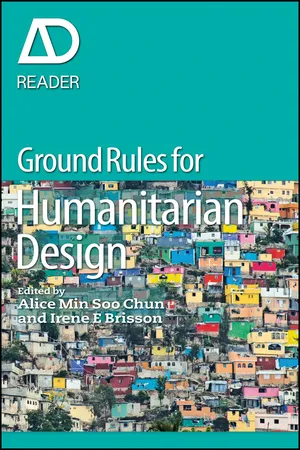
Table of contents

  1. Cover
  2. Title page
  3. Copyright
  4. Introduction
  5. PART 1 HISTORIES OF HUMANITARIAN DESIGN AND AID
  6. PART 2 LAND
  7. PART 3 CRISIS IN HEALTH AND CULTURE
  8. PART 4 WATER AND SANITATION
  9. PART 5 ECOLOGY AND HUMANITARIAN DESIGN
  10. PART 6 LOCAL MATERIALS AND LOCAL SKILLS
  11. PART 7 SHELTER AND HOUSING
  12. PART 8 EDUCATION AND PRACTICE
  13. PART 9 ARCHITECTURE, PLANNING AND POLITICS
  14. Select Bibliography
  15. Index
  16. Advert
  17. EULA