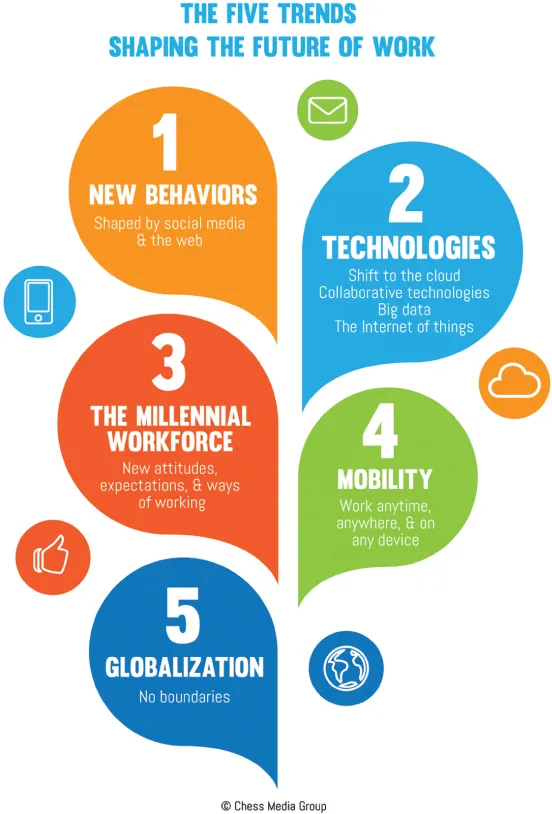
Let's take a look at each one in more detail to see how these trends are actually impacting the future of work.
New Behaviors Being Shaped by Social Technologies That Are Entering Our Organizations
Within the past 5 to 10 years we have seen a dramatic shift in our behavior. We share our company history and resumes on LinkedIn, we write blogs for the world to read on WordPress, we build communities and connect with people on Facebook, we search for and review companies on Yelp, we tell people where we are on Foursquare, and we can instantly find anything we are looking for on Google. These are new behaviors shaped by new technologies. If someone told you 10 years ago that you would be sharing so much information about yourself online for the world to see, you'd probably tell them that they were crazy. Yet look at where we are today. We share absolutely everything and this even extends to physical goods. We are opening up and becoming more collaborative. This isn't just a millennial thing either; this is a trend we are seeing across all demographics and geographies around the world.
Essentially we are much more comfortable living a public, collaborative, and connected life where we can connect and engage with people and information however we want. But therein lies the problem and the opportunity.
These new behaviors are now entering our organizations and this has given rise to new social and collaborative platforms for business. We are all very used to legacy intranets, email, CRM systems, billing and invoicing solutions, time-tracking technologies, and the like. However, we have never before had these new types of social and collaborative platforms enter our organizations.
The gap between what is called the consumer web and enterprise is large. The behaviors and the technologies that we use in our personal lives are quite different from the behavior and the technologies that we subscribe to in our companies.
If it's so easy for us to do the things mentioned earlier in our personal lives, then shouldn't it be just as easy to do those things in our professional lives? Why do we need to get 250 emails a day, why can't we find the right people and information we need to get work done? Why is there so much content duplication? Why can't we easily share, collaborate, and build communities with our coworkers? Why can't we crowdsource ideas?
These new behaviors and expectations are a key driving force that many organizations around the world are trying to adapt to and they are largely being fueled by the new behaviors we are seeing in our personal lives today.
Impact summary: New employee behaviors entering organizations are challenging the conventional idea of how employees work and what they expect from an organization.
Technology
There are many fascinating things happening in the world of technology that are dramatically starting to impact the way we work. The primary parts of technology that are impacting how we work are the shift to the cloud and collaboration platforms. However, it still remains to be seen what the impact of the Internet of things and big data will be on how we work. There are a few reasons for this. The first is that it's still a bit early to see what the impact of big data and the Internet of things will have on the workplace and while some organizations are thinking about or experimenting with these ideas, the vast majority are not. Out of all the trends, these are the two things that reside farthest on the fringes. They also operate more behind the scenes versus some of the other trends such as globalization, which are foremost in changing how we work and affect behavior. So although big data and the Internet of things might impact something such as how we share work or how customized work is created, it doesn't affect the fact that these things are happening to begin with. Automation and the introduction of artificial intelligence and robots into the workplace is another part of technology that could be discussed. However, it's too early to look at the impact of those tools in the workplace, at least for the purpose of this book.
Shift to the Cloud
The easiest way to think of the cloud is the Internet (or at least it serves the purpose for this book). The cloud powers many things that don't require any resources on the part of the user. Twitter, Facebook, LinkedIn, and probably any other piece of popular software you can think of is all powered by the cloud, no installation or assembly required. You just connect to the Internet and you're good to go.
Now this is important because typically when most organizations want to deploy a piece of technology it has to be done on the premises. In other words, some sort of physical installation needs to happen on the company site. This process can take a few days, a few weeks, or in some cases a few months. Then you have to deal with configuration, testing, and a whole mess of other issues. These deployments are regulated and controlled by specific management, HR, or IT teams that make technology decisions on behalf of everyone else in the company. The frustrating thing here for many employees is that the people who are purchasing the technologies oftentimes aren't the same people who are using them.
Then as new technologies or features are created there is a huge lag between when they are released versus when the organization actually deploys them. On average I see a one- to two-year lag between when something becomes available and when a company actually upgrades to the latest version of something. This is a huge gap, there's a lot that can happen in this time period.
Now that we can deploy cloud-based software within our companies we have eliminated the need for any type of physical installation. In fact, anyone can be up and running with the highest grade of business collaboration software in about the same amount of time as it takes to set up a Facebook page or buy something on Amazon. All you need is a credit card. This means that any employee within any company has the ability to select and deploy technology regardless of IT, legal, or corporate approval. The great thing is that as the vendor rolls out new features or upgrades, they get rolled out to the company as well, no more delay.
This is a radical shift for organizations as it now places the power in the hands of the employees. I was at a conference a few months ago and after my keynote a lady approached me and told me an interesting story. She handles accounting and invoicing at her company and they use an old in-house technology. The problem is the technology doesn't allow her to do everything she wants and often she is forced to spend hours trying to figure out workarounds. She was fed up with this and went on a search for a better solution. For $80 a month she found a platform that met all of her needs and was able to get up and running with it in just a matter of minutes. She solved her own problem and didn't ask anyone else about it. That's the power of the cloud.
However, this also creates a challenge because companies are seeing a flurry of new technology deployments that they are essentially powerless to stop! Employees are taking matters into their own hands.
Impact summary: Technology decisions are now in the hands of anyone and everyone within an organization, not just IT or management. Cloud-based technologies should decrease the time to deploy, make upgrades and deployments easier and faster, and allow organizations to put together their own “stacks” made up of components from various vendors.
Collaboration Platforms
You may have heard of Jive, Yammer, Mango Apps, tibbr, Citrix, Clarizen, Bunchball, SAP Jam, Connections, Chatter, and the hundreds of other collaborative technologies that are out there. All of these technologies are connecting and engaging our people and information in ways that were never before possible—even just a few short years ago. As mentioned earlier, all of these technologies have been modeled after many of the popular platforms we use in our personal lives.
These new technologies have enabled employees to do things in a more effective and efficient way. Take, for example, a situation in which you needed to find someone in your company with a particular set of skills. The usual approach here would be to send out an email asking your peers if they know of someone who can do XYZ. This action sets off a series of emails cascading throughout the company until someone is found. Collaborative technologies today allow you to easily search profiles within your company based on keywords or tags to allow you to find that person without having to ask anyone. Let's say you wanted to work on a strategy document with your team. The typical approach here has been for one person to get started on something, then to save it with their initials in the filename, and then send it off. From there any other edits are done by others who all add their own initials to the filename and keep sending it back and forth. Many dozens of emails can be sent by the time this is completed, resulting in a scattered mess of information that is hard to find, share, or collaborate on. Today, an employee can simply create a group dedicated to the project where employees can either collaboratively create the document online or where they can easily upload and comment on new versions. Everything is sorted, searchable, and organized.
There are hundreds of examples of how these new platforms are being used for things such as: employee onboarding, taking notes at meetings, staying on top of information, finding subject matter experts, getting access to information on the go, motivating employees and making work fun, brainstorming ideas and developing products, aligning an organization, and pretty much any other use case you can think of. The new technologies are finally enabling the behaviors we are used to in our personal lives to take shape inside...