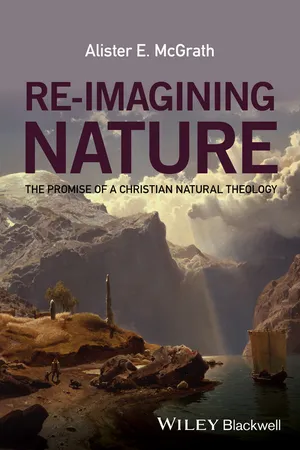
- This text sets out to explore what a properly Christian approach to natural theology might look like and how this relates to alternative interpretations of our experience of the natural world
- Alister McGrath is ideally placed to write the book as one of the world's best known theologians and a chief proponent of natural theology
- This new work offers an account of the development of natural theology throughout history and informs of its likely contribution in the present
- This feeds in current debates about the relationship between science and religion, and religion and the humanities
- Engages in serious theological dialogue, primarily with Augustine, Aquinas, Barth and Brunner, and includes the work of natural scientists, philosophers of science, and poets
- English
- ePUB (mobile friendly)
- Available on iOS & Android
eBook - ePub
About this book
Reimagining Nature is a new introduction to the fast developing area of natural theology, written by one of the world's leading theologians. The text engages in serious theological dialogue whilst looking at how past developments might illuminate and inform theory and practice in the present.
Information
1
Natural Theology
Questions of Definition and Scope
The heavens declare the glory of the Lord.(Psalm 19: 1)
Many have experienced a sense of awed wonder at the beauty and majesty of nature, evoked by a stunning verdant landscape, a majestic mountain range, or the cold and clear beauty of the sky at night.1 But might such an experience be a portal to something still greater? Might this evoke our curiosity, in the deepest sense of that word – a “respectful attentiveness” to the beauty and complexity of the world around us?2
Such an attentiveness allows nature to act as a gateway, a threshold to ways of imagining the world, and our place within it. The journey of exploration that is precipitated by a sense of wonder in the presence of nature leads to “a new way of looking at things,” in which we see things as if they were new and unfamiliar,3 bathed in “a sense of the ‘newness’ or ‘newbornness’ of the entire world.”4 Both science and religion can be argued to be a response to a sense of wonder at the world around us and within us.5
Yet there is another possible outcome, which intersects and interconnects the domains of science and religion, the sacred and secular, in a manner that is perhaps easier to describe than to define. It is often articulated most clearly by those natural scientists who sense that their research is opening up deep questions about meaning, truth, and beauty which lie beyond the capacity of science to answer, and by those theologians who realize that the rich imaginative and conceptual framework of the Christian faith makes it possible to understand the achievements and limits of the scientific enterprise in an informed and enriched manner.6 This is traditionally known, however inadequately and provisionally, as “natural theology.”7
Natural theology can broadly be understood as a process of reflection on the religious entailments of the natural world, rather than a specific set of doctrines.8 In its most general sense, it can be undertaken from a variety of viewpoints, secular and religious, and has no “essential” core, other than an engagement with the question of the relationship of nature (including the human observer) and the divine or transcendent. There are many insights to be quarried and questions to be explored at this rich interface – including the question of whether the natural world is able to signify, intimate, or disclose, no matter how provisionally, a transcendent reality which lies beyond it.
Yet perhaps the most important question to be explored in this work is whether there is a specifically Christian understanding of natural theology, and what form this might take. In 1934 Emil Brunner challenged his theological generation to “find its way back to a right theologia naturalis,”9 believing that something had been lost, which was in principle capable of being retrieved. Brunner, however, never believed he had solved his own challenge.
Brunner's challenge remains open and important, especially in the light of new debates about the rationality and integrity of faith, and its relation to other areas of human inquiry, particularly the natural sciences. This volume is an attempt to “find our way back” to such a natural theology, conscious that Christian history is rich in approaches that have been sidelined and suppressed by dominant theological voices and institutions, yet which may be of service to the theological community today, especially by encouraging theologians to “think outside the box of the latest philosophical orthodoxies or commonly held beliefs.”10
The Aim of This Work
In this work, I argue that a Christian natural theology allows us to re-imagine nature. In speaking of such an act of intellectual permissiveness, I do not mean that it encourages a spurious inflation of our understanding of nature, or a descent into intellectual vacuity or irrationality.11 Rather, I mean that we are provided with an informing intellectual and imaginative framework which both warrants and enables us to visualize the everyday natural world in a new way,12 as if an intellectual sun had illuminated it so that we could see its colors, textures, and details in a manner that had hitherto eluded us. This book is an invitation to enter into such a theological re-imagining of nature,13 alert to both its risks and its rewards.
Such a re-imagining encourages us to develop a principled attentiveness toward the details of the natural world that enables us to see what might otherwise be missed, to appreciate more fully its beauty and wonder, and to grasp its fundamental interconnectedness. Heidegger famously contrasted the openness of the classic Greek notion of “wonder” with the modern temptations to predatory possessiveness and calculating self-interest in what was observed.14 Yet this impulse can be challenged and resisted, allowing us to recover a deeper level of engagement with the natural world. Elaine Scarry points to the transformative capacity of beauty, which “ignites the desire for truth” which renders us susceptible to new competencies and imaginative possibilities.15
Something of the approach that I have in mind can be seen from John Ruskin's reflections on a “monotonous bit of vine-country” north of Lac Leman in Switzerland. In his diary entry for June 3, 1849, Ruskin noted how his attitude toward an unpromising scene of “sticks and stones” and a “steep dusty road” was transformed through an act of aesthetic imagination, driven by a determination to see the scene afresh through an active application of his mind:
I had a hot march among the vines, and between their dead stone walls; once or twice I flagged a little, and began to think it tiresome; then I put my mind into the scene, instead of suffering the body only to make report of it; and looked at it with the possession-taking grasp of the imagination – the true one; it gilded all the dead walls, and I felt a charm in every vine tendril that hung over them. It required an effort to maintain the feeling: it was poetry while it lasted, and I felt that it was only while under it that one could draw, or invent, or give glory to, any part of such a landscape.16
This act of imaginative reconceptualization goes beyond the purely rational reconfiguration of natural philosophy advocated by writers such as Francis Bacon in the early modern period.17 The French poet Paul Claudel (1868–1955) wrote critically of the “starved imagination (imagination à jeun)” of rationalism, in which a cold rational dissection of things becomes disconnected from a joyful imaginative embrace of reality.18 Wordsworth made the same point, in emphasizing the aesthetic coherence of nature, grasped by the imagination yet fragmented by reason:19
Sweet is the lore which Nat...
Table of contents
- Cover
- Praise for Re-Imagining Nature
- Title Page
- Copyright
- Introduction
- Chapter 1: Natural Theology: Questions of Definition and Scope
- Chapter 2: Natural Theology and the Christian Imaginarium
- Chapter 3: Text, Image, and Sign: On Framing the Natural World
- Chapter 4: Natural Theology: Contexts and Motivations
- Chapter 5: Natural Theology: Some Concerns and Challenges
- Chapter 6: The Promise of a Christian Natural Theology
- Bibliography
- Index
- End User License Agreement
Trusted by 375,005 students
Access to over 1.5 million titles for a fair monthly price.
Study more efficiently using our study tools.
Frequently asked questions
Yes, you can cancel anytime from the Subscription tab in your account settings on the Perlego website. Your subscription will stay active until the end of your current billing period. Learn how to cancel your subscription
No, books cannot be downloaded as external files, such as PDFs, for use outside of Perlego. However, you can download books within the Perlego app for offline reading on mobile or tablet. Learn how to download books offline
We are an online textbook subscription service, where you can get access to an entire online library for less than the price of a single book per month. With over 1.5 million books across 990+ topics, we’ve got you covered! Learn about our mission
Look out for the read-aloud symbol on your next book to see if you can listen to it. The read-aloud tool reads text aloud for you, highlighting the text as it is being read. You can pause it, speed it up and slow it down. Learn more about Read Aloud
Yes! You can use the Perlego app on both iOS and Android devices to read anytime, anywhere — even offline. Perfect for commutes or when you’re on the go.
Please note we cannot support devices running on iOS 13 and Android 7 or earlier. Learn more about using the app
Please note we cannot support devices running on iOS 13 and Android 7 or earlier. Learn more about using the app
Yes, you can access Re-Imagining Nature by Alister E. McGrath in PDF and/or ePUB format, as well as other popular books in Théologie et religion & Théologie chrétienne. We have over 1.5 million books available in our catalogue for you to explore.