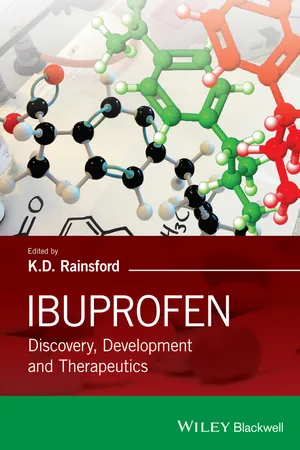
Ibuprofen has become one of the foremost pain-relieving medications world-wide with its proven safety and efficacy in a wide variety of painful and inflammatory conditions. It has also been widely investigated for application in a variety of painful and non-pain inflammatory states including cancer and neurodegenerative conditions, reflecting the unique and novel properties of the drug that would never have been foreseen from knowledge of the properties when it was initially discovered.
Edited by leading world expert with over 40 years record in research, teaching and as a scientific advisor in the field of anti-inflammatory/analgesic agents. Professor Kim Rainsford is also the founding Editor-in-Chief of the journal, Inflammopharmacology, as well as being an Associate Editor of The Journal of Pharmacy & Pharmacology.
Provides a thorough coverage of the medicinal chemistry and pharmaceutics of ibuprofen, and its pharmacokinetics in both humans and animals.
Includes molecular, pharmacological and toxicological studies, and discusses the safety and efficacy of non-prescription ibuprofen, including its side effects.
Ibuprofen: Discovery, Development & Therapeutics provides a definitive reference on all the main aspects of the chemical and pharmaceutical properties, mechanisms of action and therapeutic uses of ibuprofen including its role in the prevention and treatment of rheumatic conditions, cancer and neurodegenerative conditions such as Alzheimer's and Parkinson's diseases. The book has its origins in a volume first published in 1999, since when there have been considerable advances in research and clinical studies on ibuprofen in the treatment of many inflammatory and even non-inflammatory states. This book will prove invaluable to scientists, clinicians, pharmacists and all those who need to know about the actions and uses of anti-inflammatory and analgesic drugs.
Biomedical Research Centre, Sheffield Hallam University, UK
Summary
Ibuprofen was discovered over half a century ago following pioneering approaches by Professor Stuart Adams OBE for the identification of anti-inflammatory properties of drugs related to aspirin and later screening of a range of acidic compounds that were synthesized by the late Dr John Nicholson. The subsequent clinical assessments of the anti-rheumatic activities of ibuprofen were initially as a prescription-only medication for treating rheumatoid arthritis. With extensive trials in various other rheumatic and painful states the drug consistently proved to be effective and relatively safe. By the early 1980s the data amassed on the safety of ibuprofen set the basis for granting by the health authorities in the United Kingdom and United States of America as a non-prescription drug for over-the-counter (OTC) sale by pharmacies at the half-prescription (1200 mg/day) dose for short-term use by the lay public. Later OTC sale was approved by a large number of drug regulatory agencies worldwide and this has since been extended to it being available in stores under the general sales list (GSL) regulations in a large number of countries. Ibuprofen has become amongst the most widely used pain-relieving medication worldwide with its proven safety and efficacy. The drug has also been widely investigated for application in a variety of painful and non-pain inflammatory states including cancer, Parkinson’s disease and dementias, reflecting the unique and novel properties of the drug that would never have been foreseen from knowledge of the properties when it was initially discovered.
1.1 Introduction
The history of ibuprofen began over 50 years ago and has been inextricably linked to understanding of the concepts of the pathogenesis of inflammatory diseases and the actions of therapeutic agents used at that time (Rainsford, 2011). The principal initiator of this research leading to the discovery of ibuprofen was Dr Stewart Adams (Figure 1.1), a pharmacologist in the Research Department of The Boots Pure Drug Company Ltd at Nottingham, United Kingdom. His aim was to find analgesic drugs with improved efficacy over aspirin. As with all major discoveries, there is an important personal element and what has been attempted here is to bring together information to show what were the most significant events and thoughts that were important for the discovery process. I am most indebted to Stewart Adams for a considerable amount of information and historical detail that enabled me to write this important chapter. I am also especially grateful to him for discussing what have been most interesting historical details and for giving me an insight into those earlier years and the thinking behind the discovery of ibuprofen.
Figure 1.1A photograph of Dr Stewart Adams taken in 1987 (a) and a recent photograph taken in 2012 (b).
Stewart Adams has written a detailed account of the pharmacological aspects of the discovery of the propionic acids (Adams, 1992). It is worth noting that the discovery of ibuprofen occurred in the period before the discovery by Vane and colleagues in 1971–1973 of prostaglandins as targets for the anti-inflammatory actions of non-steroidal anti-inflationary drugs NSAIDs (Vane, 1971; Flower et al., 1972; Ferreira, Moncada and Vane, 1973; Moncada, Ferreira and Vane, 1973). Thus there was no biochemical or cellular target established that could have been employed in the identification of anti-inflammatory actions of ibuprofen and its precursors. The animal models that were employed in the discovery of propionic acids and other NSAIDs were the only means then available for identifying their anti-inflammatory activity. The late Dr John Nicholson (Figure 1.2), who first synthesized ibuprofen, reviewed in depth the medicinal chemistry of the propionic acids and the chemical discovery process underlying the development of ibuprofen (Nicholson, 1982). It is not proposed to give a total account of what these expert authors have already reviewed in depth. I hope more to emphasize the main thinking at the time and key events involved in the discovery of what has been one of the most successful NSAIDs developed since aspirin.
The standard drugs for treating rheumatoid arthritis and other painful arthritic diseases at the time when Stewart Adams started his research were aspirin and cortisone. The pioneering studies supported by the Empire Rheumatism Council (later to become the Arthritis and Rheumatism Council) and the Medical Research Council in the United Kingdom had established the efficacy of cortisone and aspirin in the relief of pain and soft-tissue swelling in rheumatoid arthritis. However, the shortcomings of both drugs were becoming strikingly evident even at the time of these reports.
In the 1950s when Boots were beginning this research, only a few other companies had begun research programmes into aspirin-type drugs, notably Dr T.Y. Shen at Merck and Company (Rahway, NJ, USA) and Dr Steve Winder at Parke Davis (Ann Arbor, MI, USA). Before this Dr G. Wilhelmi at J R Geigy AG (Basel, Switzerland) had worked on derivatives of amidopyrine and other pyrazoles. In 1958 Winder and his colleagues published an important paper indicating their thinking about the use of the ultraviolet (UV) erythema technique for determining the anti-inflammatory activity of novel compounds. This assay was similar to that in use at Boots and they had, moreover, obtained similar results with standard drugs (e.g. aspirin). The Parke Davis group eventually produced mefenamic acid, flufenamic acid and other fenamates as a result of the initial testing of compounds in this assay.
Boots, however, started with a distinct disadvantage with their meagre resources as their Pharmacology Department was housed in a group of old rambling buildings attached to a Victorian house located in the outskirts of Nottingham (Figures 1.3 to 1.5). It was moved there at the beginning of the Second World War from the centre of Nottingham as a precaution against bombing – a wise move since part of the Research Department was destroyed in an air raid in 1941. The first six years of the research on new aspirin-type drugs was thus carried out under most unsatisfactory conditions. Adams’ laboratory (Figure 1.3) was in one of the ‘front rooms’ of the house and later he was able to acquire the kitchen and larder (Figure 1.4) as additional accommodation.
Figure 1.2The ‘ibuprofen team’ comprising Stewart Adams (centre) with his technician, Colin Burrows (right) and John Nicholson (left).
Figure 1.3Stewart Adams with John Nicholson, Colin Burrows (right) in the mid-1960s.
Figure 1.4Part of the laboratory (‘kitchen’) in 1957 showing the Kromayer ultraviolet lamp in the background and guinea-pig holding cages on either side.
Figure 1.5...
Table of contents
Cover
Title page
Table of Contents
List of Contributors
Preface
1 History and Development of Ibuprofen
2 The Medicinal Chemistry of Ibuprofen
3 The Pharmaceutics of Ibuprofen
4 The Pharmacokinetics of Ibuprofen in Humans and Animals
5 Pharmacology and Toxicology of Ibuprofen
6 Therapeutics of Ibuprofen in Rheumatic and Other Chronic and Painful Diseases
7 Safety and Efficacy of Non-prescription, Over-the-Counter (OTC) Ibuprofen
8 Use of Ibuprofen in Dentistry
9 Gastrointestinal Adverse Reactions from Ibuprofen
10 Hepatorenal Effects of Ibuprofen Compared with other NSAIDs and Paracetamol
11 Adverse Drug Reactions Attributed to Ibuprofen
12 Human Toxicity of Ibuprofen
13 Ibuprofen in the Prevention and Therapy of Cancer
14 Ibuprofen in Prevention of Neurodegenerative Diseases
Appendix A Some Proprietary Brands and Preparations of Ibuprofen Available Worldwide
Appendix B References to Analytical Methods for Determination of Ibuprofen in Biological Fluids, Principally Plasma
Index
End User License Agreement
Trusted by 375,005 students
Access to over 1.5 million titles for a fair monthly price.
Study more efficiently using our study tools.
Frequently asked questions
Yes, you can cancel anytime from the Subscription tab in your account settings on the Perlego website. Your subscription will stay active until the end of your current billing period. Learn how to cancel your subscription
No, books cannot be downloaded as external files, such as PDFs, for use outside of Perlego. However, you can download books within the Perlego app for offline reading on mobile or tablet. Learn how to download books offline
Perlego offers two plans: Essential and Complete
Essential is ideal for learners and professionals who enjoy exploring a wide range of subjects. Access the Essential Library with 800,000+ trusted titles and best-sellers across business, personal growth, and the humanities. Includes unlimited reading time and Standard Read Aloud voice.
Complete: Perfect for advanced learners and researchers needing full, unrestricted access. Unlock 1.5M+ books across hundreds of subjects, including academic and specialized titles. The Complete Plan also includes advanced features like Premium Read Aloud and Research Assistant.
Both plans are available with monthly, semester, or annual billing cycles.
We are an online textbook subscription service, where you can get access to an entire online library for less than the price of a single book per month. With over 1.5 million books across 990+ topics, we’ve got you covered! Learn about our mission
Look out for the read-aloud symbol on your next book to see if you can listen to it. The read-aloud tool reads text aloud for you, highlighting the text as it is being read. You can pause it, speed it up and slow it down. Learn more about Read Aloud
Yes! You can use the Perlego app on both iOS and Android devices to read anytime, anywhere — even offline. Perfect for commutes or when you’re on the go. Please note we cannot support devices running on iOS 13 and Android 7 or earlier. Learn more about using the app
Yes, you can access Ibuprofen by K. D. Rainsford in PDF and/or ePUB format, as well as other popular books in Medicine & Pharmacology. We have over 1.5 million books available in our catalogue for you to explore.