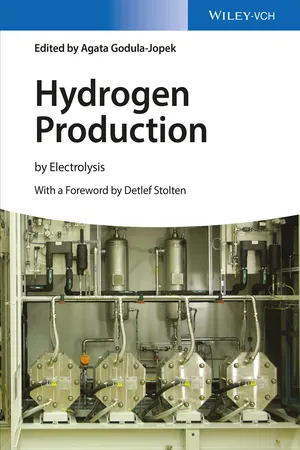
Covering the various aspects of this fast-evolving field, this comprehensive book includes the fundamentals and a comparison of current applications, while focusing on the latest, novel achievements and future directions.
The introductory chapters explore the thermodynamic and electrochemical processes to better understand how electrolysis cells work, and how these can be combined to build large electrolysis modules. The book then goes on to discuss the electrolysis process and the characteristics, advantages, drawbacks, and challenges of the main existing electrolysis technologies. Current manufacturers and the main features of commercially available electrolyzers are extensively reviewed. The final chapters then present the possible configurations for integrating water electrolysis units with renewable energy sources in both autonomous and grid-connected systems, and comment on some relevant demonstration projects.
Written by an internationally renowned team from academia and industry, the result is an invaluable review of the field and a discussion of known limitations and future perspectives.
- English
- ePUB (mobile friendly)
- Available on iOS & Android
eBook - ePub
Chapter 1
Introduction
Agata Godula-Jopek
We find ourselves on the cusp of a new epoch in history, where every possibility is still an option. Hydrogen, the very stuff of the stars and our own sun, is now being seized by human ingenuity and harnessed for human ends. Charting the right course at the very beginning of the journey is essential if we are to make the great promise of a hydrogen age a viable reality for our children and a worthy legacy for the generations that will come after us.Jeremy Rifkin [1].
Hydrogen is being considered as an important future energy carrier, which means it can store and deliver energy in a usable form. At standard temperature and pressure (0 °C and 1013 hPa), hydrogen exists in a gaseous form. It is odourless, colourless, tasteless, non-toxic and lighter than air. The stoichiometric fraction of hydrogen in air is 29.53 vol%. Abundant on earth as an element, hydrogen is present everywhere, being the simplest element in the universe representing 75 wt% or 90 vol% of all matter. As an energy carrier, hydrogen is not an energy source itself; it can only be produced from other sources of energy, such as fossil fuels, renewable sources or nuclear power by different energy conversion processes. Exothermic combustion reaction with oxygen forms water (heat of combustion 1.4 × 10⁸ J kg−1) and no greenhouse gases containing carbon are emitted to the atmosphere.
Selected physical properties of hydrogen based on Van Nostrand are presented in Table 1.1 [2].
Table 1.1 Selected physical properties of hydrogen.
| Parameter | Value | Unit |
| Molecular weight | 2.016 | Mol |
| Melting point | 13.96 | K |
| Boiling point (at 1 atm) | 14.0 | K |
| Density solid at 4.2 K | 0.089 | g cm−3 |
| Density liquid at 20.4 K | 0.071 | g cm−3 |
| Gas density (at 0 °C and 1 atm) | 0.0899 | g l−1 |
| Gas thermal conductivity (at 25 °C) | 0.00044 | cal·cm s−1 cm−2 °C−1 |
| Gas viscosity (at 25 °C and 1 atm) | 0.0089 | cP |
| Gross heat of combustion (at 25 °C and 1 atm) | 265.0339 | kJ g−1 mol−1 |
| Net heat of combustion (at 25 °C and 1 atm) | 241.9292 | kJ g−1 mol−1 |
| Autoignition temperature | 858 | K |
| Flammability limit in oxygen | 4–94 | % |
| Flammability limit in air | 4–74 | % |
Source: By permission of Wiley VCH.
The energy content of hydrogen is 33.3 kWh kg−1, corresponding to 120 MJ kg−1 (lower heating value, LHV), and 39.4 kWh kg−1, corresponding to 142 MJ kg−1 (upper heating value, UHV). The difference between the UHV and the LHV is the molar enthalpy of vaporization of water, which is 44.01 kJ mol−1. UHV is obtained when as a result of hydrogen combustion water steam is produced, whereas LHV is obtained when the product water is condensed back to liquid.
Because of its high energy-to-weight ratio, hydrogen has commonly been used in a number of applications for the last 100 years and a lot of experience has been gained since its production and use, with it becoming the fuel of choice. Hydrogen application for transportation has a long history. One of the first demonstrated applications took place in the eighteenth century in Paris. The first manned flight (Jacques Charles and Nicolas Robert) had been demonstrated in a balloon called “hydrogen gas aerostat” for about 45 min, covering a distance of about 21 km.
A car with an internal combustion engine (ICE) that used a mixture of hydrogen and oxygen for fuel was invented by Francoise Isaac de Rivaz from Switzerland in January 1807 and it was the first internal combustion-powered automobile. The main application of hydrogen in the twentieth cent...
Table of contents
- Cover
- Related Titles
- Title Page
- Copyright
- Foreword
- Preface
- List of Contributors
- Chapter 1: Introduction
- Chapter 2: Fundamentals of Water Electrolysis
- Chapter 3: PEM Water Electrolysis
- Chapter 4: Alkaline Water Electrolysis
- Chapter 5: Unitized Regenerative Systems
- Chapter 6: High-Temperature Steam Electrolysis
- Chapter 7: Hydrogen Storage Options Including Constraints and Challenges
- Chapter 8: Hydrogen: A Storage Means for Renewable Energies
- Chapter 9: Outlook and Summary
- Index
- End User License Agreement
Trusted by 375,005 students
Access to over 1.5 million titles for a fair monthly price.
Study more efficiently using our study tools.
Frequently asked questions
Yes, you can cancel anytime from the Subscription tab in your account settings on the Perlego website. Your subscription will stay active until the end of your current billing period. Learn how to cancel your subscription
No, books cannot be downloaded as external files, such as PDFs, for use outside of Perlego. However, you can download books within the Perlego app for offline reading on mobile or tablet. Learn how to download books offline
Perlego offers two plans: Essential and Complete
- Essential is ideal for learners and professionals who enjoy exploring a wide range of subjects. Access the Essential Library with 800,000+ trusted titles and best-sellers across business, personal growth, and the humanities. Includes unlimited reading time and Standard Read Aloud voice.
- Complete: Perfect for advanced learners and researchers needing full, unrestricted access. Unlock 1.5M+ books across hundreds of subjects, including academic and specialized titles. The Complete Plan also includes advanced features like Premium Read Aloud and Research Assistant.
We are an online textbook subscription service, where you can get access to an entire online library for less than the price of a single book per month. With over 1.5 million books across 990+ topics, we’ve got you covered! Learn about our mission
Look out for the read-aloud symbol on your next book to see if you can listen to it. The read-aloud tool reads text aloud for you, highlighting the text as it is being read. You can pause it, speed it up and slow it down. Learn more about Read Aloud
Yes! You can use the Perlego app on both iOS and Android devices to read anytime, anywhere — even offline. Perfect for commutes or when you’re on the go.
Please note we cannot support devices running on iOS 13 and Android 7 or earlier. Learn more about using the app
Please note we cannot support devices running on iOS 13 and Android 7 or earlier. Learn more about using the app
Yes, you can access Hydrogen Production by Agata Godula-Jopek in PDF and/or ePUB format, as well as other popular books in Physical Sciences & Chemistry. We have over 1.5 million books available in our catalogue for you to explore.