- Greatly expanded and improved, this successful text introduces students to the major ethical traditions, and provides a simple methodology for resolving ethical dilemmas
- Treats teleological and deontological approaches to ethics as the two most important traditions, but now includes chapters on virtue ethics and the ethics of care
- The very accessible writing style speaks directly to students' own experience
- Draws examples from three types of real-life ethical scenarios submitted by students: academic dishonesty, partying, and personal relationships
- Provides a concise treatment of this notoriously complex subject, perfect for entry-level ethics and applied ethics courses
- English
- ePUB (mobile friendly)
- Available on iOS & Android
eBook - ePub
About this book
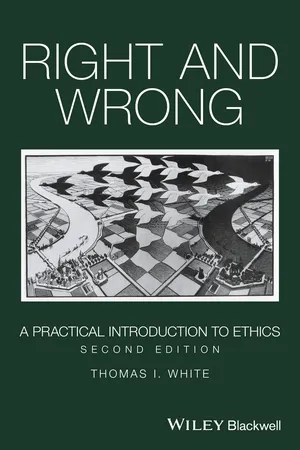
The newly updated Right and Wrong 2nd Edition is an accessible introduction to the major traditions in western philosophical ethics, written in a lively and engaging style. It is designed for entry-level ethics courses and includes real-life ethical scenarios chosen to appeal directly to students.
Information
1
Ethics: What It Is, Does, and Isn’t
Philosophical Ethics
Let me begin with two claims you will probably reject: ethics is something totally new to you; and your current ideas about right and wrong aren’t nearly as clear or logical as you think they are.
I say that ethics is new to you because, although ideas of right and wrong have been part of your life since infancy, you are probably unfamiliar with a philosophical approach to ethics. Parents, teachers, preachers, friends, and associates try to shape our conduct and beliefs, but most of them don’t use a philosophical approach. They cajole, coddle, argue, encourage, bribe, and sometimes even threaten us to agree with their ideas or, at a minimum, to get us to do what they want. They may try to reason with us, but most likely not especially well. Intense and disciplined thinking about right and wrong is something totally new to you because, at least in public discourse about ethical issues in our culture, it’s usually rejected for more emotional, rhetorical, partisan, and ideological approaches.
You may feel comfortable with the way you approach ethics and see no need for a new way to look at things. You probably have deeply held beliefs about right and wrong, and you assume that everyone’s entitled to his or her own ideas. And you probably think that’s all ethics is about.
However, because your current approach to ethical dilemmas is based on a hodge‐podge of beliefs, feelings, traditions, and convictions you’ve picked up throughout life, your ideas about ethics are much less clearly formulated, systematic, and consistent than you think they are. Some of your approach to ethics is emotional—you probably believe something is wrong if you feel guilty when you do it. Some ideas are based on something practical—you know you’ll get in trouble with the law or some other authority if you get caught. Your decisions about how to act may also be affected by your wanting to please other people—you might want the approval or acceptance of your parents or friends. But precisely because this hodge‐podge of ideas about ethics comes from so many different sources, there’s a good chance your thinking may be inconsistent and contradictory.
- You agree with the law says stealing is wrong. But when you’re told to buy a very expensive textbook for a required class that you didn’t want to take in the first place, you might decide your friends are right when they say that stealing textbooks isn’t wrong because, as a “captive market,” students are being taken advantage of.
- Perhaps the conflict is as simple as having one set of rules for ourselves and another set for others: “It’s OK for me to cheat on the person I’m dating, but it’d be wrong if they did it to me.”
- Maybe you believe what your religion says about right and wrong, and that you should feel guilty after doing something wrong. But you also know that you can feel really good after engaging in some pretty serious “sinning.”
- It’s also possible that at this point in your life, you’ve decided to engage in your own version of Socrates’ “examined life.” Maybe you’re questioning what you were taught when you were younger as you meet people who think very differently. But if you’re just starting that process, you don’t have an overarching understanding of how you separate right from wrong.
- Or maybe you’re at the other extreme and you’ve decided to reject any specific standards and leave your sense of morality to “gut feel”—even though you can’t explain to other people very convincingly what you mean by right and wrong.
The goal of this book is to help you learn how to approach ethical dilemmas in a systematic, sophisticated, and consistent fashion so that you will understand ethical issues more fully and make better‐informed decisions. In short, this book aims to make a philosopher out of you—someone who can slog through the confusion, put it in order, think about it clearly, understand why you believe what you do, explain your beliefs to others, and resolve ethical dilemmas in an intellectually sophisticated way. All it takes is patience and practice.
Ethics: What Is It?
The simplest way to describe what ethics does is to say that it evaluates human actions. It’s a particular way of making positive and negative judgments about what we ourselves and other people do.
Obviously, philosophical ethics isn’t alone in evaluating behavior. Law divides actions into “legal” and “illegal,” and tells us that if we disobey, we’ll go to jail, pay a fine, or lose some privilege. Most religions advise us what to believe and how to act if we want to please God, achieve everlasting happiness, or avoid eternal punishment. Psychiatry explains the difference between behavior that’s “normal,” “neurotic,” and “psychotic.” Medicine gives us a yardstick for deciding how “healthy” our behavior is. Business tells us how “profitable” something is.
But with so many different ways of measuring human behavior, how is ethics different? What is ethics? Does it have anything special to contribute apart from law and religion?
Ethics
Ethics (or moral philosophy) is a branch of philosophy that dates back two thousand years to Socrates (c. 470–399 BCE), the ancient Greek philosopher who spent his days in the Athenian marketplace encouraging people to think about how they lived. Two of Socrates’ most important ideas were: the unexamined life is not worth living, and vice harms the doer.1 Socrates believed that his mission in life was to challenge his fellow citizens to live in a more self‐reflective way and to act ethically. He would ask them, “Are you not ashamed of your eagerness to possess as much wealth, reputation, and honors as possible, while you do not care for nor give thought to wisdom and truth, or the best possible state of your soul?” (Apology 29 d–e). Socrates lived and died following the idea that “the most important thing is not life, but the good life” (Crito 48 b).
Socrates did nothing more than ask people to reflect on and study their behavior, and that’s essentially what ethics does. But, as we can learn from the original meanings of “ethical” and “moral,” this includes both what people do and how they do it.
The English words “ethics” and “morals” come to us from two words in ancient Greek and Latin, ethos and mores; both mean “character.”2 When we ask if an action is ethical, we can think, “Is it the sort of thing somebody with a ‘good character’ would do?”
For example, when we say that Alex has a good character, we mean that we trust her to do the right thing—to keep her promises or be kind. But we’re also saying something about the way she does things. Alex keeps her word because it’s the right thing to do, not because she wants to impress people. She gives to charity out of generosity, not because it’s a tax deduction. We’re unimpressed if George keeps his promise only with people bigger than he is or if Dorothy is helpful only when there’s an audience around. Acting “ethically” is connected with both what a person does and how he or she does it.
In reflecting on what we and others do, however, precisely what do we mean when we say that an action is positive or negative from an ethical viewpoint? What standard does an ethically acceptable action meet? What does it mean to say that an ethically unacceptable one falls short? These are the basic questions in ethics. And because they are so important, the next chapter is devoted to them. Right now we’ll look at what ethics is—its connection with philosophy—and then move on to what it isn’t. In Chapter 2 we’ll see what goes on when we evaluate the ethical character of an action, that is, when we make some judgment about how right or wrong an action is.
Ethics and Philosophy
Ethics is a part of philosophy. And like any branch of philosophy, it uses reason, logic, concepts, and arguments to analyze problems and find answers. Philosophical questions are abstract or conceptual, so the most important tool to use is your mind.
Of course, real‐life ethical dilemmas do involve facts. And sometimes uncovering more facts will help clarify an issue. For example, to go back to one of the examples in the Introduction, if Sasha learns that Melissa and Ron don’t have an exclusive relationship, she doesn’t have a conflict about whether she should keep her promise to Crystal. On the other hand, if Melissa confides to her that she suspects Ron is cheating, and she would definitely want anyone who knew the truth to tell her, Sasha has a clearer path to say something like, “I can’t tell you how I know this, but I can confirm your suspicions.”
Even if digging up additional facts helps, it is only a preliminary step. What Sasha should do depends more on how those facts fit into the concepts of promise keeping and one’s duties to protect a friend.
Similarly, the pronouncements of laws, sacred writings, or religious authorities may give us some relevant data on which to reflect, but they aren’t the final word in a philosophical approach to an ethical issue. Some strictly illegal actions can be quite ethical (breaking the speed limit while rushing a sick friend to the hospital) and many immoral actions are perfectly legal (misleading someone about how you feel just to seduce them). A religious pronouncement about abortion may settle the issue for members of one particular church, but it doesn’t make it wrong for members of other religions, agnostics, or athei...
Table of contents
- Cover
- Title Page
- Table of Contents
- Preface
- Introduction
- 1 Ethics
- 2 An “Ethical Yardstick”?
- 3 Measuring Consequences
- 4 Evaluating Actions
- 5 Virtue Ethics and the Ethics of Care
- 6 Doing Right
- 7 Case Studies
- Index
- End User License Agreement
Trusted by 375,005 students
Access to over 1.5 million titles for a fair monthly price.
Study more efficiently using our study tools.
Frequently asked questions
Yes, you can cancel anytime from the Subscription tab in your account settings on the Perlego website. Your subscription will stay active until the end of your current billing period. Learn how to cancel your subscription
No, books cannot be downloaded as external files, such as PDFs, for use outside of Perlego. However, you can download books within the Perlego app for offline reading on mobile or tablet. Learn how to download books offline
Perlego offers two plans: Essential and Complete
- Essential is ideal for learners and professionals who enjoy exploring a wide range of subjects. Access the Essential Library with 800,000+ trusted titles and best-sellers across business, personal growth, and the humanities. Includes unlimited reading time and Standard Read Aloud voice.
- Complete: Perfect for advanced learners and researchers needing full, unrestricted access. Unlock 1.5M+ books across hundreds of subjects, including academic and specialized titles. The Complete Plan also includes advanced features like Premium Read Aloud and Research Assistant.
We are an online textbook subscription service, where you can get access to an entire online library for less than the price of a single book per month. With over 1.5 million books across 990+ topics, we’ve got you covered! Learn about our mission
Look out for the read-aloud symbol on your next book to see if you can listen to it. The read-aloud tool reads text aloud for you, highlighting the text as it is being read. You can pause it, speed it up and slow it down. Learn more about Read Aloud
Yes! You can use the Perlego app on both iOS and Android devices to read anytime, anywhere — even offline. Perfect for commutes or when you’re on the go.
Please note we cannot support devices running on iOS 13 and Android 7 or earlier. Learn more about using the app
Please note we cannot support devices running on iOS 13 and Android 7 or earlier. Learn more about using the app
Yes, you can access Right and Wrong by Thomas I. White in PDF and/or ePUB format, as well as other popular books in Philosophy & Ethics & Moral Philosophy. We have over 1.5 million books available in our catalogue for you to explore.